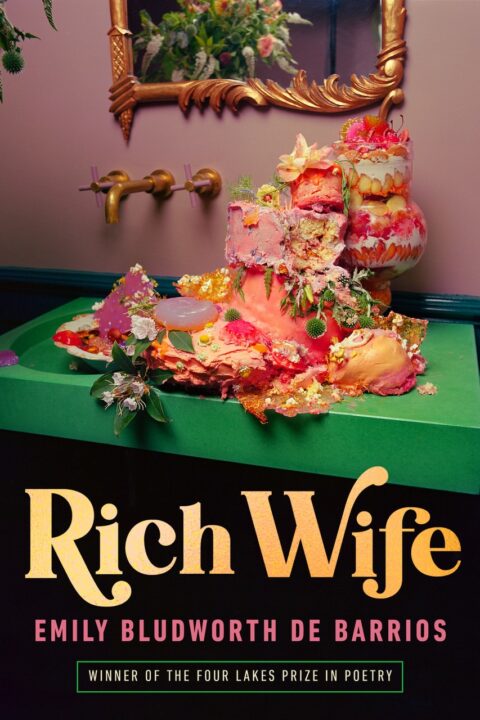
Rich Wife. Now, that’s a cheeky title for a volume of poetry — concise as a Hollywood pitch, memorable as a slap to one’s face, topical as the latest headlines about wealth and gender inequality. It also signals that Houston-based poet Emily Bludworth de Barrios knows how to make waves and keep a reader’s attention.
Open to the book’s title poem — a 50-page testament, composed of single-line stanzas, which deliver the guilty secrets one expects from an insider’s expose.
The rich wife is like the worst sort of creature
Like an ancient queen Let them eat free & reduced lunch
She doesn’t say at a dinner table
But she feels it “Magnanimous”
Or, consider this passage, which mixes anxious self-loathing with sociological detail, setting the tone for much of the book’s centerpiece:
The rich wife is both “rich” and a “wife” in the same way that one is alive:
Temporarily
Like standing on a very little raft in the center of the ocean
The rich wife is the most despicable creature in the world
Whirled emotions rise when considering the rich wife
Chiefly among them: derision, disgust, antipathy
The rich wife feels a sense of embarrassed scorn when anyone begins to
“show off”
When anyone begins to brag about money
She feels queasy when anyone asks about someone’s “last name”
Sending forth some little signals
Or not sending signals forth Merely Really
Ascertaining the social order
Whether you know such women personally, or never expect to meet them — it hardly matters. Bludworth de Barrios brings them to the page with lancing authority and rare compassion. She knows the rich wife’s habitat and hesitancies. She registers the private joys and domestic pathos of entrapped lives — reminding us that all women, privileged or not, face continuing obstacles.
One section begins with documentary evidence — court testimony in a case that was settled in 2006, and reported in a Harvard Law Review headline: “Ninth Circuit Holds that Women Can be Fired for Refusing to Wear Makeup.” Here’s how Bludworth de Barrios responds:
Imagine a doll that has a person inside it
I dress the doll thusly
If my doll is very pretty
If my doll pleases
What does a doll create?
A doll waits patiently for accolades & accomplishments
A doll a delusion an invisible accomplishment
How to be more gentle more genteel
A doll proffers her hand when introduced to an accomplished man
He squeezes the tips of her fingers, oddly
Or he refuses to relinquish her hand until she introduces herself properly
To bear the skin of a doll is to wear an inferior type of costume
Its power is diaphanous, permeable, wavering, temporary
It is a power that turns and collapses
A doll is a stupid metaphor
A woman cannot climb from the skin of a doll
Thus “Rich Wife” unfolds in lines that sound with the calm assurance of index entries, tracing the slow, daily accumulation of women’s lives under patriarchy. Lines that dangle — grammar be damned. Lines that refuse completion, except in the minds of readers.

When Bludworth de Barrios writes, “23 years ago a girl was jogging alone” — she lets the sentence sit alone on a blank page. Continuing, on another blank page, she writes, “Or / She was on a date.” And, again, she continues — one line to a page — until her blank paper does its job. Until we fill the blanks with dread. Until we see the empty lives, feel the daily horror, and understand that something more than paper is being wasted. Such slow-building modernist effects are difficult to showcase in a handful of quotes, especially with a book that centers on three long poems. In “The Pelvic Bone,” Bludworth de Barrios revisits the birth trauma and its aftermath. In “Hera,” named for one of her three children, she focuses on motherhood.
Bludworth de Barrios is an expansive talent, one who eschews both the compression of metrical verse and the oratorical manner of Whitman and his descendants. Instead, she grits her teeth and unfolds her purpose gradually. In her dissociative word play and deliberate repetitions, one hears her making good use of Gertrude Stein’s advances. The steady tread of her one-line stanzas can be as mesmerizing as the plain speech of Joe Brainard’s “I Remember.”
For all that, however, there is much original music in Rich Wife — not the kind that leaves one whistling tunes, but something akin to Morton Feldman’s tolling, aleatoric hymns to unhurried calm; those hour-long compositions, full of silences and held notes, which often feel more topographical than musical. It’s in just such a place — one of unforced sublimity — that Bludworth de Barrios reconciles her rage and her joy, her shame and her analytical temper. It’s where she confirms the old Feminist mantra: “The Personal is Political.”
[Published by the University of Wisconsin Press on April 15, 2026, 136 pages, $17.95 paperback]