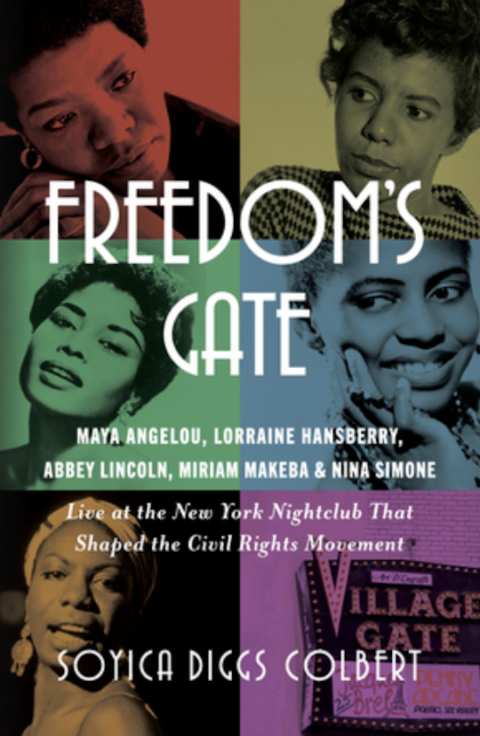
 Situated at 160 Bleeker Street in the Village is a CVS Pharmacy, one of 9,000 outlets run by a multi-billion dollar corporation responsible for driving independently owned drugstores out of business. At first glance, no one would know that the building hosted one of the most influential and premier concert venues in Manhattan. However, just above the automatic doorway is an antique lighted sign that says “Art D’Lugoff’s Village Gate,” the remnant of a venue that hosted exceptional performances by outstanding black female artists, intellectual excellence, and political advocacy geared toward stopping the scourge of segregation. The Gate closed in 1994.
As Soyica Diggs Colbert says in Freedom’s Gate, from 1959 to 1969 the Village Gate was part of an “unparalleled period of political, artistic, and social transformation for black people and of black work,” and supported the work of marginalized black women in the entertainment industry, becoming a hotspot for high-quality music and Black female empowerment. As Diggs Colbert writes, “The women depended on one another more than they even knew. As they went from being ingenues to career starts, they collected and created shared practices for survival in communities, industries, and movements that did not fully understand or welcome them. But always in search of the affirming light of recognition, they left pieces of themselves with one another and in their work.”
Thus, Freedom’s Gate is not just about D’Lugoff’s establishment of this iconic concert hall; the book is also a biographical study of five fascinating women of color and their respective catalogues composed and performed within a prolific 10-year period (1959-1969). Individually, each woman struggled through domestic violence, mental and physical illness, creative but daunting artistic shifts, racial injustices, and toxic masculinity to express their specific forms of artistry. The Village Gate provided the stage on which to express their spirited views to a receptive desegregated audience. As Diggs Colbert suggests, “The women of the Gate staged performances that pulsated with the push of convention and the pull of revolution.”
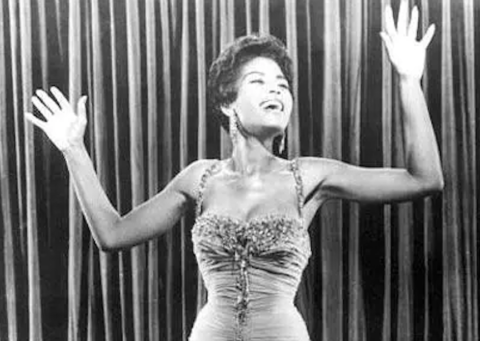
[left — Abbey Lincoln]. Diggs Colbert emphasizes the specific difficulties faced by her subjects. For instance, Lorraine Hansberry, wrote A Raisin in the Sun not only as a family drama but also to show how a family “provided an important structure for working through pressing political problems.” Accomplishing this work required much time, financial backing, and support from Black men such as Harry Belafonte, Sidney Poitier, and James Baldwin. While Hansberry was producing her most famous work, Nina Simone was toiling as a classical pianist, who pivoted to become a dynamic blues and jazz singer/songwriter and a member of the “black bohemia: an intellectual artistic scene fueled by the prosperity achieved during World War II.” She understood the business side of the music industry, but also wrote “black freedom music” like “Mississippi Goddam” as a condemnation of the bombing of churches and the killing of young black girls, as well as to move forward the Civil Rights movement in America.
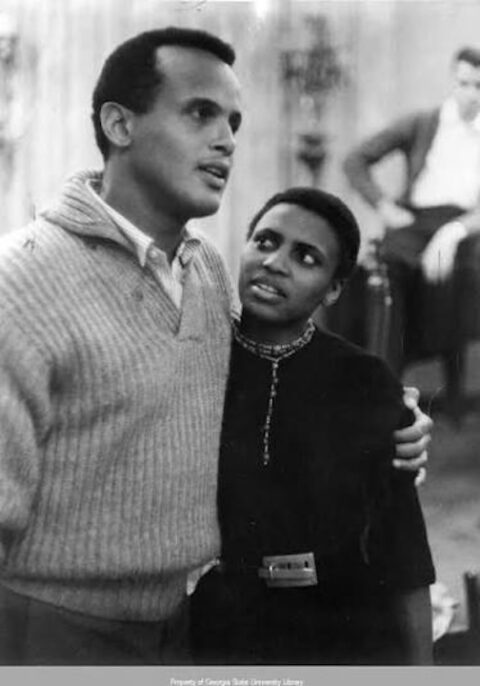 [right — Miriam Makeba & Harry Belafonte] Miriam Makeba spent her formative years in apartheid South Africa until she befriended Harry Belafonte who mentored her, helped to move her to New York, and advocated for music that was true to her African roots. Hearing her sing songs such as “Jikele Maweni,” “Novema” and “Qongqothwane,” white audiences became acquainted with the beauty and political power in he music. Makeba’s vocals, along with the poetry and prose of Maya Angelou, inspired organizations like the NAACP and SNCC to promote their agendas of non-violent direct action. Angelou, a victim of domestic violence, voiced her pain to write I Know Why the Caged Bird Sings (“Angelou revised the autobiograpical form”), which developed after shifting her focus from dancing and stage acting to the written and spoken word. Abby Lincoln, a jazz singer and accomplished film actress (Nothing but a Man) who would regularly cross paths with Angelou, had also been assaulted; she was date raped and then dismissed by police after filing a complaint. She then moved to California, where she “struggled to remain steadfast in her political vision of a self-determined black world and grapple with personal contradictions.”
“This story does not end with Angelou, Lincoln, Makeba, and Simone in dispersal,” Diggs Colbert says in her “Coda,” reflecting on their post-Village Gate lives. “The many connections forged at the Gate by five remarkable black woman artists offer us lessons in how to live. In the spirit of these women, that statement can be refined to say that such connections offer lessons in how to commit to a practice of living freely, even if it requires keeping your bags packed.”
[Published by W.W. Norton on October 13, 2026, 384 pages, $35.00USD/$48.99CAN hardcover]