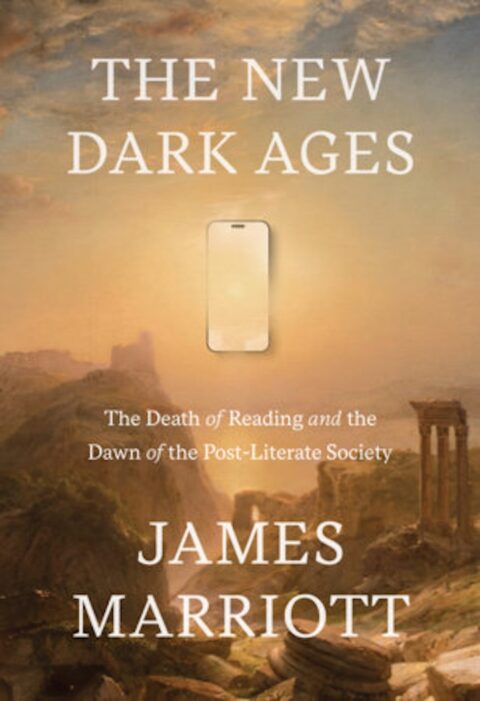
Cassandra may have been beautiful — Homer described her as the fairest of Trojan king Priam’s daughters — but we know her best as the princess gifted with prophecy, whose dire predictions others ignored or mocked, a Bronze Age Debbie Downer. She was vindicated when Troy fell as she’d foretold, a myth that may have originated with the demise of Mediterranean civilizations during the 12th-century BCE. Now there are warning signs amid our own beleaguered century. In his eloquent, essayistic The New Dark Ages, London Times columnist and critic James Marriott sounds the alarm, adding context and personal stories. His thesis — that we’re standing on the precipice of a post-literate world — is all the more resonant for its restrained tone, ice mixed with fire. Screens have superseded print, starting with television and eclipsed by smartphones. Celebrity hook-ups, Nasdaq sell-offs, saag paneer recipes, the Paris Commune’s body count: information is a thumb’s swipe away. This transformative technology may rewire our brains and erode our institutions. Hence “dark” in Marriott’s title.
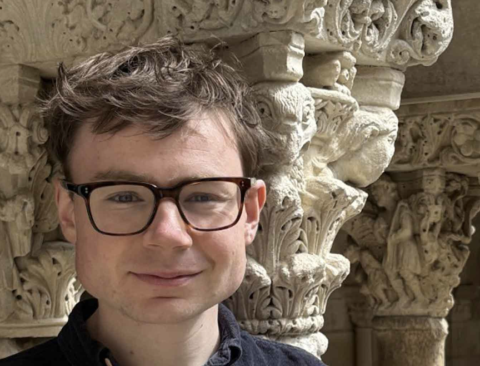
 He comes by his bookish cred honestly. His father was an A-level English teacher, obsessed with the canon. “Shakespeare was our Jesus or, more probably, our God,” Marriott claims. “My dad celebrated Shakespeare’s birthday with a homemade cake, and like superstitious peasants our house was strewn with devotional items: Shakespeare mugs, Shakespeare socks, Shakespeare tea towels. I was once presented with a Shakespeare bear, wearing a t-shirt featuring a quotation from Hamlet.” Marriott’s exposure to “deep reading” — a concept meted throughout The New Dark Ages — sparked early forays into Narnia and Hogwarts and later fueled his education at Oxford and a stint in the antiquarian book trade. Recently he noticed a panic within academia, a professional path he’d considered before turning to journalism. Increasingly students, including those from privileged households, were incapable of finishing novels or, in some instances, even 10 pages. They couldn’t sustain attention for Middlemarch or Ulysses, couldn’t explicate a paragraph. Puzzled, he wrote an article for the Times. Other researchers uncovered similar patterns. Literacy rates had skyrocketed since the Enlightenment — what the hell was going on?
Structured in six chapters, The New Dark Ages posits that smartphones are villains, dumbing down humans by stripping the ability to read, a “Great Simplification.” There was nothing inevitable about literacy. Despite tens of thousands of languages spoken across millennia, writing was “invented” on just four occasions: in Mesopotamia around 3400 BCE, in nearby Egypt around 3250 BCE, in China around 1250 BCE, and afterwards in Mesoamerica, during the first millennium BCE. The vast majority of narratives have been oral, transmitted in religious ceremonies and by glow of bonfires, potent in their own right. Yet it was literacy that opened the door to massive innovations; without it history, scientific inquiry, and some engineering wouldn’t exist: “The philosophy of Plato and Aristotle, the history of Herodotus and Thucydides, the mathematics of Euclid — all these achievements are inseparable from literacy.”
A revolution emerged in the mid-18th century CE: princes, merchants, and female servants alike pored over texts, heralding the birth of a radically different order. Marriott credits two breakthroughs: Gutenberg’s invention of the printing press, which allowed production to flourish, and the European Reformation, which interrogated power and planted seeds for equality under the law. The spread of reading destabilized “tidy” intellectual spheres as more people read more books on more topics. “Martin Luther, as one historian has put it, was ‘salvation’ for the publishing industry. For at its heart Protestantism contains a profound emphasis on the written word,” Marriott observes. The Reformation altered “the intellectual map of Europe so profoundly its effects were still visible hundreds of years later. Long after Martin Luther, analysis of literary data in Protestant regions of 19th-century Germany showed literacy rates 20 per cent higher than those of Catholic ones.” For common folk, reading took on evangelical zeal. It became the core of their identity.
Marriott evokes the advance of literacy in a wealth of characters and anecdotes. He celebrates great readers, among them the eccentric Samuel Johnson, whose omnivorous tastes ranged from Cervantes to travelogues to “Icelandic natural history” — a “dabbler,” Dr. Johnson would dip into a book only to toss it aside for a more enticing volume — and a French Renaissance luminary: “In Montaigne you have the uncanny sense of encountering someone from the distant past who sounds really modern: self-conscious, skeptical, funny; amused by life and perplexed by it. To Montaigne nothing seemed fixed or obvious. In his essays he joins stray ideas together, leaps from one subject to another and asks weird questions.” Marriott sprinkles in delightful bits on the Republic of Letters and the 20th-century’s golden age of print. ”The Rise of the Screen” highlights television as the smartphone’s precursor; studies reveal a loss in reading hours correlated to sitcoms, variety shows, and primetime soap operas such as Dallas and Dynasty.
 The author’s strongest chapter focuses on print’s political impact. In 1761, a prominent Protestant was lynched in Toulouse; Voltaire’s fictionalized account spurred societal change and culminated in his influential Treatise of Tolerance. Marriott underscores the force of the “better argument” (Jürgen Habermas’s term) as literacy chipped at hierarchies, from Versailles to the Vatican. No longer would lower classes accept their meager status as part of a heavenly mandate: “Books alone cannot topple regimes but the spread of literacy was a powerful solvent of monarchical authority. The historian Orlando Figes has pointed out that the English, French and Russian revolutions all occurred at a time when literacy in these societies was approaching 50 per cent. Perhaps the greatest tribute that has been paid to the political power of books is the effort every dictatorship in history has made to censor, ban and burn them.”
Marriott’s last chapter, “The End of Democracy,” captures the anxieties of our era. He views literacy as the foundation of liberal democracy; if the foundation crumbles, the edifice collapses. The shift away from print has stoked a broader crisis. Truman and Churchill “were not perfect politicians but they benefitted from habits of attention, powers of imagination and a deep internalized sense of history that can only be bred by reading,” Marriott notes, contrasting postwar leaders with today’s policymakers, who rely on an attenuated market of digital content. “To work in a thirty-second video political communication needs to be fast, arresting and emotional. Strong imagery like guns, flags and men in chains do well. Speeches, arguments and ideas do not.”
His voice is the real sell here: warm, passionate, erudite, witty. He feels our pain: “In my early twenties I must have spent hundreds of futile and faintly tragicomic evenings attempting to improve my reading by hiding my smartphone from myself. I have shoved it behind wardrobes and under beds. I shut it up in cupboards. I hid it in the stale depths of laundry baskets … Inevitably, of course, it was often a matter of minutes after sitting down with a book that I would spring up again, assailed by thoughts that were at once impossibly petty and yet possessed of an inexplicable urgency — has a major news event occurred? Has anyone liked my tweet?”
How, then, has our intellectual culture — academia, publishers and legacy media — confronted the existential challenges of screens? How are they complicit? How do we reverse STEMification in our schools? The private sector incentivizes careers with little connection to “old-fashioned” liberal-arts curricula; students are incessantly told only majors such as computer science and chemical engineering lead to lucrative jobs. How do we lure millennials and Gen Z back to print when their lives are shaped by pixels? And where does the publishing industry fit into his thinking? As a Marriott fan I wished he’d grappled with these questions. The stampede toward genres like romance and fantasy has whipped up a transatlantic dust cloud, filtering out precious light for upmarket fiction and nonfiction. There’s been a spike in audiobooks, but is that real reading or being read to? What about “brain fog” associated with Long COVID? I hope Marriott will circle back to these omissions, if deep reading is, in fact, a means to stave off a brave new world that looks remarkably like an older one: “As reading fades I believe that we may find ourselves facing a post-literate future that resembles the pre-literate past: mystical, tribal, and autocratic.”
 Fear not, though: his conclusion is a full-throated defense of knowledge and standards. “We read not only for fun but to become better and more knowledgeable people. This will sound puritanical to some, but it is an idea worth paying attention to. For centuries, people have accepted that literature and learning are among the highest purposes and deepest consolations of human existence.” Books should be more than accessories flaunted like Birkin bags on Instagram, or props for influencers. (In 2024, Esquire reported that advanced reader editions of Sally Rooney’s Intermezzo had become “the summer’s latest must-have for the literary It girl, a hot-ticket item to prove one’s reputation as both well-read and well-connected.”) Books should be read, not just clasped in a Tik-Tok video. I’m with Marriott: there’s something essential about scanning sentences and forming them as my own, lips curled around, say, Cormac McCarthy’s recondite language, a throwback to childhood when I would “sound out” words and phrases, as my late mother, also a teacher, insisted. If reading is a collaborative skill as theorist Wolfgang Iser argued, then it’s vital to approach texts with the eye. We’re a visual species, after all.
Back in 1177 BCE, the mysterious “sea peoples” attacked Egypt, triggering the kingdom’s decline; they destroyed other polities, such as Babylonia and the Hittite empire. Our sea peoples may be land machines: AI and chatbots, whose growing sentience could relegate us to extinction (or so we’ve been warned). The New Dark Ages echoes Cassandra yet ends on a hopeful note, one that doesn’t so much dispel doom and gloom as offer tools to combat the hypnotists in our hands. Unlike smartphones, books are “irreplaceable,” a medium “capable of comprehending and explaining the world.” The author deserves our gratitude for laying out a concise and elegant case, a launch pad to larger themes. I’m eager for his insights on deep reading, LLMs, on-line clout-seekers, and elite apathy. Get cracking, James Marriott!
[Published by Doubleday on October 6, 2026, 191 pages, $26.00US/$36.00CAN hardcover]