The Stylites were the most extreme of the penitential sects. They were active in the fifth and sixth centuries, modeling themselves after St. Simon of the Stylites, who sat atop a pillar in the Syrian desert for 36 years. Mendicant hermits had resided in the desert caves of Egypt and the Sinai for several centuries, but Simon thought they were sissies. The truly earnest ascetics were pillar-dwellers, braving the elements for years at a time, and sermonizing for the crowds that sometimes gathered below. Simon’s travails and temptations are the subject of a wacky surrealist biopic devised by Luis Buñuel — abounding with that anti-clerical fervor that so defines Buñuel’s work. But Buñuel’s treatment of Simon is also sympathetic.
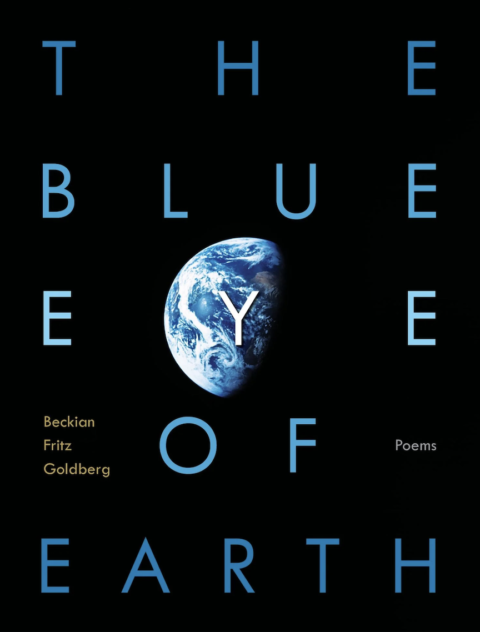 I bring up Simon and the Stylites in part because Beckian Fritz Goldberg’s new collection — her first in 13 years — is the journal of a contemporary Stylite, whose pillar is an exurban house in the outskirts of Phoenix. The desert that lies just beyond this fringe of urban sprawl is always scrupulously evoked, but is almost always menacing, almost always a force of Othering and alienation. Goldberg has chosen this perch with some reluctance, but it seems the only locale where she is able to properly mourn the deaths or impending deaths of loved ones, fellow poets, and – on a much more macro level — the planet. And her vantage point allows her to at least provisionally endure the other slings and arrows that now afflict the Boomer generations. She contemplates these losses with a searing relentlessness, unflinching self-reckonings, some scathing social commentary, and a commanding admixture of loopy narratives and striking metaphors, all of it delivered with the mordant sense of humor that her readers have come to expect. There’s a fair degree of showmanship on display in these poems, but it never distracts us from Goldberg’s elegiac intentions and the earnestness of her spiritual quest. The Blue Eye of Earth is a formidable accomplishment, the best book yet by a poet who deserves to be much better known.
I say “showmanship” in part because Goldberg has always been a very protean writer — she’s published a collection of prose poems, has written sonnets and a sonnet crown, and also works in a canny variety of free verse modes. The Blue Eye of Earth displays all of her characteristic formal range, but her preferred mode in the new volume is made up of longish lines, loosely hexameter, without stanza breaks. This unfussy form showcases the ruminative and retrospective intentions for the poems; they’re filled with digressions, abrupt shifts in tone, long sentences and quirky syntax.
All of these qualities are amply present in the opening of the collection’s opening poem, cheekily entitled “Music at an Exhumation.” The exhumation in question is of Pablo Neruda, although the benighted digging-up of Petrarch’s remains will also be prominently featured.
This spring they dug up Pablo Neruda to see if he was poisoned.
A guitar, a violin, played beside the grave overlooking the sea,
though what good is a grave that overlooks the sea. Still,
the desert blooms a thousand golds and yellows, summoning
every possible memory. Still, the moth like a dusty ghost
tries to unbutton the window at night. And I can tell you
on the same night in the east Antares burns like a rose that has seen hell.
It is the night of my 59th birthday, the resinous scent
from sweet acacias drifts the cool dark, and I am asking what happened.
There’s a lot going on here that will later be developed: it’s an anti-ode to Neruda (that great master of the ode), and an anti-ode to the desert spring. And of course there’s that tone; Goldberg gazes down from her pillar with a mixture of bewilderment and snark. She answers the question of what happened with a lengthy catalogue of memories that goes on for several pages, each very specific but few of them interrelated: a fourth grade teacher, a “crazy kid from a halfway house” who turns out to be a stalker, Goldberg’s mother and father, teenage friends, and more exhumations — of Hugo Chavez, of Simon Bolivar, of Salvador Allende. The poem is quite a tour de force, and its closing is majestic:
The body
has told us all it knows which first and last is separation. Between
hunger, heat, habit, heavenly touch, helplessness, beauty and
more beauty, and more hurt — like music at an exhumation
it is the difference between a silence, and a violin, and then a silence.
Still, the desert blooms a thousand golds and yellows which are steeped in night
and exude memory. Still, the ashy moth falls open to the same page with
its mysterious watermark. And spring rises from the underworld alone
and dies of nothing.
 I would not be surprised if in the final two lines Goldberg had in mind the famous closing of one of Miguel Hernandez’s prison poems, which reads, in Ted Genoways’ translation: “There I would like to stretch out/to fall out of love. // After love, the earth. / After the earth, no one.” There’s little about these endings that’s consoling, though both hold out hope for some sort of tentative rebirth.
The rest of the book is a continuance of this exhumation music. Goldberg rarely leaves her pillar perch, and when she does so the dramatic situations bring out a similar unease. The speaker in “Henry’s Song” is the houseguest of a couple who are tending to their dying cat. It’s a bucolic autumn evening, and the speaker tries, gamely but unsuccessfully, to Just Chill. Here’s the poem’s opening:
Sometimes sitting in a friend’s backyard on a fall evening
a thing comes to you. But then you second guess yourself.
You second guess yourself, and your grace is gone.
The cat dish is there by the step, overturned in the dry leaves,
the trees here taller than any trees in your dreams. You’re afraid
if you stay here they might talk. And these nights
you only want to hear someone say, Yes,
I think of these things too.
Few writers can evoke anxiety the way Goldberg can. By the end of the poem the anxiety abates, but it takes several pages to reach that point. Similarly, in a poem entitled “Concerning the Terrestrial,” the speaker and the brother revisit the town where they both grew up — Mesa, Arizona. It’s the brother who initiated the trip, and who seems also to have chosen the beat motel where the poem’s action takes place. As the pair smoke and people-watch at the hotel window, the speaker has a decidedly un-Proustian series of involuntary memories, among them the suicide of a high school friend, prompting these lines:
So much is unremarkable and daily, it’s a wonder
life gets lived. How did you spend your life, God asks. You say,
Well, I went to school, I ate dinner most every night, got a job,
must have gone to the post office at least a hundred times, raised
a family, visited a few places, watched 9/11 on TV — until you feel like
one long etcetera. Exhale.
Several pages later, Goldberg closes the poem with almost the same gestures. But they’ve now been turned into something like prayer, and into something that recalls the “House, Bridge, Fountain, Gate” passage in Rilke’s Ninth Duino Elegy — it’s the same praise of the quotidian, but in Modern Dress:
It is all here: Your crescent moon, your shoreline palmetto in the white mist.
Even if a man is beating his lover, even if a kid we knew is pointing
the gun down his throat and the boys are driving the girls out into the desert.
Your ice. Your chair. Even if that lost boy is turning from you
as you kiss him, even if the celestial pool is closed. Your grass.
Your flag. Your At Last. Let’s buy the hotel. Let us stay here, again. Brother —
let each of us in this American romance with oblivion claim
our unremarkable place.
The fact that Goldberg spends much of the book atop her pillar does not mean she can avoid the blandishments and temptations of popular culture: William Shatner, noisy radio jingles, decorative cow skulls, taxidermy jackelopes, and bumper stickers on a gun-nut’s pickup are all present. (The sight of the bumper stickers prompts Goldberg to observe that “My rights are sweet sleep, good coffee / and Leave-Me-the-Fuck-Alone.”)
In a brief eulogy for his student Randall Jarrell, John Crowe Ransom paid Jarrell a zinger of a backhanded compliment: “Randall had a great flair,” he said “for the poetry of desperation.” I would say the same about Goldberg, and say it without Ransom’s damning-with-faint-praise. Goldberg does not exactly make desperation look like fun, but she confronts that condition with swagger and elan, with the confidence of a consummate technician, and above all her Stylite’s tenacity. Let me close with the ending of one of several slantwise and compelling elegies for the poet’s mother:
What we know
of life we know of death, that black scorch with
a flame beneath each wing. I know blackbirds
waved their cape over us on their way to
the distance, showing us their hearts, and the place
where my mother and I were standing became
the past, singular, eternal, and of
no earthly use.
[Published by the University of Pittsburgh Press on September 29, 2026, 120 pages, $20.00 paperback]
To read David Wojahn’s 2025 On The Seawall review of Constantine Cavafy: A New Biography by Gregory Jusdanis & Peter Jeffreys, click here.