A Conversation with Erin Belieu: on Project Books, Intellect & Emotion, Early Influences & Shaping One’s Books
⟐ ⟐ ⟐ ⟐ ⟐
Joy Priest: You write short books. Sharp, punchy, panoramic, but compact. I notice this because it’s something I thought about when making my first book. It seems to me that poetry collections started to become longer in the last 15 years or so — 100-plus pages and so forth — a turn to poetry collections as “concept books,” perhaps unlike a more classic understanding of the poetry collection as poems you’ve written over the past several years, reflecting a range of one’s consciousness over a given period. The concept book then makes, it seems, the construction of a book such a substantial and distinct art form from merely writing a poem. Your most recent full-length — before the Selected, Come-Hither Honeycomb, published in 2021 — comes to a slender 45 pages. It makes me think of the EP. What are your thoughts on the concept book trend and why are your books so short? Are you a tease?
Erin Belieu: I don’t think my books are particularly short. I prefer “filler-free” as a description. I have all kinds of lesser poems filed away under “Probably Not.” I worked for months on one poem for my new and selected, but it just didn’t get there in time before Copper Canyon had to close the book. As much as it hurt to admit after so many drafts, it just wasn’t good enough to be included. It has a big hole in the “why” of it I haven’t figured out. Poor little poem. But I don’t give participation trophies like that.
Some poets write longer books that sustain their length because their poetic nature has the marathoners’ doggedness. Someone like Richard Siken perhaps. And then there are other books in recent years that make me think, “This doesn’t exactly exude confidence,” where you feel the poet is kitchen-sinking it with anything and everything. Why surround your actual gems with paste? I’ve always been influenced by those great 20th century poets whose collections were on the slimmer side. As I say to my students, “It’s not the most poems that wins.”
The project book is its own animal. At their best, they’re testing the boundaries of form in a way that’s truly exciting. Robin Coste Lewis’s Voyage of the Sable Venus seems one of the very best to me. You can feel how vital the book’s obsessions are, how profound her engagement with both the poetry of it and the history she’s exploring. It requires many pages to contain all the things it needs to contain. Tyehimba Jess’s Olio is another for me that has that kind of exciting, world-making monomania and range.
But I also think the explosion of project books in recent years has much to do with the economically driven “Lit-ification” of emerging writers who are stuck chasing the Ph.D. for the employment credential. They provide the “butts-in-seats” for lit programs that are being starved to death by our now fully corporate administrators.
I’m aware it’s a huge generational advantage that writers my age never had to worry about. But yeah, the prebaked, cerebrally cooked-into-oblivion, bodiless, poetry-as-prospectus book, those tend to be long. I have huge sympathy for the pressures emerging writers are under. I just hate seeing what happens to their art when they get replicated into not-quite-Lit specialists before they’ve forged a strong connection to their poetry making. I did all the course work for the Ph.D. I loved my theory focused classes and all the different approaches they gave me for thinking about poems. But I already knew who I was as an artist before I jumped into that pool.
Also, back to rates of literary production, to state the obvious — writing, first and foremost, takes time. When I got to my second book, I was a wife, a full-time employee on the tenure clock, the director of a very large writing program, and the mother of a toddler. I don’t come from any kind of money, so I had to go get some. I’ve always been the breadwinner in the family, then the single mom of a wonderful kid. But if we look at the present statistics on “shared” household labor, childrearing labor, who does the majority of grunt work labor in academia — answer: women — for considerably less money on average, sometimes I’m shocked I’ve gotten anything written, much less six books. If we counted up the hours, how many years do most women spend over a lifetime being unpaid support staff?
JP: “Cerebrally cooked into oblivion, bodiless, poetry-as-prospectus book” — Ha! you’re spittin’! This characterization and your association of it with creative writing PhD programs is really useful. It explains maybe the type of book I was talking about, which is somewhere between the traditional collection and the project book. In this type of “poetry-as-prospectus” book, there’s usually a conspicuous theme that likely comes from the PhD program’s mandate to have an area of focus. Since your second book, you’ve been on faculty at a PhD creative writing program, and I graduated from the Houston program where you now teach. I feel that the book that came from my time there is cerebral (but it’s good!). I certainly felt, however, that in the manuscript’s incipient stages I was thinking too much. I’m reminded of Terrance Hayes saying, when it comes to poetry, he’s not trying to get at thought, he’s trying to get at feeling. Do you agree? If a fiction writer goes to fiction to put form to narrative, and the essayist goes to the essay because they have some question they’re trying to answer, why does one begin a poem? And do you think feeling is the poetic mode more so than thinking?
EB: I’m not anti-cerebral. I’m anti-only-cerebral. And I’m not here to be some poetry mall cop terrorizing people on my Segway — poets should do what pleases them and disregard any opinion that doesn’t help them make their work, mine included.
But I’m generally on the side of Terrance with this one. I know his work and mine have some clear aesthetic affinities. I’ll expand on his comment by saying you likely won’t get that visceral intensity and distilled emotional resonance without the interplay of some kind of intellectual framework. I just don’t personally have a lot of interest in poems that read like they were written by a disembodied head for five other disembodied heads.
One of Terrance’s own poems as my ideal of poetic thought and feeling combined is his “Black Confederate Ghost Story,” a fantastic example of how they intertwine at the most meaningful levels in a poem. Its inciting narrative of the racist handyman trying to convince the speaker of the old Klan lie that there were pro-slavery Black brigades during the Civil War — how that triggers the speaker into considerations of American history, literary history, how we understand “the South” as a concept and the foundational sin off slavery — it’s a poem full of information, historical analysis, cultural critique.
But Terrance makes his thinking feel tactile and 3-D by way of the sensory pressures image and music put on language, syntax, and its recursive structure. Terrance’s poem really is a masterpiece. The craft of it is sickening. And this interplay leads to what I believe is one of the most powerfully felt endings of any poem I know. This poem has made me physically shiver when reading it out loud to my classes.
After summoning the ghosts of all those who’ve died at the hands of white supremacist violence, after referencing the Black man lynched in Carrolton, Alabama who’s been haunting their courthouse ever since, the poem does this kind of Keatsian punching through its many facts and reasons into something truly hair raising at the end:
Attention apparitions: this is a solicitation
very much like a prayer. Your presence is requested
tonight when this man is polishing his civil war relics
and singing “Good Ol’ Rebel Soldier” to himself.
Hello sliding chairs. Hello vicious whispering shadows.
I’m a reasonable man, but I want to be as inexplicable
as something hanging a dozen feet in the air.
The viscerality of that final image, the controlled burn of the physical feeling it conjures — I don’t think you’d get that incredible burst of emotional intensity without the oppositional tension of the poem’s thoughtful critique. But the prospectus poem, as I’ll call it, won’t risk leaving room for that kind of instinctive leap into feeling and physicality, for that shattering of its tidy, intellectual reasons.
JP: The power in those last few lines is, for me, in the abstraction “inexplicable,” which puts language to the violence that a lynching does to one’s mind, the inability to register, initially, such a scene. I’ve thought “What am I looking at?” each time I encountered a postcard of a lynching or other such image. And so both the intellectual abstraction and the emotionally charged sensory image are absolutely necessary for this hair-raising effect.
Let’s turn back to your work: In your first three books, you avoided the sort of classic lyric speaker, first person point of view. You love a “you.” You’re in second-person or direct address/apostrophe more than any other POV, and then the third person “she,” which has the effect of a hidden or omniscient observer. I notice in the last two books that you move more fully into a first-person speaker and, along with that, more of a conversational witnessing, and longer single stanzas that sweep down the page instead of dancing around it. Maybe that’s simplifying the many forms and registers you’re skillfully able to accommodate across your compact books but there’s some sort of noticeable shift. What do you think?
EB: I’ve always worked in many points of view. In Slant Six and Come Hither Honeycomb, the books you’re referencing, the direct first-person addresses have very different flavors and volumes. In the former, to quote Carl Phillips’ description, there’s a kind of “boulevardier-like” character in that “I” representative who’s reporting on the absurdity and hoopla of American culture. Kind of a woman-on-the-scene witness. In Come Hither Honeycomb, the “I” speaker is having a private conversation with the reader.
Come Hither Honeycomb is an inward-facing book. It was written over an unsettled period in my life, the first time I’d ever lived alone for any extended period. My close friends and family were mostly elsewhere, I loathed my job, so I became a little island on which I was stranded. Come Hither Honeycomb could be called Castaway, with me there talking to the volleyball. Much of that book was written before dawn on my patio in Tallahassee. I couldn’t sleep much during those years, so would be out there at 3am working, waiting for the birds to warn me the world was about to wake up again. Maybe that’s why that book is shorter than the others — I was up to my eyeballs in silence.
It’s true, I do love a second-person address. Probably because two of my great poetry loves are in second person — Yeats’s “When You Are Old” and Richard Hugo’s “Degrees of Gray in Phillipsburg.” Both are poems I fell in love with as a teenager. The second-person as actual addressee, and the second-person as the poet talking to herself but also implicating the reader. Here are Hugo’s lines …
Isn’t this your life? That ancient kiss
still burning out your eyes? Isn’t this defeat
so accurate, the church bell simply seems
a pure announcement: ring and no one comes?
And Yeats’ …
But one man loved the pilgrim soul in you
and loved the sorrows of your changing face.
They’re both in the personal anthology I carry inside me at all times — their tenderness and pain. I love opera, and I guess correspondingly I love a poem with a good operatic gesture. I like seeing if I can get away with making the reader a part of my conspiracy with the second-person. And I like writing poems for someone. Most of my poems have an addressee, whether acknowledged in the poem or not.
And yes, I’ve always been an avid collector of words and phrases, as long as I can remember. Every color, texture, high or low language (though that’s a silly hierarchy). I have a magpie’s personality and I’m always on the lookout for shiny words.
JP: I’m in my Castaway era. Pray for me. I’m interested in this idea of the poem as a conversation, whether because we’re on an island in our lives, or because we’re silenced in some way and the page is our conversation partner. Writing started with reading for me, a conversation with what I was reading. And then it became a way to speak because I had joined a new, strange, patriarchal household where I was silenced, which wasn’t what I was used to. Reading helped me escape, writing was a way to speak. I have a theory that most writers have been silenced in some way as a child or adolescent. I think of Maya Angelou going mute as a child after she was abused by her stepfather and her uncles murdered him — she thought she was responsible. Is this true for you? Were you silenced in any way as a young person? Is this related to how you started writing?
EB: I love this conversation with you. It’s like we’re hanging out on my patio in Houston again, cutting it up about poetry. Houston misses you, Joy. We surely do.
To circle back to the great point you make about the word “inexplicable” and how it functions in Terrance’s ending, I think you’ve perfectly stated what I’m getting at — the abstract conceptual, identifying something impossible to comprehend, rationally pushing up against the concrete visceral surprise of “something hanging a dozen feet in the air.” How the “inexplicable” horror that defies logic alley-oops the reader into that enormity of feeling at the end. I don’t think a poet plans for that, but rather they keep themselves open to the possibilities for the beautiful disruptions of feeling. Hayden’s famous, smash cut leap into “What did I know, what did I know / of love’s austere and lonely offices?” feels like another brilliant example of what we’re describing.
As for being a castaway, it’s a big part of the poetry nomad’s life that probably doesn’t get talked about enough. For many writers, it’s like being a military kid moved from spot to spot, needing to uproot ourselves frequently to get the better job or wage. It’s a good thing writers can probably bear aloneness more than most humans.
I hadn’t thought of my initial impulse toward writing specifically as an unsilencing, but now that you say it, that makes complete sense.
I was lucky in that I had a father who was unusually invested in making sure I wasn’t silenced as a girl and was extremely encouraging of my writing. He saw value in my gifts whereas most kids growing up in Omaha in the 1980s would not have received that kind of unwavering enthusiasm.
I was unlucky in that I have a learning disability that made school fairly hellish. The teachers knew I wasn’t stupid, but I also couldn’t legitimately pass a math class after 6th grade.
Now we have an awareness and language for this kind of kid, the notion of “twice gifted.” But back then there were two tracks — college material or not. By high school, I’d been discarded by the school system as a non-starter. My GPA was tanked from repeatedly failing Algebra. But then I kept winning competitions for young writers. Where does a kid like that fit?
I didn’t know what I was going to do as I watched my friends get accepted to fancy colleges — mine was a hyper competitive school that wouldn’t blink at flunking you in your senior year. But I knew I had to keep writing. That if any good was possible for my life, I knew it was attached to my writing.
Ultimately, my father saved the day. He worked in the special education and gifted programs for my public school system and had vaguely heard of this new thing called “learning disability.” No idea how he scammed the budget for this, but they ended up flying in a university specialist from California who was doing cutting edge work on this new concept of learning differences. After three days of testing, I was officially declared learning disabled and allowed to graduate from high school.
I often wonder what would’ve happened to me if the Fates hadn’t given me the exact parent I needed who could and would push that emergency button. The Erin who came very close to being thrown away has a totally different life than this one, and not for the better. As a person with invisible disability, I’m very attuned to disability in my classes. Disabled people are still disposed of all the time in academia and I find the rampant ableism I encounter in faculties fairly maddening.
So yes, writing was my lifebuoy that allowed me to speak and have some sense of essential self-worth when a lot of the feedback I was getting was very negative.
JP: I didn’t know that about you. It shows that someone can be perfectly smart without being typically brained, and it elucidates the range of brains we’re working with as educators, and therefore the different pedagogical approaches young people and students deserve to encounter.
Funny enough, I always say, “I don’t do numbers.” Best I can do is count back change from my decade as a waitress. What’s funny is, when I read the first new poem in Cocklebur, which was recently published in APR, it strikes me as formally reminiscent of a math problem. Can you talk a little bit about these nine new poems and how they depart from your previous work?
And then also, I’m curious about how you decided what to keep and what to leave out of the Selected — I’m a disgruntled reader because a few of my favorite, more risqué poems were not included like “Of the Poet’s Youth” and “I Heart Your Dog’s Head,” “Poem of Parental and Philosophical Conundrums Written in An Election Year”! What were your criteria?
EB: Well, thank you for seeing me that way. At least according to my GRE scores, I do have a highly analytical brain. I’m good at identifying structures and patterns in thought and language and seeing how things fit together or don’t. I’m always interested in poetic structures and in thinking about different ways to build them in free verse.
In the poem you referenced, “The Key To All Mythologies,” I’m exploring the idea of naming something into being — the many names I had as an orphan before being placed with my family, the numerous possibilities for what my name could be, my final form name being a true rhyme for the name of my sister who died and whom I literally replaced. The poem let me know it wanted a flowchart shape to track the complex parts of it that are narrative. But I also liked the structural idea of human lives as Rube Goldberg machines. How the unformed idea of Baby X ultimately becomes a specific someone, after a wildly circuitous set of improbable circumstances that all had to happen in very small, specific windows of time in order for this particular human to be here talking to you today. I thought the arrows pointing down and right got at this idea of the patterns that emerge from the chaos theory outcome that all people are, whether adopted or not — just biochemical flickers in the entropy for an infinitesimally small amount of time—slapped together with a bit of self mythology, a shot of electricity, and a teaspoon of stardust.
Oh, I wish I’d left you feeling more gruntled! I had to make some very hard choices about how many of the voice-ier, first-person poems I wanted to include In Cocklebur, trying to find a balance, given my penchant for working in many different modes, something reviewers and interviewers have always mentioned about my work. The good thing is all of those poems are still in print in their original books, and most will live on inside the internet somewhere.
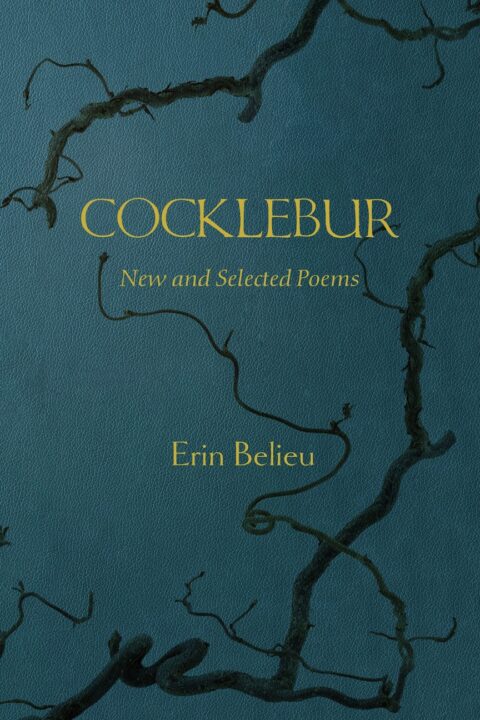 The new poems in Cocklebur bubbled up from two major life events in recent years — the sudden, awful death of my mother caused by the most enragingly stupid medical malpractice — look up Florida’s “Freekill Law” courtesy of Rick Scott, and don’t ever let your elderly parents move there — and the another big suddenness around the same time, discovering my entire birth family and all the historical origin stories that go along with that.
State law had made my origins a mandatory mystery that chafed at me all my life. So that big reveal, along with the psychic blow that is the death of The Mother, along with finally discovering the Ur-Mother — who sadly still can’t bring herself to know me —the 1-2 punch spun me into thinking about origins, origin stories, the human fictions of self-making, the myths we build for ourselves and those foisted on us. How many of us are motherless children — literally and figuratively — who have to invent and reinvent ourselves? Very many, I think.
In the last decade, so many things I believed in — personally, politically, philosophically — changed or broke, or I realized had never been worth believing in at all, so that whoever this Erin soul is now, she’s not who she used to be in some major ways.
JP: I picked up on that transformation across your last three projects. One example is the notion of “progress” and how it evolves from Slant Six — in the more obviously political woman-on-the-scene poems as you called them — to Come Hither — which as you said is more interior. In the former, in a poem called “Poem of Philosophical and Parental Conundrums Written in an Election Year,” the speaker is talking to their precocious son about politics. You write, “Then I / tell him briefly about a guy named Gandhi and / another guy named Martin Luther King and how // the progressive mind always triumphs in the end …” Then in the latter collection, the speaker’s thinking around progress has changed: “To talk and talk like this is what / our age calls progress — / that peculiar human rage for moving / forward, like tourists walking off / of cliffs while taking selfies,” you write in “In Which a Therapist Asks for the Gargoyle Who Sits on My Chest.” It represents that phenomenon of broken belief you’re talking about that I feel, when I read these two collections, archives a particular turning point in electoral politics and a loss of faith on a collective level. You were writing the poems in Slant Six around the time that Obama and Romney were running and then you were writing the poems in Come-Hither Honeycomb contemporary with the current president’s first campaign — someone who has broken a lot of belief.
These two major life events, though — the poem about your mother was so hard to read, I texted our Houston patio sitters club when I read it. And then finding out about your origin family — it feels like a lot more poems are coming from these major unsettling personal paradigm shifts and the new poems in the Selected are just the beginning. Like the singles music artists release before the album. So, what are you working on now? The writer’s least favorite question: What’s next?
EB: I kept myself awake last night thinking about your question — being a fitful sleeper remains one constant in my life.
There’s what I feel I should say — that of course my poems will go on as long as I’m breathing, that poetry itself will go on; the record of our shared and separate histories, the beauty of which humans are capable of being and doing, valuing every kind of soul that’s whatever stripe, shape, or flavor of person — it’s fundamentally what we fight for when we make art. Some days, I feel the truth and necessity of poetry intensely.
But today, honestly I’m mostly holding my breath, counting the few weeks left until the midterm elections and wondering what the world will look like on the other side. I keep checking my voter registration every day to make sure I haven’t been stripped from the voter rolls as has been happening in Texas. As you know, Harris County, where Houston is, is a huge ground zero for fascist malfuckery and voter suppression because we’re so enormous and so diverse in our population.
This wildly imperfect republic, this sorta democracy thing we patched together not all that long ago — to echo Benjamin Franklin, will we keep it? Will we rouse from our comfy screens and unsnarl this mess before the oceans completely collapse? Will we learn how to collectively combat the ugliness that the Death Machine creatures shoot into our bloodstreams daily? Will we turn away from AI before it and its data centers kill us? Will we actually stupid ourselves to death? To me, it seems maybe a 50-50 chance right now. I don’t love those odds.
So maybe more poems are coming for me. Probably, as they always seem to creep up again even when I’m sure they’re gone for good this time. But the world is at several tipping points right now. Maybe this interview will appear after we’ve already received our answer. Maybe the world is going to need me to do something else entirely to make sure what I love and what I believe in survive in some form.
But if we end up bugged out and ganging together in our wilderness survival camps, I hope you’ll be in mine, Joy. We could definitely run the joint.
⟐ ⟐ ⟐ ⟐ ⟐
To read Justin Balog’s On The Seawall review (2021) of Erin Belieu’s Come-Hither Honeycomb, click here.
To read “The Scent from a Cupboard,” a poem by Erin Belieu from the July ’26 edition of On The Seawall, click here.