“Call Every Resource”: Muriel Rukeyser in the Twenty-First Century with Catherine Gander and Stefania Heim
In a series of lectures delivered at American colleges in the 1940s, later adapted and published as The Life of Poetry, Muriel Rukeyser developed a defense of poetry as the cultural form best suited to respond to conditions of crisis. “In time of crisis,” she writes, “we summon up our strength … [and] call every resource.” Rukeyser argues that poetry is a valuable renewable resource and that its potential to effect social and political change was being “wasted” by proponents of then-dominant New Criticism. When The Life of Poetry was first published in 1949, it was largely ignored by the post-war literary establishment. In the first decades of the 21st century, however, Rukeyser’s poetics has become a “resource” for poets whose work contends with the cascading effects of contemporary polycrisis.
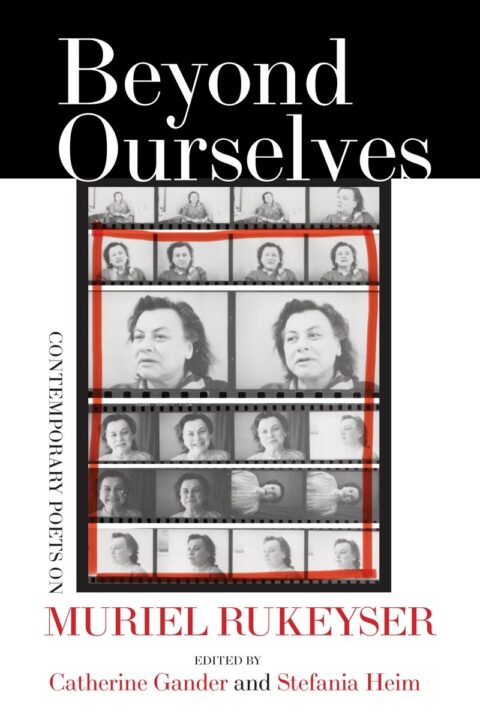 This morning, I woke to news of the ongoing hunger and labour strike by hundreds of immigrants detained in Delaney Hall, New Jersey’s private ICE facility. At this moment, America is five months into a second war in the Middle East; yesterday, five more Palestinians were killed by Israeli attacks, adding to an unfathomable death toll that is now over 70,000. In Beyond Ourselves: Contemporary Poets on Muriel Rukeyser, editors Catherine Gander and Stefania Heim gather twelve poets and researchers who respond to Rukeyser’s legacy. If the task of the poet is to “hold for a moment the giant clusters of event and meaning that every day appear,” the creative and critical projects collected in the Beyond Ourselves mobilize Rukeyser’s expansive archive as a vessel for that holding. Catherine and Stefania’s scholarly work has been integral to the recuperation of Rukeyser’s legacy as one of the most significant poets of American modernism, and this collaborative project provides a fresh account of Rukeyser’s influence by inviting her to a lively gathering of today’s most innovative writers. Unsurprisingly, she continues to supply the resources we need to face another century of war and ascendant fascism with honesty and conviction.
— Claire Farley
⟐ ⟐ ⟐ ⟐ ⟐
Claire Farley: Catherine and Stefania, thank you for joining with me to talk about this important and hearteningly hopeful book. I’m interested in how the project began, so let’s begin with the deceptively mundane as Rukeyser might and talk about the rudimentary details of assembling an edited collection. It’s remarkable how many contemporary poets turn to Rukeyser to anchor their work — Juliana Spahr, Susan Briante, Solmaz Sharif, Julie Morrissy, Claudia Rankine immediately come to mind but there are so many. How did you select which writers to include in this collaboration? Did you approach writers about work you were already aware of or did the book occasion new writing, or both? I found your commitment to a creative-critical methodology in this book really refreshing and, as you trace in your introduction, this interdisciplinary and transmediality descends from Rukeyser herself. Could you talk about the curatorial and generic decisions that went into this project?
Stefania Heim: As we write in our introduction, the poets themselves gave us the idea for this book. Catherine and I met more than a decade ago through our work on Rukeyser and had long wanted to create something together. Over those intervening years, Rukeyser studies changed significantly, and we saw this new wave of readers joining aspects of her writing and life that had previously been held separate at best or completely ignored. Solmaz Sharif’s epigraph to Look — ”During the war, we felt the silence in the policy of the governments of the English-speaking countries …” — was an early sign of the way Rukeyser’s work was resonating beyond scholarly venues. And in the early months of the pandemic we saw her everywhere.
Catherine Gander: We did: — in epigraphs, opinion pieces, reviews, and on countless Twitter feeds quoting Rukeyser’s opening line to The Life of Poetry (“In time of crisis, we summon up our strength”). And for a moment, during the height of that brutal pandemic, it seemed that room might be made for a new kind of social contract to emerge, in which care could be centered over capital. That was not to be the case. The second half of the Rukeyser quotation that Solmaz Sharif uses remains achingly pertinent: “That policy was to win the war first, and work out the meanings afterward. The result was, of course, that the meanings were lost.” It’s no coincidence that the book started to take real form during those months and years, as we sought for ways, as Rukeyser writes in the poem that gave us the title of our book (“Poem (I lived in the first century of world wars)”), to “try to find each other … to reach beyond ourselves.”
 SH: I’ve just gone back into my sent-mail archive and see that we sent our first invitations to contributors in early March 2021. Our hope was to harness the energy we were experiencing, so we sent out cold emails to people whose work we loved who we noticed referencing Rukeyser. We were tracing what felt like a faultline, a deep but buried thrum of influence that we wanted to probe and plumb and explore. The book started — and honestly, continued all the way through — with our own questions about what Rukeyser was illuminating and making possible in our moment. And we explicitly invited writers to reflect using modes that grew directly out of their own inquiries so that — as in Rukeyser’s own work — the “form and content, relation and function” might “reach and merge.” So that the book might be more than a sanitized, synthesized comment at a distance and instead enact the contributors’ thinking and grappling through the material of their own writing.
CG: Yes — that was very important to us. I’m really glad that the book’s creative-critical methodology appealed to you, Claire. This approach is something that both Stefania and I care deeply about, and is very much related to Rukeyser’s own convictions regarding the falsity of barriers erected between disciplines and genres. The responses to our initial enquiries were overwhelmingly enthusiastic. We had, as Stefania says, tapped into not only an influence but a need, and while not everyone we approached was able to participate — you mention Juliana Spahr and Claudia Rankine, for example — we were lucky to be able to bring on board a dream assemblage of poets who are making some of the most socially important and poetically innovative work today. All the pieces in the book were commissioned especially for it, although two pieces — by Khadijah Queen and Deborah Paredez — grew out of extant work. In the case of Daniel Borzutzky and Stacy Hardy, the book occasioned a long, illustrated poem that has gone on to develop a life of its own.
CF: One of the book’s major contributions, to my mind, has to do with tracing literary lineage, which is a gesture that has always been especially integral to the leftist literary circles — the construction of a “usable past” and so on. Throughout the book though, in essays like Erika Meitner’s, Nomi Stone’s, and yours, Catherine, an engagement with the materiality — and, indeed, messiness — of mothering surfaces and calls attention to specific forms of embodiment within the wider context of literary progeny. This was a surprising and beautiful thread to find. What of this literary and fleshly mothering?
CG: I love this question, because the unforgotten and the unborn are so intrinsically linked in Rukeyser’s modes of thinking and writing. She often related the story of how, when she was a child, her mother told her she was descended from the 1st century Jewish sage Rabbi Akiba (Akiva ben Joseph). This was, in her words, “an extraordinary gift,” but whether it was a verifiable fact was no matter because what moved Rukeyser was the conviction that human freedom involves the ability to choose one’s ancestors. The 19th century chemical physicist Willard Gibbs, whose thermodynamic “Phase Rule” informed Rukeyser’s own treatment of poetic energy exchange, is another person she chose as “an ancestor and a contemporary of our moment in history.” In her book-length biographical treatment of Gibbs, she traces not only his most memorable achievements but seeks to capture his expression of “the life of the world,” moving in what she calls the “dynamic equilibrium” of shared, war-torn existence. Stefania writes about this in her essay for our book.
SH: This is a beautiful point about lineage as something that is not inevitable or stagnant but that must be nurtured and cultivated, like love. It brings to my mind Rukeyser’s correspondence with Einstein, whom her publisher approached to write a preface for her Willard Gibbs biography. Einstein was kind but he staunchly refused, worried that as a lay person she would not understand “the problems and the solutions which have characterized [Gibbs’s] life-work” and write a book “based on emotion and not insight.” Rukeyser’s counter to him, that the “life-work of any great scientist or artist is his whole life” gets at the urgency of this more expansive and embodied understanding of lineage, art-making, science — all of our work. Rukeyser persistently asks — and answers in ways that remain radical — what from our lives is relevant to the “work” we do? How is our authority to do that “work” determined or meted out and by whom?
CG: With regards to the messiness of birthing and mothering — with its frayed edges and its ruptures and fragmentations, with its deep recesses of love and of fear, and yes, also with its bodily excretions! — the book at certain points brims over with it. There’s a moment toward the end of Nomi Stone’s piece where her child moves from lap to lap — a moment I saw very clearly in my mind’s eye and read instantly as a joyful, embodied gesture of the distributed self. It’s a very Rukeyserian moment — have I just coined a word? — an uninhibited, authentic demonstration of the multiplicity of human identity, of how we are all plural selves — the “many-born,” as Rukeyser puts it in the first, untitled poem of her “Lives” series — ignited by our interactions with others. Rukeyser wrote so much about the lives of children, about how their lack of fear toward poetry and toward making mistakes can teach us what she called a “total response” to the world. I think this cannot be unthreaded from another configuration of selfhood that weaves through the book, that of the “open self” that Khadijah Queen, Erika Meitner, and also Philip Metres, grapple with so generatively.
SH: And that “open self” is always multivalent — not an inoculation against harm nor even an inevitable good. I want to return just quickly to that “messiness” you pick up on, Claire, because something I love about our book is the rejection in so many of the essays of the decorous or seemly, and the willingness to sit with challenging, ugly, or even scary feelings. Catherine’s essay is a breathtaking example of this as it lingers on Rukeyser teetering with fear on a sliding hill of cow shit, trying to inhabit and understand what seems an uncharacteristic moment of fear, and juxtaposing that interrogation with the terror and proximity to death of childbirth in those moments before the “large and ruddy” baby, “slicked with blood and vernix” emerges safe. There’s real fear and danger in Nomi Stone’s essay, too, before and even as her child climbs so movingly from lap to lap. And when Deborah Paredez chooses Rukeyser as a “mad,” anti-epic foremother and fellow daughter of war, it is in the shadow of Hecuba, “shrieking at the shoreline,”: “Child, you lie there, and I see your wound, that is my wound.”
 CF: I’ve often wondered what Rukeyser would have made of our contemporary moment, which contains not only echoes of her own but also emerges directly from political decisions made in the wake of the war she so assiduously documented. I was moved by the openness with which many of the book’s contributors contend with the more difficult aspects of Rukeyser’s legacy. As Rukeyser’s place in the American canon is rightfully solidified, this conversation is all the more urgent. In one of the book’s most compelling essays, poet Khadijah Queen writes that “despite [Rukeyser’s] convictions and front-line activities … a careful reading of her work reveals that her approach to race, like Whitman and Melville’s, still often operates from a baseline position of ingrained white supremacy.” Queen responds to Rukeyser’s “perceived (and actual) failures and failings” by insisting on a quality of attention and a principle of responsibility that are equally present in Rukeyser’s work. I’d love to hear your thoughts about what Rukeyser teaches us about balancing complicity and openness, especially in the context of white liberalism.
SH: There is an uncanniness to how chillingly Rukeyser seems to anticipate aspects of our moment. I often teach “Poem (I lived in the first century of world wars)” and my students are always startled to learn that it was published in 1968, because they recognize their own experience so completely in lines like: “The news would pour out of various devices / Interrupted by attempts to sell products to the unseen. / I would call my friends on other devices; / They would be more or less mad for similar reasons.” There is Rukeyser’s understanding of the deep impacts of living in perpetual war, her insight into the insidious interweaving of consumerism, journalism, and the war machine, as well as that prescient use of the word “devices”! I, too, wish we could ask her what she makes of the ways these dynamics have persisted and amplified in our present.
CG: I’m still astonished by that poem’s acute relevance to our current moment. And I know we’d both agree entirely with you that as Rukeyser is brought more fully into a 21st century consciousness, the more important it is that the challenging and difficult aspects of her legacy be equally attended to. Neither of us wished to produce a hagiographic account; that type of approach is really in no one’s best interests.
SH: Absolutely. I’d go so far as to say that refusing hagiography, being willing to investigate the failures, was essential to how we imagined our project.
CG: I’d also add here, in relation to the idea of failure more generally, that the notion we must all “learn” from our “failures” – that failure can be reappropriated into the lexicon of “success” by repositioning it on a ladder toward redemption – is a capitalist invention that prizes the end-product or the “solution” above all else. Part of Rukeyser’s appeal to the both of us is how, across much of her work, she denies this logic of productivity, how she refuses to disavow failure or difficulty for their own sakes.
SH: You read Queen’s contribution keenly in your question, Claire. And I’d say, too, that it was important to us that Queen’s essay was grounded in a desire to look hard at the precise nature and the ongoing effects of Rukeyser’s failures and her gifts, as well as the way they are often intertwined, instead of beginning and ending with the identification of Rukeyser’s “baseline position of ingrained white supremacy” and then “throwing it all away,” as Queen writes in a precursor essay. That “throwing it all away” feels like a twinned risk to looking away from difficulty or to putting the meanings off until the war is “won,” to return the lines of Rukeyser’s that Sharif quotes.
CG: The “open self” I mentioned earlier is vital to this question. In fact, as the various contributions arrived in our inboxes, the question of Rukeyser’s “open self” emerged as one of the book’s key considerations, allowing for some truly revelatory treatments of her work. Those gestures of looking away, in fear, in despisal, or postponing working out the meanings of our dynamic interactions are examples of a closure of spirit, against which the open self operates. Khadijah Queen approaches that balance of complicity and openness to which you refer, Claire, via a consideration of Rukeyser’s “earnestness,” which she reads as an invitation to “embrace imagination and the conversation it creates” and in so doing, “risk mistakes, rejection, and failure.” What this approach to Rukeyser enables us to do is open ourselves to scrutiny and dialogue, to interrogate the erasures perpetrated by others and by ourselves.
SH: I am thinking about all the places in the book where our contributors model an answer to your final question as they interrogate and also negotiate the oscillating balance between complicity and openness — in their readings of Rukeyser as well as in their own lives and work. For example, when Jena Osman asks of Rukeyser’s documentary projects: “Must the particular disappear for the sake of a general cause?” Or when Susan Briante struggles to position herself vis-a-vis the “stories of migrants and asylum seekers” knowing that “as a US citizen, I am implicated in and responsible to them” but knowing also that “they are not mine to tell.” Approaching such questions as ongoing, these moments lay bare the stakes of negotiation as well as the fact that balance can never be settled or prescribed.
CG: I’d say this has always been a key challenge of the documentary mode with which Rukeyser is most often associated — how to represent others without essentialism, reductionism, or paternalism.
CF: Excellent segue, Catherine, because I do want to ask about how documentary surfaces in this book. Rukeyser’s book-length sequence “The Book of the Dead” is widely considered documentary poetry’s ur-text and is her most well-known work. Daniel Borzutzsky’s and Stacy Hardy’s “The Breathers,” a collaborative intermedial sequence collected in Beyond Ourselves, is one of the most compelling creative engagements with “The Book of the Dead” that I’ve read — and everyone should find a copy if only for this moving meditation on “the politics of breath.” It was refreshing to see many of the contributors engage not only poems other than “The Book of the Dead” but also with Rukeyser’s contributions as a novelist, playwright, biographer, and scriptwriter. Jena Osman’s research into Rukeyser’s contributions to the 1941 documentary film A Place to Live, about a significant Philadelphia housing development, is another stand-out contribution. Could you talk about how Rukeyser’s influence has shaped current understandings of documentary poetry? I’m also equally curious about whether you think we lose some of Rukeyser’s most potent resources by overemphasizing the role of documentary culture in her work.
SH: Rukeyser’s “The Book of the Dead” is undoubtedly an enormously important text — both for the lineage of documentary poetics that stretches so fruitfully into our own moment and for the understanding it provides that one might encounter real-time, real-world wrongs and choose to respond with a poem, as opposed to, say, a piece of media with an apparently larger and certainly more immediate audience. The continued impact of this 90-year old poem is a testament to the enduring power of Rukeyser’s choice. But it is also true that documentary practices exist much more variously across her oeuvre than this legacy indicates, so to my mind the question is less about whether we are overemphasizing documentary in her work than it is about whether we are preemptively constraining our conception of what her engagement with documentary might actually have been. In fact, Catherine wrote a whole book about this (Muriel Rukeyser and Documentary: The Poetics of Connection)!
CG: I did! And, like Stefania, I would still caution against applying a logic of containment or categorization that Rukeyser herself would discard. Philip Metres, in his searingly insightful and vulnerable essay in Beyond Ourselves, notes Rukeyser’s young age at the time of her writing “The Book of the Dead,” and wonders why “[s]he never did anything quite like it again.” From one perspective, he is correct — and of all the commentators on documentary poetics, I find Metres among the most compelling. But my reading is that those poems — forged as they were in the crucible of Depression-era America during which diverse documentary cultures thrived — clarified a lifelong commitment to finding the most fitting ways to speak the truth of her response to the injustices, pleasures, and gifts of the world. Indeed, Rukeyser found ways to, in her words, “extend the document” — her famous phrase from the author’s note of US.1, in which “The Book of the Dead” is published — across poems, photonarratives, plays, biographies, novels and auto-ethnographies, many of which are engaged with in Beyond Ourselves. And just as there’s room for growth in our understanding of how Rukeyser approached documentary, there’s also room for growth in our critical understanding of documentary poetics beyond the current scholarly concentration on North America and Western Europe. Such approaches might, again to use Rukeyser’s words, “widen the lens” from its focus on the document to consider the various ways we build, register, and rewrite our histories together — such as in oral storytelling, visual cultures and arts, performance and repertoire, music, ritual, and dance. So much of Rukeyser’s work was dedicated to demonstrating the falsity of separating these expressions of humanity from each other, and from poetry.
 SH: In the opening to her third book of poems, A Turning Wind (1939), Rukeyser articulates an expansive understanding of documentary that I think is helpful for approaching its development across her life and work in the full breadth of genres Catherine indicates — with significant implications for contemporary poetics. Talking about “sources of power” including symbols and individual lives, she writes: “I have wished to use such material as document, in much the same way that newspapers or congressional reports or broadcasts may be used.” Imagine what might it mean to treat a dream or a myth as document alongside, say, a congressional report, as she does in her musical about Harry Houdini. To treat the symbolic as valid, as evidence of our whole lives, as material, doesn’t only shift our understanding of what documentary poetry might be, but reorients our approach to meaning. I think this is what she means when she argues that poetry is built of facts that are both “verifiable” and “unverifiable” (as she articulates in her 1968 Scripps College lecture “Poetry and the Unverifiable Fact”). In that same introduction, Rukeyser describes her “Lives” poems in A Turning Wind as a continuation of “The Book of the Dead” though we might not ascribe documentary status to them. This more expansive understanding also allows us to return to the host of texts from the middle of her career especially — the period between her early success as a new left poet and her recuperation in the 1970s as the “mother of us all” — which have not received the treatment they deserve. There is still so much to discover and bring into full conversation.
CG: Finally, I think it’s worth noting that Rukeyser delivered that lecture — “Poetry and the Unverifiable Fact” — in the same year that “Poem” was published in The Speed of Darkness (1968), but both works reach back decades into her life and her thinking. Her conviction across her entire career was that those two kinds of poetry, those two kinds of “fact,” are not discrete, but offer testimony of the world that requires us to bear the responsibility of witness. You say that Beyond Ourselves is a hearteningly hopeful book, Claire. I think a key reason for this is because of its collective effort to meet and treat the verifiable and unverifiable fact equally, as key resources to be used. To come to this book, as to come to poetry, is to open oneself to the possibilities that arise when the facts of one’s own existence meet with the facts of another — and that in itself is a most human, and most heartening, act of hope.
CF: Thank you both for this generous conversation! There is indeed still so much to discover about Rukeyser’s extraordinary life and work and Beyond Ourselves reveals several paths to follow.
⟐ ⟐ ⟐ ⟐ ⟐