Translator’s Introduction
Colette was partial to The Pure and the Impure. When the American writer Glenway Wescott visited her Palais-Royal apartment in 1952, more than a decade after its publication and two years before her death, she had just reread it, and told him she believed it to be her best book. She also considered it her most autobiographical. In this startlingly modern, genre-crossing work (is it fiction or nonfiction? memoir? autofiction?), an interlocutor named Colette sets out to plumb the mysteries of sexuality, gender, love, and sensual pleasure, interviewing the “ghosts” of her past in the various sexual subcultures of Belle Époque Paris.
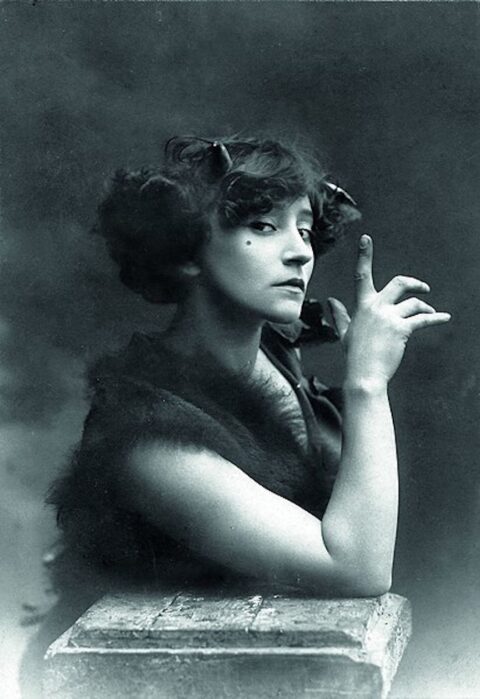 In this excerpt, Colette remembers some of the gay men whose friendship saw her through a time of deep unhappiness, insecurity, and isolation, during the years of her first marriage. Here we meet a handsome poet and his younger lover, whose relationship, movingly described, offered Colette “the tangible expression of union, and even of dignity”; and Pepe, a timid Spanish nobleman “incurably in love” with the beauty of blond-haired manual laborers in blue coveralls. Colette reveals a great sympathy and tenderness for these men, acknowledging the “eternal nature” of homosexuality and making a lyrical plea for its acceptance. We find, in this excerpt, all the hallmarks of Colette’s writing throughout The Pure and the Impure: the dialogic form, the particularity of her observations, the concision of her expression, her lyricism, her love of uncommon words (chrysoprase, aconite, scilla), and the sinuous musicality of her prose. While the identity of the poet remains unknown, Pepe is believed to be José de La Peña de Guzman, a grandee of Spain who was employed as a designer and fitter at Maison Doucet, one of the most fashionable couturiers in Belle Époque Paris, among whose clients was the famed courtesan Liane de Pougy, through whom Colette could have met him.
Many of Colette’s books are ripe for retranslation because earlier translations often obscured her exceptional style — its concision, its intelligence, its musicality. The Pure and the Impure was recommended to me by several scholars as one that was most in need of retranslation. My aim, in making this new translation, has been to create an English version that closely reflects Colette’s original in its syntax, its broad, precise vocabulary, its economy, and, above all, its musicality. I approach translation like a poet: what is most important to me, as I am translating, is the music of the language — its sound and rhythm. And I hope that the translation will stand on its own as a work of art.
— Rachel Careau
⟐ ⟐ ⟐ ⟐
A kind of pauper’s despair pushed women, after the war, to imitate the sexually ambiguous young man. They had counted on the frenzied attentions of men returning to peacetime and to women, and must have noticed that their own grand finale was lackluster … It was at that moment that they wildly imitated the external trappings of a tribe they despaired of, cropped their hair, bankrupted themselves at the shirtmaker’s, drank and smoked immoderately. They scarcely regained ground, they weren’t sufficiently objective.
Unwittingly they contributed to the creation of a type of young man at once effeminate and tough, made up with ochre, greedy for advantage, whom I compare, in my memory, to certain male friends from 1898, 1900, shocking on the cheap, their magnificence extending to moonstone and chrysoprase, and certainly ridiculous; but their fashions in those days didn’t disguise them so much that I couldn’t recognize in them a primitive vigor, the strength granted spindly species that we believe to be weak, the gravity and savageness of love. I am recalling, in writing those last words, a couple who never mingled with my usual denizens … But I’m afraid that if I say only that he was well read, a poet, a writer, handsome from head to toe, people might recognize the older man … As for his ward, the color of wheat, the color of an apple tree in bloom, as dignified as the purebred little peasant he was, he spoke little, listened to his master and friend, and they lived in seclusion, outside Paris. I can picture the hostile glance they both cast, one day when they came in unexpectedly, on my slightly shrill clique …
“Shhh …” the older man whispered to me in a hushed voice. “Don’t disturb these … these kind people. We were just stopping by, we’re leaving this evening.”
“Where are you going?”
“To Touraine, to the boy’s home, for haymaking. They need him.”
“And what about you?”
He held out to me the weatherworn hands of a seasoned traveler, his wrists as tough as saplings, and added:
“We’re making the journey on foot. It’s not the first time. It’s so much more pleasant …”
The “boy’s” eyes, impatient, of a radiant blue, were already awaiting the signal for their departure, the long walk through the June night, the vagabonds’ stopovers and meals, the warm bread bought passing through a village … Smaller than the older man, he modeled himself on him out of admiration, carried his head high and with poise. What would time do to such a bond?
The older man, who was killed facing the enemy, isn’t one of those who will be forgotten. I will bequeath his letters to no one. As for the younger man, the scent of haymaking, when he fluffs the windrows with a pitchfork, perhaps still rends his full heart … Friendship, male friendship, unfathomable emotion! Why would the pleasure shared by lovers be the only sob of exhilaration forbidden you? …
I am revealing a leniency that people will find strange, that people will fault me for. It’s true that these two men whom I have just briefly depicted offered me the tangible expression of union, and even of dignity. A kind of austerity enveloped them, a necessary austerity that I nevertheless cannot compare to any other, because it was neither an outward display nor a precaution, nor engendered by the pathological fear that galvanizes, more often than it restrains, so many of those who are hounded. In my heart of hearts, I am able to recognize in homosexuality some kind of legitimacy and to admit its eternal nature. Out of spite I was shocked, in the past, that the male was less devoted, in the female body, to the lure of the deep trap, the satiny abyss, the living pelagic corolla, than to the intermittent arrogance of what is most virile in a woman — and I am not excluding the breast. Men are drawn toward what can reassure them, toward what they can recognize, in that hollowed female body, quite the opposite of their own, unsettling, never familiar, whose indelible scent is not even earthly but borrowed from the primitive eelgrasses, from raw mollusks … Those who helped me, in those days that were, for me, all constraint and imposed untruth, explained to me that the antipathy of one sex for the other exists apart from neurosis. Since then, I haven’t observed, as I’ve changed spheres, that the opinion of “normal” men is so different … Only among the “monsters” of my past did I love, and call “pure,” the atmosphere that banished women. But by that reckoning, I might also have loved the purity of the desert, and that of the prison. The prison and the desert are not easily accessible to everyone …
Tenderly I look back on the monsters who, for a long way, accompanied me, because that way was difficult … “Monsters” … It’s easy to say. All right, monsters. But those who distracted me from myself, whom deep down I beseeched, could I call them that and say to them: “O monsters, do not leave me alone … I confide to you nothing except my fear of being alone, you are what I know to be most human, most reassuring, in this world … If I call you ‘monsters,’ what name would I give to what others inflict on me as normal? See, on the wall, the shadow of that fearful shoulder, the aspect of that broad back and that neck engorged with blood … O monsters, do not leave me alone …”
They and I came up against identical dangers: an uncompromising man, a wicked woman, we knew what it was to tremble with fear. I sometimes saw them as less fortunate than I, because fear would grip them unexpectedly, suddenly, according to the delicacy of their nerves, whereas I always knew why I trembled and lost courage. But I had good reasons to feel envious of them, since many among them mistook panic for a heightening of the senses. I envied them their tightly encaged and terrified illusion. One whom I was fond of would keep timorous on its short tether his own personal madness. He would bring it along to breathe its essential element in districts that it and he were acquainted with, like those Chinese who go off in the evenings to show their captive songbirds flowering gardens and the reflection of the setting sun among the reeds.
Pepe was — death has removed him from harm’s way — Spanish, of the ancient nobility, slight, rather stiff, chaste owing to timidity, and pleasantly unattractive. He was incurably in love with blue, gold, the color of silver gilt, male beauty, blond men whom manual labor forces to wear blue overalls. Pepe, leaning on the balustrade of the Métro in the evening around six o’clock, would watch, bewitched, as all the range of blues, and the sturdy boles of blond necks, ascended from the shadows. He would savor a pleasure purer than that savored, on the rue de la Paix, by the connoisseurs of the little shopgirls, because he would neither move nor speak. He had given me his friendship, and confided in me in his correct French, which lacked only the z sound. No one spoke to me as he did of the color blue, nor of the lock of golden hair curled around a ruddy ear, nor of the vibrant roguish youthfulness of blond-haired workers.
“Pepe,” I said to him, “write down what you’ve just told me!”
Pepe, modest, and shocked, at heart, in his lyricism, lowered his eyes:
“It wouldn’t be at all amewssing, my dear.”
On warm, dry nights, he would endlessly walk, seeking, fleeing. The bleak Paris of summer became for Pepe a voluptuous hell, almost tropical. He would describe to me impoverished streets that I did not recognize, because under the canopy of dusk he would leave behind, a pillar of silver and gold, light-filled luxuriant blue, some apprentice plumber with Venetian hair, some metal turner sequined with copper. For a long time, he loved blond, cerulean young men the way one loves the vast sea and each wave in a swell. But one day, the six-o’clock tide, which, emptying the metalworking and electrical shops, pours out across Paris forget-me-not and cornflower, aconite, gentian, and scilla, set Pepe face-to-face with an indescribable blue, and dazzlingly golden hair streaming across a face …
“Ah!” Pepe stammered … “Vercingetorix! …”
He pressed both hands against his finally pierced heart, and closed his mouth. Because a man has the right to sigh aloud, “Adèle! …” or “Rose! …” and publicly kiss the likeness of a woman, but he must stifle the names of Daphnis or Ernest.
Pale, winged like dead men walking, Pepe followed Vercingetorix. On the collar of his jacket, in the creases at his elbows, and even on his sabots, the Gaul glittered with fresh metal filings, and at times his enormous mustache, submitting to the evening wind, nearly encircled his neck. He went into a nearby tobacco shop so abruptly that he bumped into Pepe. Brushed by the tip of his mustache like the lash of a whip, Pepe staggered.
“Excuse me, monsieur …” Vercingetorix said.
“I’m dreaming,” Pepe thought. “Or I’m about to die. He excused himself. He looked at me. He has just looked at me once more … What do I have instead of knees? My knees don’t know what they’re doing, and yet I’m moving forward, I’m following him, I’m …”
He ceased thinking, because Vercingetorix, turning around playfully and exuberantly, had just smiled at him …
“I felt,” Pepe told me, “that penetrating pain that forewarns you, in your sleep, that a good dream is about to end. But I wouldn’t have been able to stop walking. And a half hour later I climbed, behind Vercingetorix, a ladder stairway, and I sat down in a small, very clean, very quiet bedroom, where there must have been chiffon curtains, because everything appeared white. Vercingetorix had said to me: ‘Sit down,’ and he had disappeared behind a glass door. I think I was left alone for a long time. Never had anything like this happened to me. I said to myself: ‘My God, what if he should kill me! … My God, what if he should kill me! …’ because I was already thinking that would be the best thing that could happen to me … At last the door reopened and Vercingetorix …”
He closed his child-sized fists, beat them against each other.
“No, not Vercingetorix! No more Vercingetorix! A horror! He had put on a ribbon-trimmed chemisse, low cut … And do you know what on his head? A … a … I hardly dare to say …”
He swallowed, made a sickened expression:
“A crown of pompon rowsses … Pompon rowsses … with leaves … And that soft mustache underneath … His beauty ruined, a shameful masquerade …”
Since he fell into a bitter silence, I asked him:
“And then, Pepe? Afterward?”
“Afterward? Nothing,” he said, surprised. “I’m sure you don’t find my story amewssing enough. Afterward I left … I gave him something, on the table.”
“Did you see him again?”
“Thank you very much,” Pepe said, waving his hand. “I see him enough in my imagination — with the pompon rowsses. Don’t ever again speak to me of pompon rowsses …”
Anxiously visiting the fortune-tellers, the psychic on the rue Caulaincourt, the woman with the candle, the woman with the tarot cards, the woman with the pins, Pepe endured a life under threat, because the prophetesses never ceased foretelling that something terrible would befall him at the hands of a tall blond woman. They easily saw her through Pepe’s small body, a small, thin body, made attractive by some elegance born of frailty, the arrogance of a hunchback without a hump, the gracefulness of a lame man without a limp. When he’d had enough of disclosing to second sight the muddled, cross-dressed image of his love, he disappeared, let himself be forgotten, then exited his uncomfortable life by means of a very discreet suicide, dull, carefully planned, and well mannered, which troubled no one.
[Excerpted from The Pure and the Impure. Translation copyright © 2026 by Rachel Careau. Used with permission of the publisher, W. W. Norton & Company, Inc. All rights reserved.]
⟐ ⟐ ⟐ ⟐
Une sorte de désespoir de pauvresse poussa la femme, après la guerre, à copier le garçon équivoque. Elle avait escompté la frénésie amoureuse des hommes rendus à la paix et à la femme, elle dut constater que sa propre apothéose manquait d’éclat… Ce fut le moment où elle imita follement les dehors d’une gent qui la désolait, se tondit, se ruina chez les chemisiers, but, fuma sans mesure. Elle n’en regagna guère de terrain, elle n’était pas assez désintéressée.
Sans le vouloir, elle contribua à la création d’un type de garçon à la fois efféminé et dur, fardé d’ocre, âpre à tous profits, auquel je compare dans mon souvenir tels amis de 1898, 1900, scandaleux à bon compte, fastueux jusqu’à la pierre de lune et à la chrysoprase, et ridicules à coup sûr ; mais leur mode de ce temps-là ne les déguisait pas au point que je ne pusse reconnaître en eux une primitive fraîcheur, la force dévolue aux espèces grêles qu’on croit débiles, la gravité et la sauvagerie de l’amour. J’évoque, en écrivant ces derniers mots, un couple qui ne se mêlait jamais à mes hôtes habituels… Mais j’ai peur, si je précise seulement qu’il fut lettré, poète, écrivain, beau de la tête aux pieds, qu’on ne reconnaisse l’aîné… Pour son pupille, couleur de blé, couleur de pommier fleuri, digne comme un petit paysan de race qu’il était, il parlait peu, écoutait son maître et ami, et ils vivaient retirés, hors de Paris. Je revois le regard hostile que tous deux jetèrent, un jour qu’ils entrèrent à l’improviste, sur ma coterie un peu criarde…
« Chut…, me souffla l’aîné à mi-voix. Ne dérangez pas ces… ces aimables personnes. Nous ne faisons que passer, nous partons ce soir.
— Où allez-vous ?
— En Touraine, chez le petit, pour les foins. On a besoin de lui.
— Et vous ? »
Il avança sous mon regard ses mains cuites de grand voyageur, ses poignets durs comme des baliveaux, et il ajouta :
« Nous faisons la route à pied. Ce n’est pas la première fois. C’est tellement plus agréable… »
Les yeux du « petit », impatients, d’un bleu resplendissant, attendaient déjà le signe du départ, la longue marche sous la nuit de juin, les haltes et les repas de vagabonds, le pain chaud acheté en traversant un village… Plus petit que l’aîné, il se modelait sur lui par admiration, portait la tête haute et dégagée. Que fait le temps d’un semblable attachement?
L’aîné, qui fut tué devant l’ennemi, n’est pas de ceux qui se laissent oublier. Je ne léguerai ses lettres à personne. Pour le cadet, l’odeur des foins, quand il échevèle à la fourche les andains, serre peut-être encore son cœur qui fut comblé… Amitié, mâle amitié, sentiment insondable ! Pourquoi le plaisir amoureux serait-il le seul sanglot d’exaltation qui te fût interdit ?…
Je laisse paraître une complaisance qu’on trouvera étrange, qu’on blâmera. La paire d’hommes que je viens brièvement de peindre, il est vrai qu’elle m’a donné l’image de l’union, et même de la dignité. Une espèce d’austérité la couvrait, austérité nécessaire et que, pourtant, je ne puis comparer à nulle autre, car elle n’était pas de parade ni de précaution, ni engendrée par la peur morbide qui galvanise, plus souvent qu’elle ne les bride, tant de pourchassés. Il est en moi de reconnaître à la pédérastie une manière de légitimité et d’admettre son caractère éternel. Malignement je me scandalisais, autrefois, que le mâle s’en prît, dans le corps femelle, moins à l’attrait de piège profond, de gouffre lisse, de vivante corolle marine, qu’à l’arrogance intermittente de ce qu’une femme possède de plus viril — et je n’oublie pas le sein. L’homme va à ce qui peut le rassurer, à ce qu’il peut reconnaître, dans ce corps féminin creux, tout à rebours du sien, inquiétant, jamais familier, dont l’odeur indélébile n’est pas même terrestre, mais empruntée au zostère originel, au coquillage cru … Ceux qui m’assistèrent, en ce temps qui ne fut, pour moi, que contrainte et mensonge imposé, m’expliquèrent que l’antipathie d’un sexe pour l’autre existe en dehors de la névropathie. Depuis, je n’ai pas constaté, en changeant de milieu, que l’opinion des « normaux » soit tellement différente… Seule parmi mes « monstres » d’autrefois, j’ai nommé « pure », et aimé l’atmosphère qui bannissait les femmes. Mais, à ce compte, j’eusse aimé aussi la pureté du désert, et celle de la prison. La prison et le désert ne sont pas à la portée de tout le monde…
Avec douceur je me retourne donc vers les monstres qui m’ont, un long bout de chemin, accompagnée, car ce bout de chemin n’était pas commode… « Monstres »… C’est bientôt dit. Va pour monstres. Mais, ceux-là qui me distrayaient de moi-même, qu’au fond de moi je suppliais, pouvais-je les nommer ainsi, et leur dire : « Ô monstres, ne me laissez pas seule… Je ne vous confie rien, que ma crainte d’être seule, vous êtes ce que je connais de plus humain, de plus rassurant au monde… Si je vous appelais “ monstres ”, quel nom donnerais-je à ce qu’on m’inflige pour normal ? Voyez, sur le mur, l’ombre de cette effrayante épaule, l’expression de ce vaste dos et de la nuque embarrassée de sang… Ô monstres, ne me laissez pas seule… »
Nous rencontrions, eux et moi, des dangers identiques : un homme intraitable, une femme pernicieuse, nous savions ce que c’était que trembler de frayeur. Je les voyais parfois moins fortunés que moi, car la frayeur les saisissait, imprévue, par caprices, selon leur fragilité nerveuse, tandis que je savais toujours pourquoi je tremblais et perdais courage. Mais j’avais des raisons de leur porter envie, puisque nombre d’entre eux confondaient la panique et le soulèvement des sens. Je jalousais leur chimère encagée à l’étroit et terrifiée. L’un, que j’aimais bien, tenait, attachée court et craintive, sa folie personnelle. Il la menait respirer son élément vital dans des quartiers qu’elle et lui connaissaient, comme les Chinois qui s’en vont le soir montrer à leur oiseau chanteur, prisonnier, des jardins en fleur et le reflet du soleil couchant parmi les roseaux.
Pepe était — la mort l’a mis en sûreté — espagnol, de noblesse ancienne, petit, assez gourmé, chaste par timidité et laid agréablement. Il aimait sans remède le bleu, l’or, la couleur vermeille, la beauté masculine, les blonds à qui un métier manuel impose le port de la salopette de toile bleue. Pepe, accoudé vers 6 heures à la balustrade du métro, regardait, ensorcelé, monter de l’ombre toute la gamme des bleus, et les fûts robustes des nuques blondes. Il goûtait un plaisir plus pur que ne font, rue de la Paix, les amateurs de petites filles d’atelier, car il ne bougeait ni ne parlait. Il m’avait donné son amitié, et se confiait dans son français correct, privé de z. Personne ne m’a parlé comme lui de la couleur bleue, ni du copeau de cheveux d’or tourné autour d’une oreille sanguine, ni de la mordante jeunesse populacière des ouvriers blonds.
« Pepe, lui disais-je, écrivez ce que vous venez de me raconter ! »
Pepe, modeste, et choqué au fond dans son lyrisme, baissait les yeux :
« Ce ne serait pas du tout amussant, ma chère. »
Par les soirs chauds et secs, il marchait sans fin, cherchant, fuyant. Le Paris triste de l’été devenait pour Pepe un enfer voluptueux, quasi tropical. Il me peignait des rues pauvres que je ne reconnaissais pas, car sous la voûte du crépuscule il y plantait, pylône d’argent et d’or, bleu générateur de lumière, quelque apprenti plombier à chevelure vénitienne, quelque tourneur sur métaux pailleté de cuivre. Un long temps il aima les garçons blonds et céruléens comme on aime la mer innombrable et chaque flot de la houle. Mais un jour, la marée de 6 heures, qui, vidant les ateliers de métallurgie et d’électricité, verse sur Paris le myosotis avec le bleuet, l’aconit, la gentiane et la scille, mit Pepe en face d’un bleu qui n’avait pas de nom, et d’un poil d’or aveuglant, en banderole au travers d’un visage…
« Ah ! balbutia Pepe… Vercingétorix !… »
Il appuya ses deux mains sur son cœur enfin déchiré, et referma la bouche. Car un homme a le droit de soupirer haut : « Adèle !… » ou « Rose !… » et de baiser publiquement le portrait d’une dame, mais il faut étouffer les noms de Daphnis ou d’Ernest.
Pâle, ailé comme ceux qui marchent à la mort, Pepe suivit Vercingétorix. Sur le col de sa veste, dans les plis du coude et jusque sur ses galoches, le Gaulois étincelait d’une limaille toute fraîche, et parfois ses moustaches démesurées, obéissant au vent du soir, lui cravataient presque la nuque. Il entra au tabac proche, d’un pas si brusque qu’il heurta Pepe. Touché par la pointe d’une moustache en mèche de fouet, Pepe chancela.
« Pardon, monsieur… » dit Vercingétorix.
« Je rêve, se dit Pepe. Ou bien c’est que je vais mourir. Il s’est excusé. Il m’a regardé. Il vient de me regarder encore une fois… Qu’ai-je à la place des genoux ? Mes genoux ne savent pas ce qu’ils font, et pourtant j’avance, je le suis, je le… »
Il cessa de penser, parce que Vercingétorix, en se retournant d’une manière gamine et pétulante, venait de lui sourire…
« Je ressentis, me conta Pepe, cette douleur traversante qui vous avertit, dans le sommeil, qu’un songe heureux va finir. Mais je n’aurais pas pu m’arrêter de marcher. Et une demi-heure plus tard je montais, derrière Vercingétorix, une échelle-escalier, et je m’asseyais dans une petite chambre très propre, très silencieusse, où il y avait sans doute des rideaux de mousseline, car tout me paraissait blanc. Vercingétorix m’avait dit : “ Asseyez-vous ”, et il était parti derrière une porte vitrée. Je crois que je suis resté seul longtemps. Jamais rien de pareil ne m’était arrivé. Je me dissais : “ Mon Dieu, s’il pouvait me tuer !… Mon Dieu, s’il pouvait me tuer !… ” parce que je pensais déjà que c’était ce qui pouvait m’arriver de mieux… Enfin la porte s’est rouverte et Vercingétorix… »
Il ferma ses poings d’enfant, les frappa l’un contre l’autre :
« Non, pas Vercingétorix ! Plus de Vercingétorix ! Une horreur ! Il avait mis une chemisse à faveur, décolletée… Et savez-vous quoi sur la tête ? Une… une… J’osse à peine dire… »
Il avala sa salive, fit la mimique de la nausée :
« Une couronne de rosses pompon… De rosses pompon… avec le feuillage… Et les belles douces moustaches là-dessous… La beauté désshonorée, la honteusse mascarade… »
Comme il se taisait amèrement, je le questionnai :
« Et puis, Pepe ? Après ?
— Après ? Rien, dit-il étonné. Sans doute vous trouvez mon histoire pas assez amussante. Après je suis parti… Je lui ai donné quelque chosse, sur la table.
— Vous l’avez revu ?
— Merci beaucoup, dit Pepe en agitant la main. Je le revois bien assez dans mon imagination — avec les rosses pompon. De ma vie qu’on ne me reparle de rosses pompon… »
Chez les cartomanciennes qu’il fréquentait fiévreusement, chez la dormante de la rue Caulaincourt, la femme à la bougie, la femme aux tarots, la femme aux épingles, Pepe traîna une existence menacée, car les pythonisses ne cessaient de lui prédire qu’un malheur lui viendrait d’une grande femme blonde. Elles la voyaient sans peine au travers du petit corps de Pepe, petit corps maigre, qui plaisait par je ne sais quelle élégance d’infirme, une morgue de bossu sans bosse, une grâce de boiteux sans jambe courte. Quand il en eut assez d’offrir à la seconde vue la confuse image travestie de son amour, il disparut, se laissa oublier, puis sortit de son inconfortable vie par un suicide d’une grande discrétion, gris, soigneusement préparé et de bonne compagnie, qui ne dérangea personne.