Few documents have been scrutinized more than our Declaration of Independence, with particular attention lavished on the truth that all men are created equal. The Declaration’s signers, a small cadre of white male property owners, were referring to themselves, but once the democracy genie had escaped the bottle, equality morphed into guises the Founders couldn’t have imagined, triggering a definitive Constitution a decade later as state legislatures swore in an increasingly diverse range of representatives than, say, John Adams had intended. In the aftermath of ratification, Federalists and anti-Federalists, grandparents of today’s two major parties, kicked off a conflict that still roils our nation.
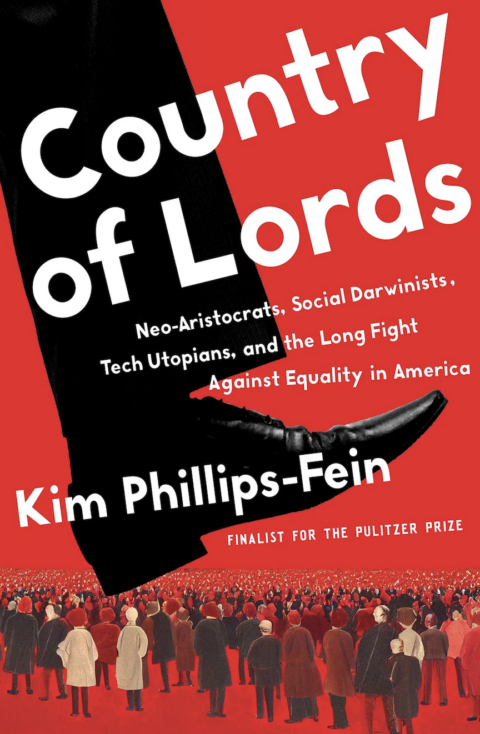 Equality has meant different things to different generations, its malleability exploited by good-government advocates and bad-faith actors alike. Columbia historian and Pulitzer finalist Kim Phillips-Fein captures the intellectual underpinnings and backlashes in her impeccably crafted Country of Lords, blending cool argument and heated jeremiad as she traces an arc from Revolution-era leaders to Silicon Valley techlords. She highlights a peculiar and deep-seated longing for aristocracy within a framework that rejects exalted titles and special rights. She keeps Country of Lords lean and supple, allowing her characters and anecdotes to shine.
Are the wealthiest among us smarter and deserving of unfettered power? Phillips-Fein broods over this question, structuring her book in six chapters on Natural Aristocrats, Social Darwinists, Utilitarian Racists, the Gospel of Production, the Market and the Meritocrats, and Technocracy, Inc. Each chapter unfolds like a discrete tale but plugs into her broader thesis: “What I have found is troubling and surprising, even me to a scholar of American politics: a shadow tradition that fiercely, angrily, and passionately defends that necessity, inevitability, and the desirability of extreme inequality.” British colonials had waged a revolution against monarchy, yet retained a cultural DNA of lords and commoners. These tensions nearly strangled the infant republic in its cradle as Federalists and anti-Federalists worked out a new form of government in real time, mercurial personalities coming to the fore.
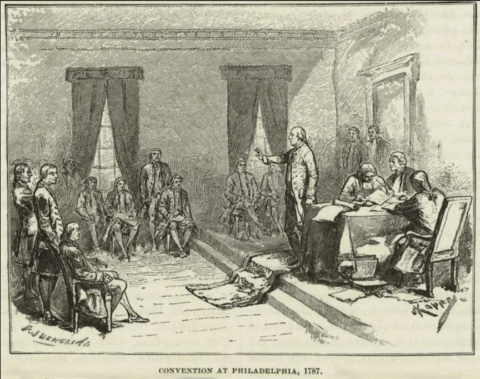 Under the Articles of Confederacy, the wrong sorts of people were winning local elections, stoking dread in the hearts of Virginia planters and Boston Brahmins alike; as Gordon Wood and others have shown, the framers called a Constitutional Convention to forge a strong central government that would tamp down mob rule. Jefferson and (belatedly) Madison believed in the collective judgment of the people, while Hamilton and Adams preferred an enlightened hierarchy. (Adams, according to Phillips-Fein, “feared the poor in a way he never did the rich and thought egalitarianism a dangerous fantasy.” ) Southerners such as John Calhoun and George Fitzhugh fueled debates about what American democracy should look like; Phillips-Fein connects them to the incendiary issue of slavery, the ultimate test of a free and fair society.
In the decades following the Civil War, Social Darwinism rose to prominence. Policymakers embraced a scientific approach (sort of), one later associated with eugenics. Phillips-Fein recounts the career of William Graham Sumner, a Yale professor who, from his lectern, preached a gospel of winners and losers and tied his message to innate intellect. The world, as he and his peers understood it, bristled with brutal competition: “They saw economic life as charged with moral meaning, even adventure. Even their derision of American nostrums about equality had a transgressive, exciting charge, as though they spoke truths kept hidden by sanctimonious reformers who taught that it was wrong to want to be on top.” The son of a Scottish weaver, tycoon Andrew Carnegie also aligned himself with these views, yet felt the über-wealthy owed a debt to society; he founded hundreds of libraries and funded schools and hospitals, a precursor to philanthropists such as Bill Gates and Michael Bloomberg. He saw no alternative to noblesse oblige. A few industrialists initially welcomed unions as a path to profits — with extra dollars in their pockets, the proletariat would purchase items manufactured in factories — but a series of bloody strikes drew battles lines between capital and labor.
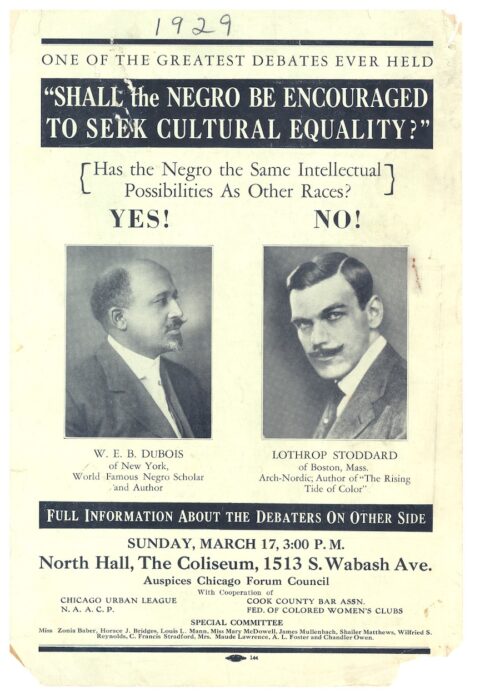 Country of Lords pivots to the darker side of free markets in a sobering chapter on Utilitarian Racists: fascism has always lurked in the depths of the American imagination. Phillips-Fein unpacks the lectures and speeches of Lothrop Stoddard — who debated W. E. B. Du Bois in 1929 — and others, figures whose pseudo-scientific sheen inspired Hitler. The automobile magnate and virulent antisemite Henry Ford envisioned a dynamic if stratified culture. The Roaring Twenties embodied the contradictions of modern America — a surging Ku Klux Klan and the violent Tulsa riots juxtaposed with Jazz clubs and speakeasies. Economic disparities widened; in The Great Gatsby, for instance, Nick Carraway quotes the popular tune, Ain’t We Got Fun: “One thing is sure and nothing is surer / The rich get richer and the poor get — children.” (What’s more American than twisting the plight of the poor into a hit song?) Reformers, Phillips-Fein points out, were racists: “There was a great deal of overlap between the early conservation and environmentalist movements and the eugenics campaigns of the Progressive Era. The Save the Redwoods League and American Eugenics Society had so many members in common that their annual meetings would often be scheduled together.”
As corporations grew — Carnegie Steel merged with J.P. Morgan’s interests to create U. S. Steel in 1901 — so did a new managerial class, equipped with spreadsheets and ticker tape. The private sector, in their view, would become an efficient engine for the greater good; they would literally manage the country toward a shared prosperity. Frederick Winslow Taylor, whom Phillips-Fein portrays as the mastermind behind consultants, introduced “time-study and efficiency experts” that would influence industry titans. Workers would be evaluated via metrics of performance and productivity. Phillips-Fein interprets “the independent expert, the neutral arbiter, the professional” as foot soldiers of oligarchy: “These were the people whose skill and knowledge could develop systems that would resolve struggles over inequalities of wealth and power. Yet their ideas presupposed a fundamental inequality between those who would make the plans and those who would have to obey.”
The elastic term meritocracy, popularized by British activist Michael Dunlop Young in his biting 1958 satire, contended that the cream of a society would rise, despite encumbrances of race, gender, and poverty — libertarianism by another name. These concepts migrated west, a kind of Manifest Destiny almost as insidious as the Nineteenth Century version. Phillips-Fein’s final chapter revisits a fringe utopian movement, Technology, Inc., which aimed to elevate engineers to the highest tier, beyond the reach of lawyers, politicians, and financiers. Engineers were the true innovators, entitled to dominate our public sphere. Their vision galvanized the Silicon Valley mavericks of the 1980s and ‘90s, attracting Wall Street investment and kindling the pharaoh philosophy that animates multibillionaires Peter Thiel and Marc Andreesen, little deities in the service of a supreme Godhead, the Machine. “They have successfully brought the techno-entrepreneurial justification for economic hierarchy and inequality to the center of attention today,” the author notes. “Their belief that the entrepreneur models alpha qualities of bravery, creativity, and aggressive drive — are key to their defense of their extraordinary wealth … In their view, tech inventors and company founders perched at the top of the human hierarchy are those rare human beings who have the capacity to touch the divine.”
 Phillips-Fein is a graceful writer and balletic thinker; her opening paragraph tucked me into its palm and held me rapt, right through to its conclusion. Her book is slender, only 200 pages, but her argument has vast implications for the future of the nation-state, centering the perils of inequality as global capitalism, boosted by AI, asserts its own independence from the rest of us. Country of Lords probes the fate of democracy while lamenting ominous trends: “Today, wealth and income in the United States have become more unequally distributed than they have in a century. Our country is the most economically unequal of all developed nations.”
The great world spins; laws come and go; but a yearning for caste endures. As Phillips-Fine observes, “Old dogmas and platitudes are often recycled in the present.” If money is the measure of all things — a big if — then it may be in our nature to crave affluence in order to feel superior to the masses. We resort to extreme actions that mask insecurities; hence the manic emphasis on education as the signifier of worth. “Like poison ivy it keeps growing back,” Phillips-Fine opines. “The constant, frantic spending by people in the upper middle class on math classes and chess tutors and test preparation for their children — and the fixation on winning admission to a small number of elite education institutions — all ratify and testify to this meritocratic faith, even as they are manifestations of the deep anxiety at its core.” Opportunity, mobility, self-reliance, freedom: these principles resonate only if the plebians are shut out. As this timely, incisive book suggests, liberty exists for the elect few, the rest of us be damned — a notion as American as Mom and apple pie. Country of Lords belongs on the same shelf as recent landmark studies by Rana Dasgupta, Jill Lepore, and Quinn Slobodian.
[Published by W. W.Norton on July 21, 2026, 256 pages, $35.00 hardcover]