When the people are ready a book arrives. Or when a poet is ready, has been ready, ready and steady, writing the book of a moment all his or her life, the book arrives. Rather chillingly –– and yet hopefully, if such a thing could be true –– Peter Balakian’s New York Trilogy appears this season as both an acutely topical capture of our deconstruction as a nation, and as a master work in the grand tradition of the American long poem.
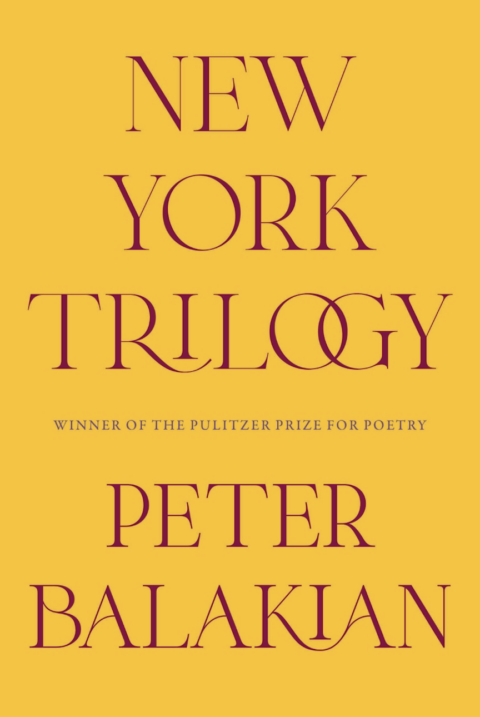 Yet to describe Peter Balakian as merely ‘a poet’ is insufficient. I would more aptly call him a prodigious writer and intellectual who moves in and out and around genre as psychic pressure demands. No doubt a singular poet, he is the author of nine books of poetry, most notably Ozone Journal (University of Chicago Press, 2015), which was awarded the Pulitzer Prize (2026). His books of poems have appeared regularly every three to five years from Father Fisheye (1979), Sad Days of Light (1983) and Reply from Wilderness Island (1988), all from Sheep Meadow Press; to Dyer’s Thistle (Carnegie Mellon 1996), June-Tree: New and Selected Poems (Harper Collins, 2001); to the three University of Chicago books, Ziggurat (2010), Ozone Journal (2015) and No Sign (2022). He’s also a translator. Along with Nevart Yaghlian, he translated the work of the Armenian poet Siamanto, Bloody New for My Friend (Wayne State University Press, 1996), and co-translated, with Aris Sevag, American Golgotha (Vintage, 2010) a memoir by his great-grand-uncle Dr. Grigoris Balakian, and about the Armenian Genocide of 1915-18.
The camera angle widens, the mode shifts. Balakian is the author of four books of prose, including the New York Times’ best-selling The Burning Tigris (Harper-Perennial, 2004), which rattled professional historians, and won the prestigious Raphael Lemkin Prize for human rights; and a memoir, Black Dog of Fate (Basic Books, 2009), which won the PEN/Martha Albrand Award for memoir. Two books of criticism exist as well, Vise and Shadow: Essays on the Lyric Imagination, Poetry, Art and Culture (University of Chicago Press, 2015), and Theodore Roethke’s Far Fields: The Evolution of His Poetry (Louisiana State University Press, 1989). This range of writings consistently derives from, imagines out of, and folds in upon his Armenian heritage and the psychic trauma of the Armenian genocide (1890-1916). At the same time, it intersects with the classic immigrant story of America, and New York City specifically. In this regard Peter Balakian’s reputation as a poet is inextricably bound up in this singularity –– NYC, and the Armenian genocide –– and he has, to my mind, been a major “poet of witness” in the 20th and 21st centuries.
He is also a public intellectual and activist, working for many years to combat the Turkish denial of the Armenian holocaust, and co-founding, in 2020, in the wake of the January 2020 insurrection, the group Writers for Democratic Action. Behind all this is the august reputation of the Balakian literary family, from his great-grandfather Grigoris Balakian to his two aunts, Anna Balakian, the foundational surrealism scholar, and Nona Balakian, long-time editor of the New York Timed Book Review.
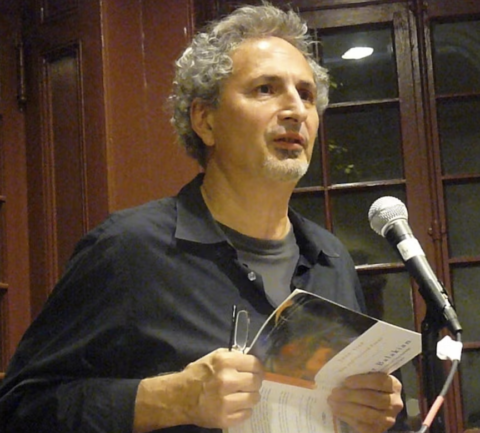 All of this to say New York Trilogy emerges with considerable weight behind it. Post Ozone Journal, Balakian has an historic place in American poetry, and while obviously working on questions of witness and identity, he is up to something more plural and global. His work takes on the larger picture of historical formation, human rights writ large, and its accretive echo across time, while also reveling in the very material culture that sustains it. No doubt, too, Balakian has always already been an ecopoet in his empathy for the more-than-human world. Unique in many ways in his wedding of the personal/political, cultural/natural, he is a meditative poet finely attuned to the material hum of particulars. These seemingly contradictory impulses –– centripetal and centrifugal –– produce a deeply layered, visual and sonic complexity.
Across his many books –– and in particular the trio of books from the University of Chicago –– Balakian’s poems enact a dialogical interrogation that tensions the here/there, then/now, he/she, outside world/personal memory of experience. Writing in irregular couplets and tercets (often) that enjamb radically down the page, the poems look and act distinctively ‘Balakian.’ I would invoke brushstroke, and indeed, that feel filaments New York Trilogy with one of its epigraphs: “Take a flat brush and work it until there are two hairs left” (Arshile Gorky). Touch. Line. Color. He balances a disjunctive opposition of subject and grammar, scale and process, often spilling syntactically in a way that vividly captures contemporary fragmentation; it has a particularly compressive effect on space and time.
I hear a version of the Upper West at a moment
when history was an image caught in a pincer:
morning was blood orange on Columbus Ave,
evening was a rum punch and then
a riot of Quiana collars/blow and poppers
arms and legs of Jell-O in the stairwells
where Calvin Klein disappeared like a holy ghost
(Ozone Journal, Sec. 16)
Yet all of this attention is to ask what is up with Balakian’s new collection New York Trilogy, and why? Bringing together the three long poems from his previous three books Ziggurat, Ozone Journal and No Sign, the book’s recombinatorial logic has a various and compounding effect. It appears that the three poems are extant from their versions in the three books; they have the same number of sections (Z=45, OJ=54, NS=45 … =144 sections). Interestingly, that’s divisible by 12; the years go by. Or is it that the long poem itself took 12 years to write? The specter of time, time passing, the built monuments of time, are a signature of Balakian’s work, and the stop/start sectionality of the poem, combined with Balakian’s “leaping” in time and place, gives the writing a textural feel of warp and woof: “history / as images through cracked glass” (Ozone Journal, sec. 44). This meticulous annularity feels powerfully intentional, the deep surprise of number and duration in poetry.
New York Trilogy suggests that this long poem has indeed been growing, sectionally, into a singular object, imagined as such, now framed quite differently through the long view of a poet’s life. This is made clear by the author’s note –– one, for the sake of discovery, this reviewer had wished Balakian had omitted. Still, the effect stretches the idea of the book, and the attentions of the poem, beyond singular containments of a book; it is a vision. In this regard it extends the span of time in the tradition of the great American visionary long poems: Whitman’s “Song of Myself,” Crane’s The Bridge, William’s Paterson, Olson’s The Maximus Poems, Roethke’s The Far Field, Ginsberg’s Kaddish, Rukeyser’s Route One, Enslin’s Ranger, Hejinian’s My Life, Notley’s Descent of Alette, Ammons’s Garbage, etc. But like those poems, New York Trilogy recalibrates the space of the book, takes on span itself as a peculiarly American trope. Balakian’s “bridging” throughout the poem is often physical between NYC and New Jersey, but dialectically it’s between NYC and world history.
The new gathering of these poems also gravitizes Balakian’s attention around the visual and musical arts. Balakian is perhaps best read as a collage artist who thinks in pieces, riffs, and imagines visually, even filmically. Brooding, musical ekphrases, Balakian’s poems are often meditating on particular paintings, parts of paintings, shards, artists –– Arshile Gorky, pottery at Ur, Pollock, Frankenthaler, Sonny Rollins’ “woodshedding on the Williamsburg Bridge,” Miles Davis’ blues, Franz Kline’s line –– but they’re also painterly themselves in his syntactic “brushstrokes.” These leap sufficiently to be able to span history from the Grünwald’s Isenheim Altarpiece through the Armenian Genocide to contemporary climate change: “Memory was someone’s history; private, political, social –– / so I remember the gingko twisted out of the sidewalk by our door / second nature of light –– light of the spectrum and love –– / light of Grünwald’s great halo sky // blew through us as walked across Sheep Meadow” (Ozone Journal, Sec. 59). It’s an Armenian story, it’s an American story, it’s our global history inducted through New York City: “The creosote vaults at 42nd / covered in Day-Glo neon Pollock / over the girders of “peace, but fuck you anyway” (Ziggurat, Sec. 21).
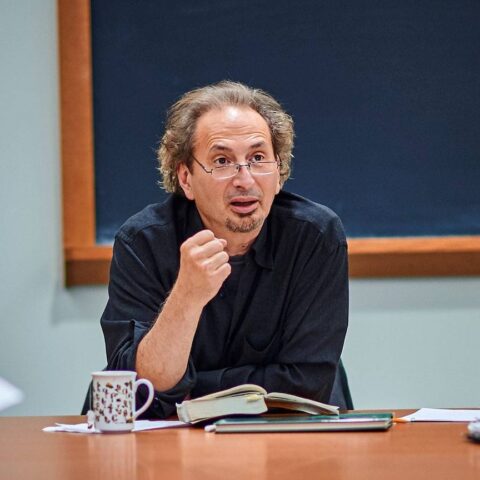 That all these pieces remain at once pieces and a singular long poem makes clear that Balakian’s poetics are importantly serial; they stop and start according to their occasional demands. This kind of “notational” poetics foregrounds daily attention, and a kind of modal thinking in pieces, gestures, iterations. But these things add up to different things; Balakian’s serial imagination has brooded these three long strands as one thing. To get there, it had to span three books. The one and the many, the person and the world, the organic gathering of historical attention over a 50-year period –– it is equally impressive as poem and poetics, and a rather crowning gesture to a career.
Finally, and perhaps most movingly, the primary effect of linking “A Train/Ziggurat,” “Ozone Journal” and “No Sign” together is narrative. There’s a kind of durational foregrounding of “characters in search of an author,” to invoke Pirandello, that is surprisingly dramaturgical and, as a marriage story, deeply personal. The I/Thou of the poem strung across follows the classical journey to the underworld; it’s katabasis and anabasis, joining Orpheus and Eurydice, and Dante and Beatrice with New York, young love, and the historic events of 9/11. The affective field of the story telescopes into the ultimate He/She of “No Sign.”
This is particularly acute in the transition between “Ozone Journal,” simultaneously the most personal and most jazzy of the sections, and the elemental “No Sign,” In its detailing of the AIDS pandemic (and his cousin’s passing),among other things, “Ozone Journal” swells to a kind of climax of death and disease that ends starkly: “If you feel the emptiness, you can see anything / be in it, as matter, as matter of fact.” The “throw” into the elemental dialogue of “No Sign” feels stripped bare, where “We’re [just] back here on the Palisades cliffs –– staring at Manhattan.” It’s been there all along but the newly gathered New York Trilogy reads as a love poem, the oldest kind there is; and the ways the dissolution of a long marriage mirrors the collapse of the ‘structure’ of America is uncanny and devastating. History happens to people, us. We succeed, fail, endure, get divorced. It’s a deepening of vulnerability –– the story of our lives slashed from Vietnam to the building of the Twin Towers to 9/11 to Trump, post-Trump, Trump again, and climate change. Recent events in America make the book all the more timely; everything is sharply on display, and a narrative of tenderness spirals down to the person, a room: “Lui: You saw nothing. // Elle: I saw everything. // Lui: What did it mean to you? // The curtains are always moving –– / light turns the hydrangea a deep blue” (No Sign, Sec. 45). Sir Leonard Woolley, the pioneering English archeologist, who offers the second epigraph to New York Trilogy, hovers eerily beneath the book: “It grieves me to watch at the end of any good work to which men have given so much thought and skill.”
To be sure. Balakian is one of our most New York poets, picking up the shards of our buildings and ambitions, consumptions and losses. But the expansive canvas and profound empathy of his poems makes New York Trilogy all of ours, and indeed an ur-document in the sedimentations of late Modernity:
He: I know beneath this hull is rift and subduction
underwater jazz and terror –– as if Sun Ra and Chopin embraced
beneath a surface they didn’t understand ––
She: –– remember light spills as dark comes –– chalk floats off the silhouettes
(No Sign, Sec. 44)
[Published by the University of Chicago Press on October 90, 2025, 104 pages, $20.00 paperback]