What is it about the human brain that moves us to anthropomorphize a container ship? In Richard Misrach’s Cargo, a collection of panoramic photos of shipping lanes in San Francisco Bay, the ships look like they might be playfully sliding across a placid flat surface; or snaggletoothed; or blessed, singled out by the heavens via a ray of sunlight breaking through a cloud. Depending on the surroundings and the angle, the boats can seem intrepid, or shy, or cagey. Here, they overwhelm and intimidate the tiny sailboats and kayakers they share the waters with; there, they’re footnotes to the masses of birds crossing the waters.
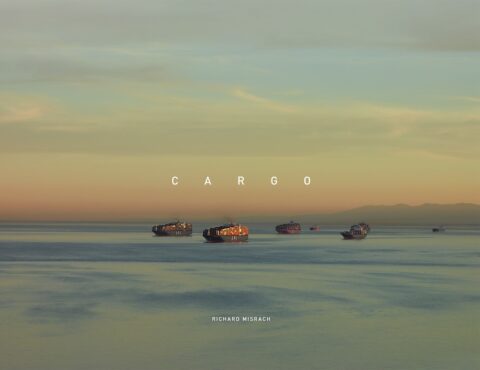 All of which is to say that Cargo is ultimately a book about the environment, and about us. Misrach has been a celebrated landscape photographer since the mid-70s. His work echoes that of other widescreen photographers like Edward Burtynsky, though Misrach’s critique of human overconsumption is less overt, more interested in asking viewers to pay attention to more individuated evidence of abandonment and corrosion. His ongoing Desert Cantos series spotlights the bleached out Western borderlands and the detritus we’ve left behind there — rusted gas pumps, empty swimming pools, an RV half-consumed by flooding. Cargo is a kind of sequel to 2001’s Golden Gate, a series of long-distance photos of the Golden Gate Bridge, shot at different times of day, in various types of weather.
In the Golden Gate photos, human intervention seems like an afterthought incapable of speaking to nature, let alone controlling it. The bridge was an incursion, but not a threat, nor an Art Deco masterpiece; just a pair of pillars and a bridge, often obscured by fog, and stripped of detail by sunlight. In Cargo, the ships generally claim more of the field, as if to suggest that the two decades years since Golden Gate, the incursion has expanded. (In both books, the photos’ titles simply register the date and time the image was taken.) The ships appear in various degrees of clarity, sometimes crisp enough to read the words on the containers the ships carry, sometimes completely obscured by fog or darkness. But the human place in our waterways is always central. Golden Gate’s imagery was indisputably beautiful, or at least concerned with natural beauty; Cargo is more skeptical.
In her introduction to the book, Rebecca Solnit sees the photos as a sly commentary on human capacity to memory-hole humanity’s destruction of the environment. The Bay, she writes, is “the region’s half-forgotten heart,” and it’s true that the images remind us of what we can’t see — the contents of the ships, and what resources were expended to manufacture and transport their contents, the wildlife underneath the water’s surface and how it’s been decimated by pollution and overfishing. Living nature is largely absent, excepting the stray flock or intrepid, wet-suited human.
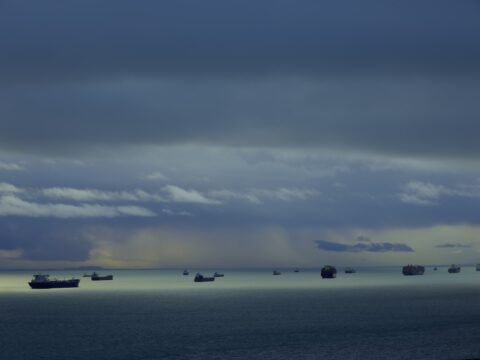
Still, if Misrach’s images evoke Burtynsky’s social commentary, they also have a bit of J.M.W. Turner’s eye for color, for the play of light and shadow. Seen a far enough distance, the ships possess an easy grace and indomitability that Turner celebrated in his more serene seascapes. Moreover, like Turner he cedes the true power of the images to clouds, water, and sunlight. At dawn, Misrach’s bay is a Rothko-like diptych of gray and orange-gold, at sunset as nocturne of blue and black punctuated by a glowing moon and city lights. White vapor trails brushstroke an ostrich-egg green sky; a shaft of molten yellow streaks across a purple-clouded sunrise. On overcast days, the scene attains a milky, industrial blandness, punctuated by a lone, barely visible standing kayaker, a speck in the center of the shot. One image is pure, all-enveloping fog, shades of gray that read almost like comic relief but with a richness that suggests a Gerhard Richter painting.
In her essay, Solnit suggests that there’s a narrative at play in these images as intense as any Turner sea storm: As humans transition away from fossil fuels, she writes, and toward sun and wind, the ships are central players in a moment of tension. “You can look at these ships as a threat and trouble as part of their cargo. And you can see sunlight as another protagonist visible in all these pictures, see wind discernible in the rough surface of the waters.”
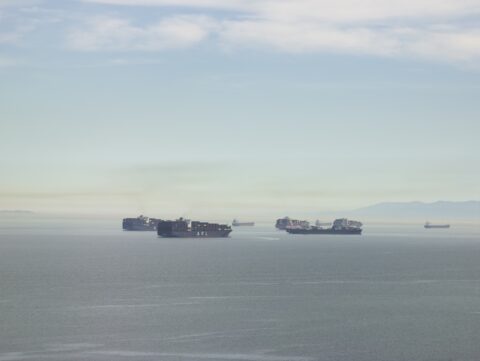
The ongoing U.S.-Iran war, and its focus on shipping traffic in the Strait of Hormuz, makes this tension more acute and consequential. News photographs of the region tend to emphasize the sheer number of ships and tankers that occupy the Strait; it takes some effort to notice the mountains girding it, or even the water itself. The word incursion is more fraught; the threat and the trouble are much more clear. The world Cargo presents is gentler, but it’s of a piece with the Strait. The images capture the consequences of decades of environmental neglect — everything about the ships, and everything above and below them, is changeable and a source of danger. In that sense, Cargo is a timely book, speaking to what we’ve done to the air and water across time. It may be, as Solnit suggests, that the number of ships will diminish, even vanish someday. More wildlife may emerge, something like stasis may come into being. What tension will we look for in the waters then? What will we take pictures of?
[Published by Aperture on June 10, 2025, 156 pages, 64 photographs, $85US/$120CAN hardcover]