Nancy Naomi Carlson interviews Margaret Jull Costa and Robin Patterson on translating Memorial de Ayres by Machado de Assis — with an excerpt from the novel
⟐ ⟐ ⟐ ⟐ ⟐
Nancy Naomi Carlson (NNC): You two have collaborated on several translations to date, as well as on this latest one by Machado de Assis (1839-1908). But how did this collaboration get started?
Margaret Jull Costa (MJC): Robin was a student in a summer school I ran some years ago now, and then I mentored him for six months as part of the British Centre for Literary Translation mentorship program. We stayed in touch after that, and when, in 2015, I was asked to translate Lúcio Cardoso’s mammoth Crônica da casa assassinada, I thought the work would be ideal as a co-translation, since there are multiple narrators. I mainly translated the females, and Robin the males. The translation won the 2017 Best Translated Book Award, which was very gratifying. When Norton asked if I would like to translate Machado de Assis’s short stories, I immediately asked Robin if he would like to collaborate on those as well, since our previous collaboration had been so successful and enjoyable.
NNC: I’m fascinated by the way different translators collaborate with one another. I especially like collaborating with a native speaker of the language. What individual strengths do you each bring to a translation? Are you able to describe the process you follow when there is no obvious division of labor such as a text utilizing multiple narrators? How do you negotiate differences of opinion?
MJC: I never thought I would co-translate anything, but I’ve now done so with four other translators, and it’s been a fruitful and companionable experience. People often ask how a co-translation can possibly have one voice, but, miraculously, so far it’s worked! What’s so valuable is having another brain equally steeped in the same text and sharing the same translation problems. With the Cardoso novel, division of labor was easy, and with the Machado short stories, we simply divided the work between us with the proviso that I could translate “Midnight Mass,” my favorite Machado story ever since I first read it at university many years ago. With other novels, my co-translators and I have simply split the book in two, each taking the first or second half. We then produce near-final drafts of our respective sections and share them, each editing the other’s work. Then there’s a final readthrough to iron out any remaining problems or inconsistencies. There haven’t – as yet – been any great differences of opinion. We simply talk things through.
Robin Patterson: Yes, I agree with that. We do sometimes thrash out various alternatives, but we both approach it in a pragmatic way, batting ideas back and forth until we find the best solution. I don’t think it has ever been a case of one person persuading the other that they were “right” from the outset. So in many ways it’s simply an externalized version of the same process that all translators carry out inside their own heads. That said, often the better solution is evident from the outset, and I’m not afraid to say that very often it’s Margaret’s!
NNC: One last question about co-translation. How does co-translation affect the time it takes to complete a project as compared to when you work individually?
MJC: To be honest, I haven’t actually worked that out. It definitely saves time having to translate only half of the book from scratch, but then each of us then has to re-read and edit that half and revisit our own half, then re-read the whole thing until we’re happy that it reads like one seamless text.
NNC: And therein lies the magic, I imagine. Shifting gears a bit, let’s talk about Memorial de Ayres, Machado’s final novel. I guess it’s more a memoir than a novel. How much of Machado’s life is found in these pages?
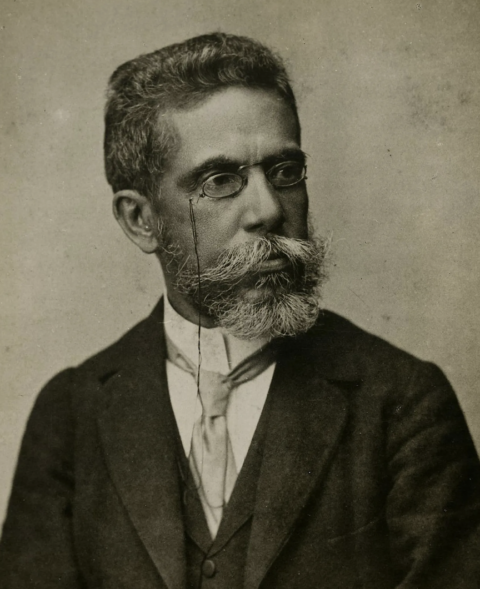 RP: A lot, I think – the voice of the narrator, Counselor Ayres, certainly sounds like how we would imagine Machado’s own voice. Of course, this could be a game Machado is playing with us — he likes playing games! — yet somehow this one feels more straightforward, as if the mask has finally slipped. As for Machado’s life, we can hear certain important parts of it refracted in various parts of the novel, although more through character than plot. It’s often said that the two young characters, Tristão and Fidélia, contain something of Machado himself as a young man and Carolina, the woman he would marry. And that the childless older couple, Aguiar and Carmo, are, perhaps more obviously, Machado and his wife in their contented later years. Machado wrote the novel shortly after Carolina’s death, and themes of widowhood and grief are explored through several of the characters, allowing a portrayal that is as multi-faceted as it is personal. Of course, there is much of Machado’s own life that is very much not in the novel – his own modest upbringing was a world away from the refined drawing rooms of all his novels, and while he did rise to the very top of Brazilian society, I rather think he was always an outsider, an observer of their world, rather than a fully-fledged participant. So the book is something more complex than a memoir — a meditation perhaps, written in the form of a diary but in fact entirely fictional, and where the narrator, and the author, seem to be both everywhere and nowhere.
NNC: I would guess that Machado’s humor has also found its way into what the protagonists say. For example, as Counselor Ayres is approaching Rua do Catete, he hears a dog barking from behind a garden wall. He imagines the dog is telling him, “My friend, do not concern yourself with what inspires my little speech: barking and dying are what dogs do, and the Aguiars’ dog used to bark; now it merely forgets, which is what the dead do.” What other examples of this kind of humor particularly struck you in the book?
MJC: There’s always a lot of humor in Machado’s writing — he had such a keen eye for the absurd. In Memorial de Ayres it’s right there on the first page, when Ayres hears the cry of a street vendor: “Get your brooms and dusters here!” which reminds him that these were the words that greeted his return to his homeland, his old neighborhood and his own language a year ago. Why is that funny? Just that mismatch between the banality of the words and a truly significant memory. Then again, essential to Ayres’ view of life is the idea that nothing is significant, least of all him.
And there is dark humor, too, in the telling of what is, after all, a fairly banal love story set against the backdrop of what was a huge social change in Brazil’s history — the emancipation of slaves. How absurd all this fuss about comfortably-off middle-class people, when thousands of enslaved workers are about to have their lives changed forever.
NNC: Yes, I love the dark humor, and how’s it’s tied to Ayres’ philosophy of life, as when he says, “Everything is fleeting in this world.” What a beautifully executed iambic pentameter phrase! What other “wisdom” comes through in this book, which reflects Machado’s 69 years on this earth?
RP: Ayres is certainly a worldly-wise narrator. Another example in a similar vein is his rumination that “Life, however, is like that, a repetition of action and gestures” – the sense that the same things happen again and again, which he expounds on elegantly for half a paragraph. And, ostensibly constrained by his career as a diplomat, he’s a pithy commentator, too. On the great political issue of the day, the much-delayed abolition of slavery in Brazil, his reaction boils down to “About time, too.”
MJC: There is an emphasis in this novel that is lacking in others, I think, about the importance of love in all its many forms — between husband and wife, brother and sister, and between parents and children. All done in Machado’s usual understated, unsentimental way.
NNC: The abolition of slavery in Brazil occurred in 1888/1889, the backdrop of Memorial de Ayres. For our readers unfamiliar with Brazilian history, how did Brazil’s handling of the slave trade and the emancipation of slaves compare to the way these events played out in other countries, particularly in the US? Why do you think Machado chose this major historical event as the backdrop for Memorial de Ayres?
RP: Machado always set his novels a couple of decades earlier than when he wrote them, and they all tend to have some sort of political controversy lurking in the background. In the case of his other novels, those controversies had largely faded even by the time of publication, and are of purely historical interest to us today. Not so with Memorial de Ayres, which deals head-on with the most emblematic event of 19th-century Brazil, and one which still resonates both inside and outside the country. I like to think that Machado felt emboldened by his advancing years and failing health to tackle a subject he is sometimes accused — unfairly, I think — of tiptoeing around in his earlier works.
Brazil’s path toward abolition was slower than that of other countries, with outside influence playing a significant role. Brazil passed a law in 1831 prohibiting the importation of slaves, but it was not enforced. In 1845, the British Navy began blockading Brazil’s continuing slave trade for reasons that were both moral and commercial. The ending of the American Civil War was a further nudge, and in 1871 Brazil passed the “Law of the Free Womb,” freeing all children born of enslaved women after that date. With the slave trade by then finished, the intended goal was for slavery, literally, to “die out.”
And so by 1888 when the novel begins, there are no enslaved people in Brazil under the age of 17 and the system is finally on the verge of collapse. The question facing the characters in the novel is how this will take place – quickly or gradually, managed or chaotic. In many ways it turned out to be a mixture of all those things, and some would say that the consequences have still not been fully resolved.
NNC: Interesting how you say that Machado may have felt emboldened by his advancing age and declining health to take more risks regarding his subject matter. What other risks do you see him taking?
RP: As we mentioned earlier, he has put more of himself into this book than in any of his previous novels, which is quite a risk for an author to take. Again, it fits with that idea of feeling emboldened — that this book might be his last throw of the dice. And he sets aside some of the pyrotechnic narrative techniques of his earlier novels for an ostensibly straightforward “diary” format. As we all know, doing something simple — or making something look simple — can be much trickier than it seems. And the novel is short, which itself is a risk – although one which Machado, also the master of the short story, was more than capable of managing.
NNC: This is not the first time this book has been translated. What approaches, including linguistic considerations, have informed this particular translation, as compared to any previous ones? In addition, can you tell us why you believe Machado’s work is deserving of many translators?
MJC: As far as I know, there has only been one other English translation of this novel, by Helen Caldwell in 1972, and we and the publishers felt it was time for a new version. We rather hope that another translation won’t be necessary for quite a while! Well, as a translator, you do have to believe that yours is the translation. As for how we approached this new translation, I think we did what we always do, that is, listen to the voice of the original and do our best to reproduce that in English. The reason why Machado, like any other great writer, deserves to be translated into many different languages is because he is a true original, a 19th-century writer who bears no resemblance to his Brazilian, American or European contemporaries – such as José de Alencar, Henry James, Flaubert, Dostoyevsky. He read widely in various languages, and was particularly influenced – as were many writers – by Sterne’s Tristram Shandy. And perhaps it’s the fragmented narrative, the sharp, ironic eye and sense of the absurd that most marks him out now as then. It’s what speaks to us across the centuries.
NNC: Thank you, Margaret and Robin, for participating in this interview and sharing your perspectives on translation, in general, and in regards to Memorial de Ayres. It’s been truly a pleasure “chatting” with you. One final question, if you don’t mind. Please contextualize the excerpt reprinted below so our readers can get a sense of how it fits in with the rest of the book.
RP: Thank you, Nancy, for interviewing us – and for asking such perceptive questions! It’s been a pleasure for both of us, and it’s wonderful to have this opportunity to bring Memorial de Ayres to a wider audience. The excerpt that follows is a short vignette which interrupts the main events of the novel. Our narrator, Counselor Ayres, has been visiting the Aguiars, a middle-aged couple, and has become engrossed in the comings and goings of their social circle. Like Ayres himself, the Aguiars have no children of their own, but unlike him, they have always delighted in the company of young people. We chose this excerpt both for its laser-like powers of observation and reflection, and for its humor – in some ways it’s a microcosm of the novel as a whole.
⟐ ⟐ ⟐ ⟐ ⟐
September 9, afternoon
It seems that the Aguiars have infected me with their liking for children, or, to use a rather more amusing phrase, their nostalgia for children. Coming along Rua da Glória just now, I happened upon seven children, girls and boys, of various sizes, walking in a line, hand in hand. I was so charmed by their youth, their laughter, and their vivacity, that I stopped to look at them. They were all so delightful, and clearly such good friends, that I laughed out of sheer pleasure. If I were to write the story down, that is where it would end, had it not been for the comment made by one of them, a girl, to her companions when she saw me standing there laughing:
“Look at that fellow laughing at us.”
“Fellow”! This spoke volumes about how children see people. They called me a fellow, me with my white mustaches and graying hair! They probably call any man of a certain stature “fellow,” and never ask to see a birth certificate.
I let the children go on their way, and was left alone with my thoughts. Off they went skipping, then stopping, tugging at each other to left and right, sometimes breaking the chain, then immediately joining hands again. I don’t know where they disappeared to, only that ten minutes later they were all gone, to be replaced by others, alone or in pairs. Some of these were carrying heavy bundles or baskets on their heads or backs, setting off to work, at an age when those other children were still laughing. Is it because I never had to carry any heavy burdens as a child that made that first group of children take me for a “fellow”? No, that’s not it. Age gives everything the same appearance; childhood sees everything as young and green. If I’d laughed, these other children would also think, “That fellow was laughing at them,” but I was grave-faced, thinking, and perhaps pained at their weariness. Not giving a thought as to whether my hair was gray or black, they said not a word, and walked on, as did I.
When I reached my house, I found my servant José standing out in the street; he said he’d been waiting for me.
“Why?”
“No reason. I just came to wait for you down here, sir.”
This was a lie. He had come out into the street to stretch his legs or to watch the maids from the neighboring houses passing by, for they were also in need of distraction, but he, being nimble, quick-witted, serious, dutiful all the talents and virtues —preferred to lie nobly rather than confess the truth. I nobly forgave him and went upstairs for a nap before supper.
I slept little, only for about twenty minutes, just enough to dream that all the children of the world, with or without a heavy burden, had formed a big circle around me, and were dancing a dance so joyful I almost burst out laughing. They were all talking about “that fellow who had laughed so much.” I woke up feeling hungry. I washed, dressed, and immediately came in here to write this down. Now I’m going to have supper. Then I will probably go to Flamengo.
⟐
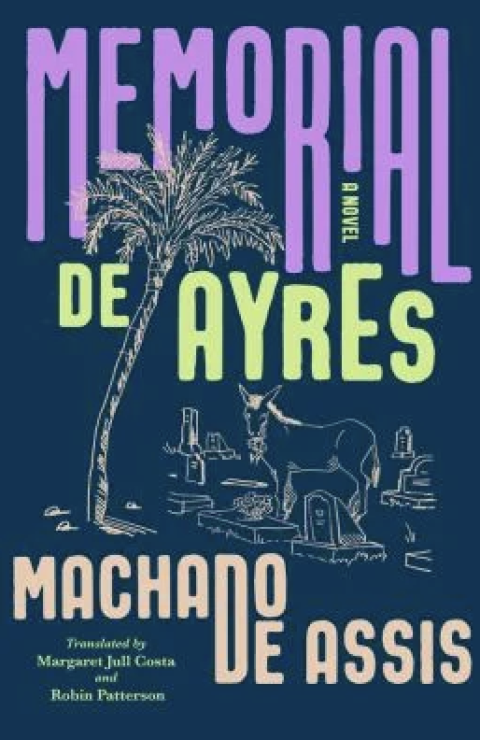 Excerpted from Memorial de Ayres: A Novel. Translation copyright (c) 2026 by Margaret Jull Costa and Robin Patterson. Used with permission of the publisher, Liveright Publishing Corporation, a division of W. W. Norton & Company, Inc. All rights reserved.