on Safe Rooms, poetry by Rae Armantrout
In his essay on Rae Armantrout’s poetry in Lyric & Spirit (2008), Hank Lazer strives to describe the lyric effects of her work: “Obliquity. That kind of swerving? As mathematical, at angle. A reticence, an ethical reticence, perhaps as with Oppen, in the pursuit of a kind of integrity, a clarity, a clarifying which bears a relationship to truthfulness, though Rae, unlike George, does not proclaim it so.” At the time of Lazer’s essay, Armantrout had produced nine collections; they now number nineteen, with new books having arrived every two years since.
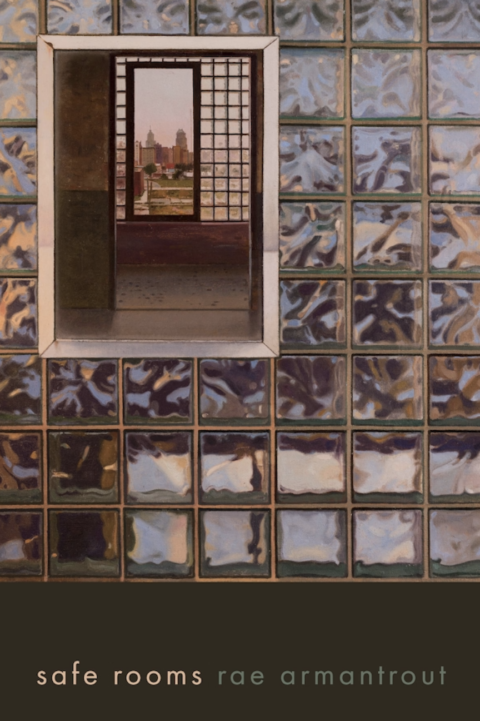 Armantrout’s poetry involves, in her words, “an equal counterweight to assertion and doubt,” a poetry that “points two ways then vanishes in the blur of what is seen and what is seeing, what can be known and what it is to know.” There is presence, but no heroic expressiveness. There are declarations, but nothing is decided. There is beauty, but not in the bloom of emotion – you’ll find it instead in the material substance of the language and her precise shapings of it. There’s a comedic verve, casual and unpredictable behavior dressed in a neatly trim wardrobe. Or as she put it, “… clarity need not be equivalent to readability. How readable is the world?” Moreover, she writes with a full awareness of the maneuvers at play. In “Jitters,” a poem in her new collection Safe Rooms, she writes, “Am I on the fence / or am I hiding, // playing hide-and-seek, / keeping my options open?”
I think of Armantrout’s work as a multi-decade enchantment with the process of cognition as she encounters our culture and tangles with popular notions. Book after book, there seems to be no concern about “developing” the art. The planet’s lifeforms change and degrade due to bad human behavior, but do they actually “develop”? Do we? Maybe it’s better for the planet and us if we just try to pay attention. Armantrout uses her senses to bring us to our senses.
Déjà vu
“Like calls to like.”
In the dream I knew I’d seen these
dripping, hangdog faces
in a dream before –
first in a mural,
then as figurines
on a bookshelf.
“Before” as metaphor.
As if recurrence meant more to me
than the faces themselves.
*
“Recursive self-locational processing
generates the awareness of self.
In cog sci as in horror flicks,
“the call is coming
from inside the house.”
(The extra space between stanzas reflects Wesleyan’s bespoke specs for Armantrout’s poetry.) One can quote sections of Armantrout’s work to underscore this or that tendency or to quote her on a topical subject, but because she likes to leap about, no segment by itself can indicate the flow of her poem’s impulse or specify a broad point of view. Most of her poems comprise packages of words, as if she goes shopping for notions and returns with the goods. The notions refresh consciousness — that’s her generosity. What I do hear in Safe Rooms is more preoccupation than in the past with assessment, a life lived (she’s 79), and inveterate thinking. Maybe even more impulsiveness, late style immediacy, playful cheekiness.
Calendar
When you’ve been around
the calendar this often
you start to feel bullied,
asked to pay attention now
to spring’s teed-up flowers
like they were really new
and not the reenactments
that you know they are.
In the old script,
spring’s a girl
about to go to hell –
but “one thing at a time”
we’re told.
No skipping ahead.
 Take a long look at Armantrout’s output and you’ll find she has been doing much thinking on our behalf about habits of thought, troubling herself over our mutual enthusiasms and habits. You’ll recognize a fellow puzzler therein. Or as she writes in “Choices,” “There’s nothing so perfect / as the perfect substitute” — a perfect apothegm that disperses into my brain before I’ve turned the page.
Each of the poems in Safe Rooms may be a space for exercising the freedom to name what is happening in the world, but there’s no safety on offer, no separation of poem and reader from our inevitable mayhem, as underscored in the opening lines of “Safe”: “All the old stories say Don’t / because we always do.” They say the monoculture is no more, but that’s just a matter of choosing which podcast you listen to. Armantrout’s poems suggest we come from a common gene pool of bunglers. She’s not in the business of trotting out her progressive bona fides:
Vampire Problems
It took us just sixty years
to slurp up the Ogallala Aquifer.
Poets keep asking, “What
if poetry won’t save us?”
It’s fun to say “Whaat?”
I taught my granddaughter, Renee.
Now she’s ready for first gtrade.
But, seriously,
we needed that water
for alfalfa.
Isn’t it great how
things we don’t expect
still happen?
With a mother who was an evangelical Christian fundamentalist, Armantrout grew up feeling the weight of dogma. “Religion has given me a taste for ultimate questions,” she said in an essay titled “Cosmology and Me.” Inquisitiveness entails a process, and there is certainly something procedural in her mode of work, a practiced technique that yields not measurable results but strangely gratifying micro-raptures and tart commentary. The pleasure of catching a glimpse. The world of Armantrout’s poems is reliably ephemeral; the process of perception there is swift. For years I’ve enjoyed surrendering to this world of speculation, and thus to my own. “What supports us / is flimsy. We’ve / come back around / to that idea” (“Mid-Century Modern”).
Published by Wesleyan University Press on August 11, 20926, 128 pages, $28.00 jacketed cloth/ $16.95 paperback/$13.99 Ebook]
To read three new poems by Rae Armantrout, published On The Seawall (January 2026), click here.
⟐ ⟐ ⟐ ⟐ ⟐
on Diary of Small Discontents: New & Selected Poems 1974-2024 by John Yau
Reviewing Robert Creeley’s Life & Death in 1998, John Yau wrote, “In his renunciation of the poetic, he has not only exposed the presumption of the oracular, prophetic thrust of American poetry, but he has also rejected the romanticist notion that the poetic self is a more sensitive, more elevated state than that experienced by the ordinary individual … ‘I know I constitute only a meager voice and mind.’ This isn’t modesty, it is wisdom.”
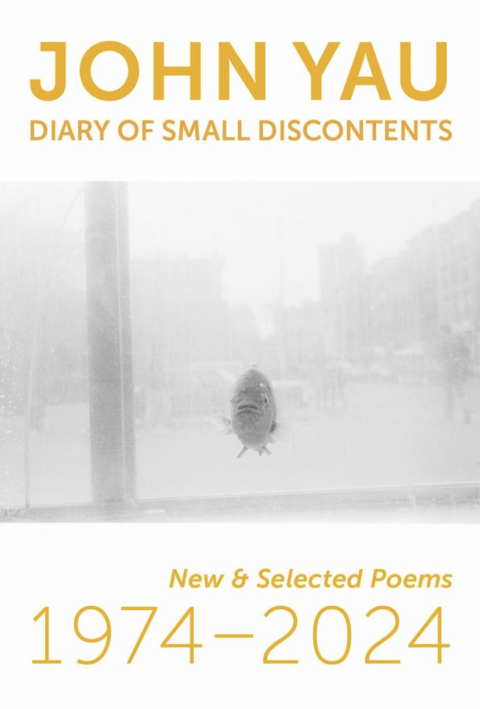 All of this pertains as well to Yau’s five decades of work – even as his approach to “the poetic self” is idiosyncratic and multifarious. He spelled out his preferences during an interview published in Brooklyn Rail: “How many different ways do you exist in the world and in your imagination? How many different voices, intonations and expressions do you hear? Can you listen to them all? In poetry, there’s this thing called voice: it’s about being sincere or transparent. I’m not interested in that.” Billie Cherinicoff, whose essay “1st Person Singular: The Lyric Eyes of John Yau” appears in the new collection Precious Beetles: Writing on John Yau (Three Count Pour/ Selva Oscura), names some of those “different ways” in which Yau comes across: “An astonishing proliferation of selves, souls, psyches, egos, shadows, mirror images, spitting images, wraiths, specters, emanations, body doubles, understudies, previous incarnations, evil twins, and dead ringers.” These aren’t personae; they’re fluctuations, shifts in register, various visions emanating sound.
Music From Childhood
You grow up hearing two languages. Neither fits your fits
Your mother informs you “moon” means “window to another world.”
You begin to hear words mourn the sounds buried inside their mouths
A row of yellow windows and a painting of them
Your mother informs you “moon” means “window to another world.”
You decide it is better to step back and sit in the shadows
A row of yellow windows and a painting of them
Someone said you can see a blue pagoda or a red rocket ship
You decide it is better to step back and sit in the shadows
Is it because you saw a black asteroid fly past your window
Someone said you can see a blue pagoda or a red rocket ship
I tried to follow in your footsteps, but they turned to water
Is it because I saw a black asteroid fly past my window
The air hums — a circus performer riding a bicycle towards the ceiling
I tried to follow in your footsteps, but they turned to water
The town has started sinking back into its commercial
The air hums — a circus performer riding a bicycle towards the ceiling
You grow up hearing two languages. Neither fits your fits
The town has started sinking back into its commercial
You begin to hear words mourn the sounds buried inside their mouths
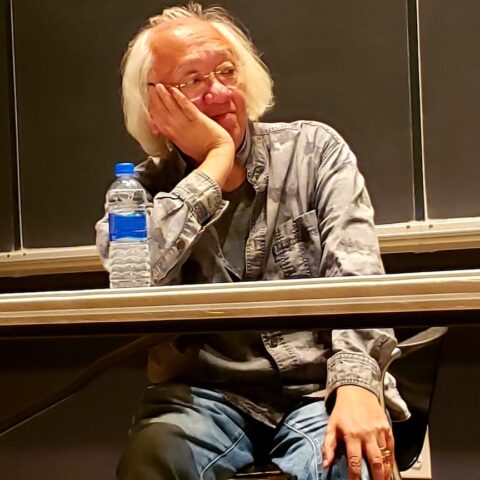 We’re well supplied with volumes of poetry by children of immigrants spoken to potential empaths. Yau was born in 1950 in Lynn, Massachusetts to Chinese émigrés, but if he portrays a condition of adversity, it is because neither English nor Chinese “fits your fits.” There is no lack of cultural or political disruption in his work, but he is not in the habit of prescribing fixes or even intimating that there are any. In the lyric prose of “Firefly Promises,” he writes, “Sympathy wasn’t what we wanted. That‘s what everyone asks for, a quick salve to bathe the deep ruins. It was as if all we wanted to do was start at the beginning and talk. Is such a beginning possible?” A Yau poem is its own preparation for finding a route to itself, sometimes declarative on a tilted field, or provisional within observed scenes, or resorting to surreal namings by the weirdness of actuality (“You just can’t pay less than full attention to huts made with a radial arm saw”).
Yau’s variable selfs entail variable forms; each form offers transportation toward the observed world, even if how far we can enter that world is in question. I don’t mean to suggest that Yau picks a self off the shelf and then organizes a poem around that self’s “voice” or identity. In the world of these collected poems, the force of historical, social and political relations, bearing down on the language, is the key determinant of expression and its materials. There are no Yau poems that purport to recall a fixed moment, to convey a remembered experience, and draw some significance from it. Instead, the making of each poem is a fresh venture. At the outset of “From My Adventures in Monochrome,” he mentions a “fundamental self,” but it isn’t a personality, and has perhaps been invented for one-time use only in this poem:
My fundamental self is at war with my multiple personalities
I love everything that does not belong to me, which is to say my life
But I despise everything that belongs to me:
education, inherited psychology, physical attributes.
In short, anything that is me because of exterior circumstances
Yau is also one of our most illuminating and dogged art critics, writing frequently for Hyperallergic. Diary of Small Discontents includes some of his poems on artists, such as “A Painter’s Thoughts (3)” which begins “All decisions are made for visual reasons.” His poems, applied down the page and, unlike conventional poetry, not made for performance, are also based on exclusive reasons. From the beginning of “A Painter’s Thoughts (1)”:
I want to paint in a way that the “I” disappears into the sky and trees
The idea of a slowed down, slowing unfolding image held my attention
Variations on a theme are of no interest. A bowl and a cup are my ideas.
I want my painting to be what it contains: it should speak, not me
The collection’s title says Yau’s discontents are small – and on the few occasions when they are specified, the aura is comedic (“Why isn’t there more meat on this chicken. / It’s as if the damned thing began starving itself / once it knew what the future had in store for it” – from “Domestic Bliss”). But there is something in the culture that doesn’t care for Yau’s I-lessness, a force that evokes in the poet something more active than mere discontent, a force that necessitates an utterly free counter-response. From “Chinatown Blues”:
Stop reminding me I have to watch what I say
Be polite or I will have to pay and pay
I am still going to grow and be a hatchet man
Doing the sharp and shiny things – being the very best I can.
[Published by Omnidawn Publishing on October 6, 2025, 250 pages, $23.99 paperback]
To read John Yau’s poem “The ABCs of ‘Of'” (On The Seawall, 11/2018), click here.
⟐ ⟐ ⟐ ⟐ ⟐
on Surety by Anna Zumbahlen
 George Oppen directed our attention to the polestar when he wrote these lines: “The self is no mystery, the mystery is / That there is something for us to stand on” (“World, World”). He wasn’t asking us to expunge our presences from — nor just to describe the world in — our poems. But there are critical choices to be made at the core. As Jack Spicer specified, it is more question of whether a poet thinks of oneself as a radio receiver or a transmission tower.
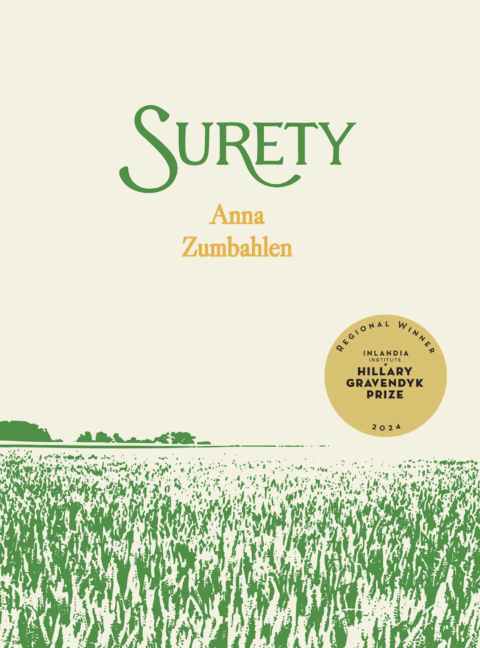
Anna Zumbahlen’s debut collection Surety enacts an extended query into an intermediate zone. She doesn’t hesitate to make personal statements, but they tend to dissipate or merge into the surround. Those statements aren’t assertions but assessments that give way to a sense of the world, an effort to see it. Here’s the first stanza of “July” –
It took some searching to know I was made
to stand humid summer, shrill and grown.
That I sounded defended.
That my acts are deliberate and burning
and neat. Water keeps a memory of the shape
it’s taken and fights to return.
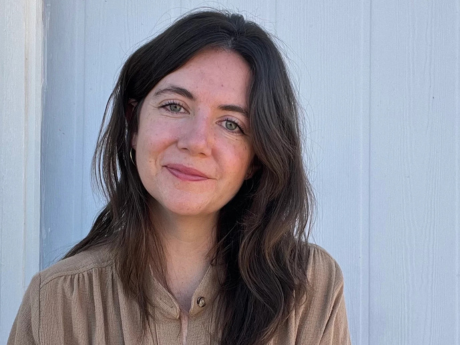 There is admission here that considers and dismisses its own defended sound. Even so, Zumbahlen perceives that forces of nature, such as water, don’t give themselves away. That leaves the poet somewhere in midstream – neither a transmission tower desirous of “mattering” nor solely deployed as a receiver. Something crucial to experience is in process, and the process occurs in austere language. The poem appears as and sounds to me like a ceremonial patterning that seeks to find what is sayable, and concludes —
This was a personal weather.
Rain at the expense of rain.
The tone shifts –
a thing that happens and can be ordered,
though not prevented, this problem
of discerning feeling from experience.
Sequences, short lyric prose, short and long poems – Zumbahlen writes with a questing, provisional intelligence, open to chance while conscious of the very limits that must be tested. There is no “surety” except the certainty of incertitude. Still, the spectre or memory of surety exerts an influence – while clearly the “I” is losing ground to other dynamics. Here’s the two-line poem “April”: “In the mirror I could not meet my own eye. / How many sides does a stop sign have. Count them.”
[Published by Inlandia Institute on April 1, 2026, 100 pages, $17.00 paperback]