In 1948, the prestigious Argentine literary journal Sur serialized Silvina Ocampo’s novella El Impostor, in which a young man named Luis strives to befriend 18-year old Armando. Armando’s father has secretly sent Luis to determine why his son has isolated himself on the family’s rundown estate southwest of Buenos Aires, but while the fear is that Armando is heartbroken or battling addiction, the truth and its consequences are much darker. Luis is actually Armando’s alternate personality, and the majority of the novella is taken from a notebook that Armando wrote from Luis’s perspective. El Impostor was Ocampo’s first lengthy work of fiction, and while she went on to publish a half-dozen novels, she remains best known for her short stories and especially her poetry. The only real criticism of El Impostor is that, despite its length, the clever twist is rather one-note. There are no clues that Armando is dissociating or that the story is mostly an alternate reality. Ocampo pulls the rug out from under readers, and nothing can really be gained by poring over the narrative to try and ferret out exactly how it all fit together.
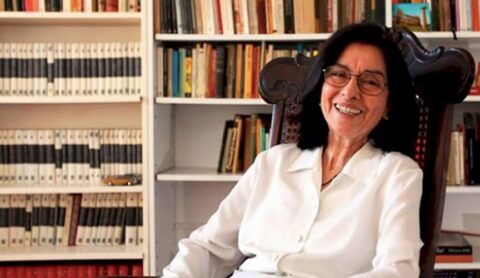
Vlady Kociancich was only seven years old when El Impostor came out, but 34 years later, the first lengthy work of her own writing career, a novel titled La octava maravilla, would portray divergent, alternate realities in a manner so well crafted that readers are left wondering what exactly really happens in the story. And if you don’t believe me, take it from Ocampo’s husband, Argentine writer Adolfo Bioy Casares, whose introduction to the novel’s first edition in 1982 classified La octava maravilla as the exemplar of speculative fiction built on “logical, extraordinary, or impossible constructions that are often adventures of the philosophical imagination.” That Kociancich should have produced such an intricately surreal novel is perhaps unsurprising given that her English literature professor from the time she was 16 and began university was none other than Jorge Luis Borges, who became a lifelong friend and collaborator, as well as her entrée into the stratospheric literary circles of Buenos Aires that would not only shape her life, but inform her fiction.
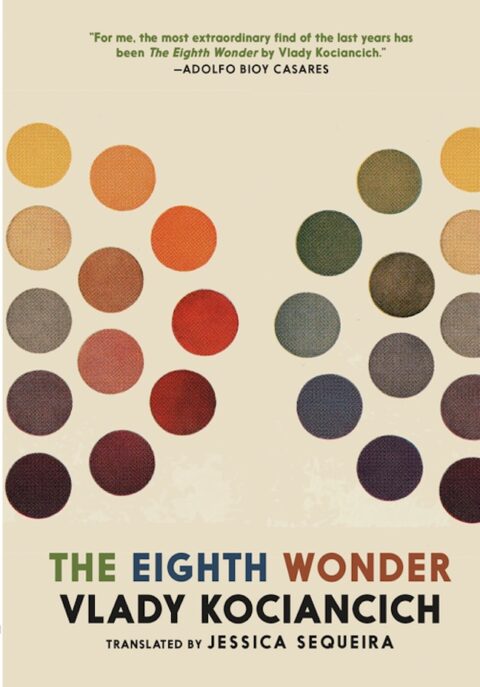 Kociancich died in 2022, and for her entire life, the only one of her six novels and four story collections accessible to English speakers was a 1991 translation of her sophomore novel, The Last Days of William Shakespeare. That shortcoming has finally been addressed with The Eighth Wonder, as Kociancich’s engrossing and delightful debut is titled in Jessica Sequeira’s new English language translation. The novel is narrated by 34-year old divorcée Alberto Paradella, a self-described “coward” who is troubled from the start: “I write with anguish, split in two: as the man who needs to write this story to understand his own story, his own life, and as the man who needs to hold that girl close, to go on living.” That girl is Alicia Martínez, “tall, naked” and blonde (the novel uses the -e spelling of blond for women). Alberto apparently picked up Alicia at the train station the day before, though he has no recollection of why he was there. He’s also confused by reports detailing early acclaim for The Life and Work of Francisco Uriaga, a film for which he believes he wrote the screenplay, despite there being no mention of him in any newspaper articles. And over the next few days, Alberto is further stymied by his estranged wife, Victoria, hanging up on him after furiously claiming not to “know any Alberto What’s-Your-Name,” and his best friend, Paco Stein, staring directly at him through a café window and not reacting when Alberto greets him.
As becomes increasingly clear throughout the novel, Alberto is unmoored, and readers will soon find themselves just as thrillingly bewildered. Alberto’s dislocation may be temporal, spatial, or both, and he gets contradictory advice as to what’s going on. Alicia tells him, “There is always time … what comes to an end is the place.” And a character referred to solely as “the madman” — who may actually be Alberto’s dissociative personality — tells him, “Just like everyone, I have all the time in the world. What’s in short supply are the places where you can go.” As for his foray into filmmaking, whatever the truth of Alberto’s involvement, movies themselves are posited as journeys of both time and space that have “no reality at all.” This explanation is put forth near the end of the novel by Safet, Alberto’s “prosperous Istanbul travel agent” who suddenly appears out of nowhere as an enigmatic nurse and minder. Safet explains that for his people, whether he means Turks or some secret society or movie club is never specified, cinema is “the eighth wonder.”
The bulk of the novel takes place in flashback, starting in earnest as Alberto is finishing law school. He’s having nightmares and is panicked at the pressures associated with becoming a lawyer,. To ensure that he’ll have ample free time, he tells friends and family at his graduation party that he’s writing a novel. The announcement is greeted with rapturous, respectful praise; his mother even bursts into tears. It’s a ridiculously comic scene, and introduces one of the funniest throughlines in this mordantly funny novel, which is Kociancich skewering both the writing life (“Literature is the art of the poor.”) and the legal profession (“When I was half asleep, they tolerated me; when completely asleep, they congratulated me”). Alberto never starts his novel, but he does copy out a book of proverbs, translate Joseph Conrad, and eventually take over Paco’s job with the Latin American Tourism Association (LATA) writing articles that contain “convincing descriptions of countries never visited,” passages taken “unscrupulously from foreign magazines,” and nothing “disagreeable or irritating for our clients.”
Alberto’s sham artistic single-mindedness eventually alienates Victoria, and so he enlists his wife’s friend Anastasia Blobsky, “a poor fat woman without a man who arranges herself as best as she can to conceal her solitude and failure,” to entice an artsy crowd of “beautiful people” into partying at his and Victoria’s home. This group is a disruptive, moveable feast (knowingly introduced immediately after a brief discussion of Ernest Hemingway), and yet another vehicle by which Kociancich lampoons the artistic community, as when Alberto discourses on how they reveal to him the similarities between “snobs and Nazis,” groups that both “share the same blindness to the dimensions of reality.”
Most everything and everyone in the novel can be considered through divisions and the liminal spaces where these dualities bleed into each other. Whether these echoes are real or Alberto imagines them is never certain. Consider the balcony that features so prominently in the novel. It’s introduced in loving detail as part of Alberto’s childhood home, the spot from which he peruses the surrounding Villa del Parque neighborhood and even loses his virginity at age 14 to a married woman who climbs over from her own adjoining terrace. Years later, Alberto’s also standing on seemingly that same balcony transposed to a boarding house in Berlin when he gets caught in a sudden downpour and becomes instantaneously sick. This illness either leads to several days of sleep, which may or may not actually take place in Vienna instead of Berlin, or a productive delirium, during which he secures or imagines securing that screenwriting gig.
 Berlin in the 1970s is of course the ultimate symbol of division, between the two halves of the city, the country, and the West and the East writ large. It also seems like more than a coincidence that Berlin’s iconic Brandenburg Gate is topped by a statue of the Goddess of Victory, otherwise known as Victoria. (I will admit that this realization made me feel that I was perhaps falling too deeply into the novel.) The existence of both Victoria and Alicia often seems to confuse Alberto, despite them looking nothing alike — Victoria is petite with black hair, Alicia is tall and blonde. He doesn’t even really buy Alicia’s name. “She is the least Alicia Martínez you could imagine. On the tip of my tongue, I have a name for this woman, but I can’t manage to articulate it.” On the lone occasion that Alicia puts on clothes, she’s described rather like the Virgin Mary, wearing a “pale blue” dress with a “vaporous” skirt that gives her the appearance of “a celestial cloud,” a description that also evokes Victoria’s ceramic angels—“pot-bellied boys with yellow hair and blue wings” — that she mass produces during her artistic phase with the “beautiful people.”
Sequeira handles dialogue particularly well, starting with the all-purpose Argentine interjection “che,” which she welcomingly leaves untranslated throughout the novel. Anastasia’s “linguistic muzzle” of using “like,” as if she were a 1980’s Valley Girl, also feels authentic. Overall, however, the translation is often oddly and distractingly literal, with phrases such as “in what lasts a blink,” “the step marked by the boots,” “hammocked by the routine shout,” and many, many others that would have benefited from a more idiomatic treatment.
For such a fantastical novel, The Eighth Wonder is also rather biographical. Kociancich, like Alberto, wrote for a tourism magazine and translated Conrad, specifically The End of the Tether, the same novel that Alberto works on in The Eighth Wonder. Sequeira discusses Conrad’s influence on Kociancich at length in her informative translator’s note at the end of the novel, and also mentions Ricardo Wullicher’s 1978 film Borges para millions (Borges for Everyone), for which Kociancich cowrote the screenplay. The film that Alberto works on in the novel is also about a writer, but the Indigenous Nicaraguan poet Francisco Uriaga may not be real. When Alberto asks the film’s director if Uriaga is a hoax, the director says, “what do I know.” And when they start watching the extensive footage of Uriaga purportedly reciting his poetry, all they hear is the word “SHARK,” before the sound drops out completely.
One scene that I kept returning to comes almost exactly halfway through the novel when Alberto sneaks away from a party with the beautiful people at his home and into his building’s courtyard garden. When he and Victoria were shown the home as prospective buyers, Alberto had heard “a long, sustained complaint,” “a lament of pure sound” coming from this garden, causing him to remark to himself that he “had no doubt it came from solitude and madness, impotence and horror.” The evening of the party, Alberto suddenly notices that sitting beside him in the garden is “the madman,” who tells him that they are the only two people who ever come there and that he uses his time in the garden to “travel.” At various points in the novel, Alberto refers to himself using the words madman or mad. When he’s first panicking about being a lawyer, he worries about being “out of the house all day, working like a madman to earn money and buy a car and a house in the country.” In a sequence that may or may not be a dream, Alberto returns to his apartment in the wee hours after roaming the neighborhood and discovers that the madman is with him in the elevator. And when Alberto first lays out his confused state to Safet, he tells him maybe you “see me as a madman.”
Everything that comes after the novel’s garden scene can be read in multiple ways, and Kociancich seems to invite that uncertainty. She even has Alberto lament, soon after taking over Paco’s job, that “Reality never adjusts to our dreams.” There are a couple moments during the height of Alberto’s delirium late in the novel when he reflects on his surroundings in a way that made me think of the iconic Kaiser Söze reveal at the end of 1995’s The Usual Suspects. But whereas the film’s director can control the viewer’s focus as Agent Kujan looks around his office and notices the inspiration for everything Verbal Kint has told him, Kociancich leaves it up to readers to determine if they think Alberto is remembering his past, imagining his future, living his life, or simply sitting in a garden that he never physically leaves. You might see Alberto as someone ruined by heartbreak, a well-intentioned “egoist in love, who waved his hands about trying to grasp, in any way, the woman who was leaving him.” You might seem him as someone who never fully recovered from a severe fever while on vacation. Or you might see him as a dreamer, someone perpetually wrestling with his mental health, trapped in his mind, “pleading for the gift of a drop of human tenderness” when he’s finally out walking the city streets with Alicia near the end of the novel. Whatever your interpretation, Kociancich concludes on an upbeat note, with what I take to be a subtle homage to Camus’s The Myth of Sisyphus: Alberto, like the doomed Greek, has found happiness despite his reality, and that’s a true wonder in our wildly challenging world.
[Published by Seven Stories Press on August 18, 2026, 320 pages, $21.95 paperback]