Ampersand Organ by heidi andrea restrepo rhodes is described on Milkweed Editions’ website as a collection of poetry. More specifically, it is a single recursive piece: 224 pages of a continuous, winding prose poem that, even on the last page, seems intent to continue. Part diary, part philosophical reflection, part ode to just about every writer who has come before, this is an animal of a book. The poem’s fragments are unnamed, although they are separated into shorter “lyric formations” which rhodes calls “ampersands.” In place of almost every and that would exist in the book is an ampersand, elegant and tentacular, keeping pace percussively as the writer ruminates. Even the footnotes citing other writers are organized by identical ampersand superscripts, which do little to elucidate what’s gone where. The article replacement and the intentional ambiguity serve as the only literary rules rhodes cares to follow. The rest is deconstruction: “Rebelling against its own absurd reduction, which cannot always parse into parts apart.”
rhodes, a self-described “creature of the Colombian diaspora,” is a professor of feminist, queer, and disability studies — and is likewise feminist, queer, and disabled, facts inseparable from Ampersand Organ. The complex fractals of identity appear frequently, not as motifs but as form. The prose poem becomes something of a jar of flitting flies as the English language, via rhodes’s stewardship, jumps, frolics, and transforms. They write:
& mirror para-ontologies mean I morph with the hours, a glassy high tide body echoing nanometric wavelengths. Always adjacent to, always with. Consecration of the gods taking up residence in form (what music they require to be hosted well), sacrosanctification of all my bodies all my brains. So many times I wore your wearings to weave me into one. I try you on & gauge the fit until I can make it my own. Now, a quietened knowing of rites stirs. Rights are willed, but ceremony is ever willing. Little arctic flowers wandering down the latitudes, making mystics of us in the wells of the wayside. So many gods so many gods so many gods & isn’t it just that we’re learning their musics & isn’t it that we know them ever in our deep?
The poetic is syntactic; the syntactic is poetic. If a queer feminist can see past the film of heteronormative patriarchy, and if a person with autism can see past neurotypical convention, and if a disabled person can see past obstacles intended for the able-bodied, then so too can the queer, feminist, autistic, disabled poet echo these “nanometric wavelengths” into flexible form. These identities are included not only to be rattled off. In offering an alternative perspective to the accepted structures of our world, they produce a fluidity of language. “& that is how we poetry,” rhodes proclaims. Later, they call this poetrying “[t]ransmissions of living matter. Percussing genders. Slapping feet into the hollersong unfurling from my lung …” rhodes relies on the sound of the poem and alliterative and the vocalic qualities of its words (both constructed and available in the dictionary) to make Ampersand Organ feel almost like an extended soliloquy.
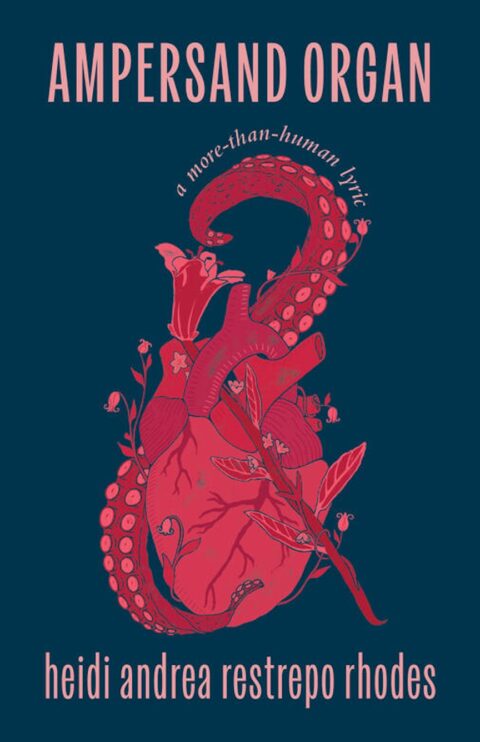 Each ampersand-form begins with an ampersand. This has the effect of making the book sound like a breathless explanation-slash-story-slash-song punctuated mainly by gasps of breath and page-turnings. An example, early on: “& my heart is a nebula my heart is at the edge of the Milky Way my heart is in your throat & at the bottom of the sea. & you are my heart & you are my heart &.” Their “devotion to an ampersand organ,” states rhodes, is “[r]evelry, revolt.” The ampersand itself, when read continuously, ceases to sound like and and becomes, simultaneously, a gasp, a laugh, a gestural flourish, and a bout of silence. It looks — rhodes notes — somewhat like a heart, the aorta heading up and the vena cava dipping low. The heart is thus an important symbol throughout, just as biological (“Quantum biologist Dr. Catherine Clinton, you tell us that the heart’s electrical amplitude is one hundred times greater than the brain”) as it is spiritual (“Echocardial. A heart sounding in another heart. I feel you. I feel you feeling me”) as it is gruesome (“& in the dream we were monsters with morphing monster heads & we sank our teeth into each other’s anatomical heartmeat still beating in our hands”). The heart, as ampersand organ, produces infinite circles of thought, feeling, and poetry.
rhodes does not play with form for the sake of it. This is calculated rebellion. The indissoluble weight of the poet’s intersecting identities informs how they feel about poetry as a whole and, therefore, how they choose to wield it. When they write …
Stave off fascism’s wight, its chain-froth & choke. Nearby, the Marines rehearse their war, marinating in fear tactic. Drop practice bombs close enough to message our cochlear tangle: we too, at the center of empire, are fragile as fuck. We know this & still.
… they do so not merely as a feminist, a queer person, or an American. Every aspect that creates their individual humanity braids in endless increase, and it’s at the center node that the poet exists. rhodes, whole and involute, describes “[a] caress that is a disruption, a disturbance of perceptions of form. No mastering. No masters” — neither of culture nor of tongue.
 Within the book’s dense, ampersand-filled plaits of language are lexical nods to those existing on the margins. For instance, members of the queer community occasionally use the words queer and trans as verbs. Internet jargon has posters facetiously refer to queering various spaces (a jab at how progressive media sometimes highlights queer influence on industries, without much substance or capitalist critique) or transing people or things (an in-joke poking fun at conservative belief that transition can be externally inflicted on a person). rhodes uses both verbs, but without the droll eye-rolling of a Gen Z netizen. Earnestly, they write, “For vibrational existences do queer my edges,” and, “I grow & trans by your touch.” It’s refreshing. Earnestness, in the era of the Internet, is often seen as frighteningly vulnerable, rife for mockery. rhodes uses the words to express the inexpressible, to show their internal joy to a young queer readership weighed down by jadedness. It’s “[v]exy, transy, complex, ante-.” Encouragingly, they insist, “& our bodies are bustling with anarchic possibilities, both devastating & solidarity to our untame.”
The world restrepo reimagines through their literary meanderings is sincere, jubilant, and delightfully eccentric. They lovingly muse, “& to be queer & brown & restfully crip in the crevices of the moon. In second planet winking in the sand. In your arms animaling me into bed. Safe harbor, the hottest. To find the quiet amidst the clamoring of harms alarming in the news.” It’s an oasis someplace past the cruelty of our own world, a place where “this no-thing some call God is a stuttering, masking autistic who knows we cannot handle the music of a wilding face” and “the temporal regime of capitalism” is nonexistent and so cannot deem “any crip’s slowslow a ‘waste’ of time.” Here, there are no structures but the ones the heart creates, and there are no humans that are not animals. rhodes writes, “Grow back thick hair where girlhood rushed it out. Grow back that low rumble in my throat, which does know itself to be a bear.” Through use of recursion, they refuse to allow their poetry to be boxed in. The poem extends boundlessly off the page, becoming a lifeform, slithering and barking and snapping its teeth.
Even the ampersand itself, its name a mumbled corruption of the phrase “and per se and,” is interminable. rhodes’s corralling of this beast, according to them, is “[a]mpersand organizing,” creating “[a] universe of ampersands. A lightning choreography of ecstatic. Synesthetic & sinuous wording of not-yets in these audacious & ochre vitalities.” The very last page ends fittingly:
Like you, my lovers collect trash, collage camouflage & fortune. & youth is a feeling & way into other ways. & geological time magnifies impermanence. In this, some will feel whittled to small. & some will remember the evanescent bouquet of fleeting & will ram their face into the lilacs at every possible uprise, breathe deep into the bowels of this everywhere shimmering everywhere &
But under this final ampersand-form are that page’s footnotes, adoring messages to the writers to which rhodes alludes. Ampersand Organ’s final footnote, referring to the quotation “In my end is my beginning,” reads, “Yes yes, T.S. Eliot, in my end is my beginning is my end is my beginning and”
It is from there, even sans ampersands, that the poem extends, disappearing into wordy wordlessness as the book concludes. In their quest to develop a form for the formless, rhodes succeeds, transposing the indescribability of a creature’s existence into an and-ing array of lively imagery. It becomes clear, by the end, that the world they’ve created is not a separate planet, or even a vision of one that could exist in the future. It is merely a reflection of our own seen through different eyes. To reach this point, restrepo says, one must “[l]ook inside the house of you, your cardiac fenestra: there are yearnings to warm by closeness.” Make no mistake: “Yes, it will hurt.” But — or, rather, and: “& yes, it will yes you into yes.”
[Published on August 11, 2026 by Milkweed Editions, 224 pages, $18.00 paperback]
To read Noelle McManus’ On The Seawall review of The Hormone of Darkness, poems by Tulsa Otta, translated from the Spanish by Farid Matuk, click here.