Frank Rosenblatt in Passing: The Rebirth of the Mimetic Impulse
“Every day the urge grows stronger to get hold of an object at very close range by way of its likeness, its reproduction.” — Walter Benjamin, “The Work of Art in the Age of Mechanical Reproduction
“To get hold of something by means of its likeness. Here is what is crucial in the resurgence of the mimetic faculty, namely the layered notion of mimesis that is involved- a copying or imitation and a palpable sensuous connection between the very body of the perceiver and the perceived.” — Michael Taussig, Mimesis and Alterity
*
It was an election day near the terrible mid-point of the Vietnam War, with Nixon ascendent facing a rising wave of passionate liberal Democrats like Eugene MacCarthy and Paul O’Dwyer. Change seemed possible. I was living in New York and two friends, father and son, both lawyers and very tall men of real commitments but easy charm, said: “Are you free? Come along. You’ll find it interesting.”
That’s how I ended up in the grand Park Avenue apartment of then mega-philanthropist (though now the sums seem risibly small) Stewart Mott. He had sponsored and was now hosting a large gathering of the National Committee for an Effective Congress. The younger friend’s then wife, also very tall, elegant and no-nonsense smart, was involved in organizing this gathering of donors, politicians and operatives. The NCEC was a powerful lobby founded by Eleanor Roosevelt and Maurice Rosenblatt. Young men and women were manning improvised banks of phones, taking calls from all over the country, recording election results and trends, and entering them in white ring binder notebooks. These were circulated to those most concerned: Stewart Mott, young, handsome serious was one; the other was Maurice, jokey, quick, with a kind of magnetic and unwavering intelligence. One could see why the women nearby were drawn to him. There was a jittery optimistic fervor.
My friend’s wife introduced me to a rather small, slight almost fragile man in his twenties. “This is Frankie Rosenblatt.” And she whispered: “He’s a genius.” Maurice glanced over as she spoke, a look of long-standing care and protectiveness. The evening swept along into an overall sense of loss leavened by the odd victory. Next day I had lunch with my friends along with Frankie and Maurice. I recall Maurice analyzing the election results, and Frankie listening. His head was a bit large, his neck slightly elongated which made him seem very fragile. He paid close attention to his brother but then his mind would suddenly drift elsewhere. What I remember about the two brothers was their mutual love and trust.
This was only one of the worlds I drifted in and out of in those years. But when recently I happened to hear James Dawson and Rena Mosteirin talk about their new book, Perceptron (Punctum Books) and its subject Frank Rosenblatt, it all swept in again. Maurice and especially Frankie, I could see them clearly. And that fleeting moment when we met, that too.
Perceptron is book with an unusual dual focus. Mosteiron’s poetry engages the inner aspect of Rosenblatt’s emotional life, while Dobson gives a full account of his intellectual development, academic career and social life. Taken together, this book is informative and particularly moving.
*
Frank was born in 1928 in the month after his father, Frank Ferdinand, died. This never to be known father was a Russian émigré historian, who spent his life as an activist for displaced Jewish laborers; he was, as well, a publisher, and the author on a wide range literary and historical topics. “A brave and honest man … [whose death] was a tragic accident,” as wrote an admiring friend. Frank then was raised in the shadow of such a loss by his mother, his sister Bernice and his brother Maurice, who were 13 and 12 years older, respectively. He experienced the strength that could come from improvised familial arrangements early on.
Frank was fortunate in attending the renowned Bronx High School of Science which has produced more Nobel Prize winners than any other secondary school in the US. From there, he went to Cornell University where he received his B. A., his Ph. D,. and spent much of his academic career. As part of his doctoral thesis, he designed and built a simple computer — the Electronic Profile Analyzing Computer — to process the psychometric data that were the experimental core of this work. Creating original computer hardware and software to advance empirical research became an intrinsic and even predominant aspect of Rosenblatt’s future projects.
Rosenblatt first worked at the Cornell Aeronautical Laboratory, then moved back to Cornell where he was the Director of Cognitive Systems Research in the Psychology Department, and later, an Associate Professor of Neurobiology and Behavior in the Biological Sciences Department. He held this position until his death in a boating accident on his 43rd birthday in 1971.
Rosenblatt had a wide range of sympathies and interests, but they all circled around the topic of how information, attitudes and beliefs were communicated from one being to another — that is to say: learning. The work for which Frank was best known was the Perceptron, a computer whose initial purpose was the recognition of specific visual phenomena and whose architecture was modeled explicitly on the mammalian neural network. This device was designed not just to achieve certain results but was itself structured as a way to understand the functioning of human perception more deeply.
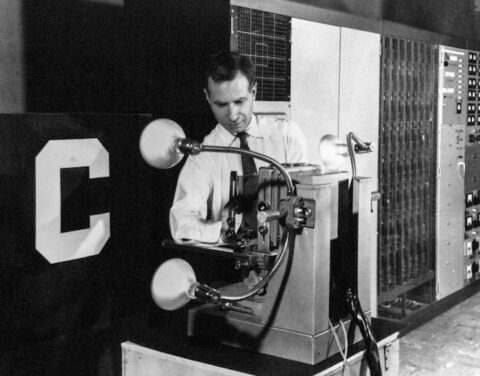 In the Perceptron, Rosenblatt was working to design a computer system (both hardware and software) to answer certain basic biological concerns: “1. How is information of the physical world senses or detected, by the biological system? 2. In what form is information stored, or remembered? 3. How does information contained inn storage, or in memory, influence recognition and behavior?”
Most computing devices of the time operated on explicit, human designed symbolic rules, such that data were formatted according to precise predetermined criteria, and the generalizations it produced derived from the application of precise, predetermined rules. By contrast, in Rosenblatt’s experiments, data, while encoded, were not structured in a fully predetermined way. Generalizations emerged from training, adjusting weights and valences in approximate patterns, to produce statistical regularities, which it adopts as parameters. While the former, then prevalent form of information processing was based on rule structured deduction, the latter architecture produces a kind of inductive, self-altering “learning.”
As Rosenblatt said: “Well, first of all let me say that we are interested in duplicating human learning. We are interested in determining the extent to which it is feasible to consider such a thing as duplicating human learning, or at least understanding how human learning operated.” And, to this end, he and his team set out to build “a machine capable of learning closely analogous to the perceptual processes of a biological brain.” As James Dobson explains: “Rosenblatt’s interest in a physical machine was motivated by his desire to have a system that did not simulate neural systems but enacted them, materially.” The implications of all this was not lost on the public at large. Rosenblatt explained in the Nyer: “for the first time a non-biological object will achieve the organization of its external environment in a meaningful way.” And he countered objections to calling this a ‘mechanical brain’ “a self-organizing system … that’s precisely what any brain is.” Hardly surprising then that headlines responding to the announcement describing the Perceptron said: “Shades of Frankenstein.” This exuberance was no doubt supported by Rosenblatt’s statements about the great range of perceptual and intellectual possibilities inherent in the Perceptron architecture that far transcended the kind of visual target recognition which the Navy who paid for all this envisioned.
There is, of course, something intensely alluring in creating a device that will replicate human capabilities and emulate our actions. Mechanical chess players, mechanical calligraphers, card sharps, fortune tellers and pianists; automata exert an almost magical kind of charm. This, despite their origin in the increasingly refined machine work of military hardware of the 18th century. Perhaps there is also a frisson of the forbidden as a shadow of transgression hanging over such an enterprise formerly considered the sole prerogative of a deity. But certainly, Frank’s wish was not simply to devise a new form of servant capable of carrying out assigned tasks. It was also to find a mirror in which we could understand ourselves in new ways and perhaps find thereby new capabilities and possibilities.
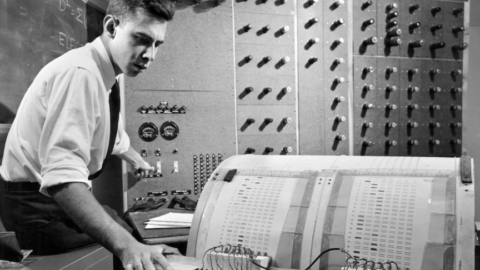 The algorithm operant in the first Perceptron, Mark I (now on exhibit in the Smithsonian Institute) was used in the construction of its successor, Tobermory, which rather than dedicated to visual perception, was designed to process auditory phenomena. This was a far more advanced neural network modeled on, as Rosenblatt said, “a cat’s visual cortex.” “It will not be long before these machines can be made to hold a conversation … For example, if you mention the name Polonius, the machine will launch into the finer points of Hamlet.” Though now they are seen as prophetic, such claims for the possibilities of neural network or a deep learning approach to computing elicited hostile and dismissive responses. The comparatively low cost of embedded technologies, combined with legislatively mandated cuts to computer research spending, obliged Rosenblatt to shift his focus from learning in inorganic to organic test subjects. This almost medieval line of inquiry bore no fruit.
Learning for Rosenblatt was not just of use or interest but something mysterious and fundamental, a capacity that enables sharing in groups and over time. Thus, he was concerned with how not just data points but broad understanding could be transmitted and received. This was clearly not only a utilitarian or scientific pursuit but something deeper and closer to what is most important in being a human. This curiosity led Frank into a multitude of interests as well as, obviously, to a great openness to a wide variety of people. He invited others into his laboratory and his home who were exploring the limits of conventional scholarship, science, and how continuity of understanding was achieved.
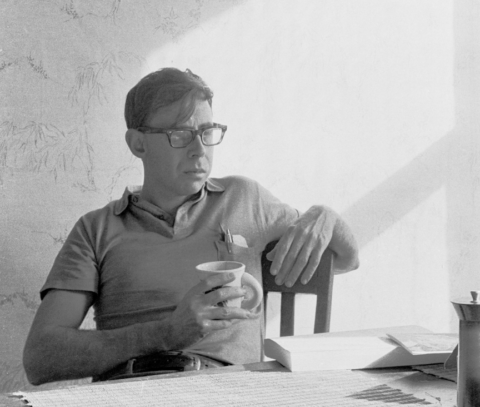 This was the beginning of a time of wide-ranging social experimentation. In 1961, Frank bought a brick farmhouse and promptly rented out rooms to people who came into his life. The house became known as Chateau Rosenblatt, and the residents were not just boarders; they were expected to help cook and clean, do repairs, paint the house, and participate in shared meals. More importantly, they shared their interests and discussed the topics and projects on which they were working. They also came together when Frank read from Alice in Wonderland, A Canticle for Liebowitz, Through the Looking Glass, and his giddy favorite, The Wind in the Willows. Eve Kosofsky Sedgewick, later a pathbreaking explorer of gender studies and queer theory, was one such resident and provided an inventory of those who passed through the Chateau Rosenblatt’s graduate students; old friends; young men who were or had been his lovers; partners, siblings, partners of siblings, and siblings of partners of siblings of the above categories; sometimes boys who’d run away from reform school farther upstate. Not counting thirty cats and a dysfunctional blue collie.” Over the years more than sixty people were part of this free-flowing, mutually supportive community.
In 1968, Rosenblatt suspended his academic career to work with his brother, Maurice, in organizing protests to the Vietnam war and supporting Senator Eugene McCarthy’s presidential campaign. Afterwards, he returned to Cornell and continued developing his theories of communication. On his birthday in 1971, he died in a boating accident. He was not known to have been much interested in writing poetry, but the following, “Courage,” was excerpted from a poem found among his papers.
Courage is to see dreams crumble,
And then shaking out he dust,
To dream again; to apprehend
The ambush hidden in the path
And still go forward; to explore
Within the hidden craters
Of you own desires; to submit
The working and creations of your mind
For public judgement.
And courage
Is to hope
When others have surrendered.
And courage
Is to face surrender
When others hope.
*
At the time of his death, Frank Rosenblatt’s work in developing the theory and applicability of the neural network had fallen on fallow ground. Now, of course, we recognize that what he explored and created are at the core of Artificial Intelligence, a technology that is globally transforming communication, research, design, economic modelling and the nature of work. Rosenblatt moved from a science based on statistical uniformities and digital abstraction to adopt a kind of mimetic method in which the structure of his computing devices mimicked the layered neurological structure of mammals. As Walter Benjamin once said: “the gift for producing similarities … and therefore also the gift for recognizing them, have changed the course of history.”
It is strange, this oscillation of utter neglect followed by world-encompassing influence. And even within that, Frank Rosenblatt’s name and work would remain known to very few without the work here of Rena Mosteirin and James Dobson. Perceptron is a book the restores the poetry, the complexity, the arduous endeavor, and the sheer élan of this extraordinary man’s life.
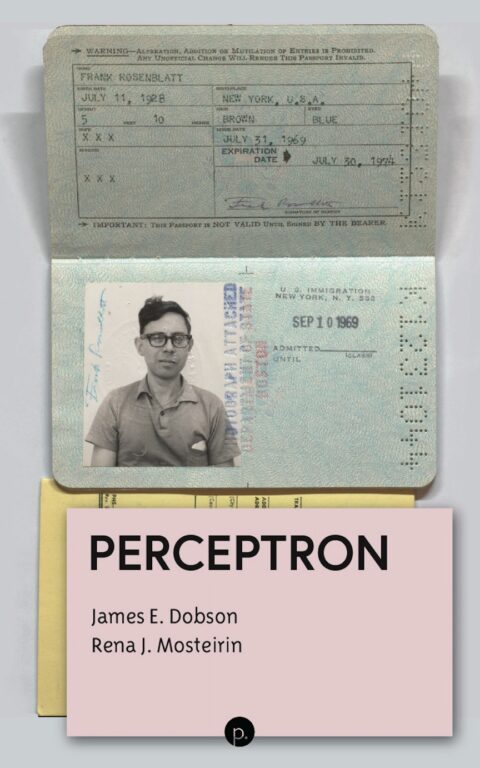 Perceptron by James E. Dobson and Rena J. Mosterin, published by Punctum Books on November 20, 2025, 174 pages, $23.00 paperback.