“Anything understood can be paraphrased,” Louise Glück once told the workshop I took with her at the University of Iowa. Hard to argue with that — partly because of Glück’s oracular confidence, one of her countless much-missed qualities. Writing about John Berryman’s poetry — especially the 77 Dream Songs — confronts the opposite problem: what can be said about what is not understood? Can the unintelligible be read intelligently?
Anthologists and commentators who select from 77 Dream Songs usually avoid the question, settling instead for the Songs most friendly to the procedures of close reading. The habitually recycled Dream Songs #1, #4, #14, and #29 have become as famous as Fifth Avenue. Roughly 30 others from that first volume — for all their deliberate swerves, gaps, and solecisms — repay patient attention, helped along by a gloss or three. And given the constant evolution of the aesthetic Zeitgeist, much in 77 Dream Songs that bemused, riled, or enraged readers in 1964 reliably amuses, terrifies, and comforts now.
I like to imagine Berryman’s delight at this outcome. I also wish I could ask him questions about certain Songs I’ve reread for decades, using all the commentary I can find, yet frequently coming away with the feeling that I’ve navigated a stranger’s nightmare. Of all those Songs that affect me in this way, “Dream Song #10” keeps its secrets most hauntingly — and, as I’ll suggest, perhaps most pertinently to our time. Inviting, disinviting, and unnerving, the poem’s murky atmosphere reveals a comfortless performance inside a mind at odds with itself:
There were strange gatherings. A vote would come
that would be no vote. There would come a rope.
Yes. There would come a rope.
Men have their hats down. “Dancing in the Dark”
will see him up, car-radio-wise. So many, some
won’t find a rut to park.
It is in the administration of rhetoric,
on these occasions, that — not the fathomless heart —
the thinky death consists;
his chest is pinched. The enemy are sick,
and so is us of. Often, to rising trysts,
like this one, drove he out
and gasps of love, after all, had got him ready.
However things hurt, men hurt worse. He’s stark
to be jerked onward?
Yes. In the headlights he got’ keep him steady,
leak not, look out over. This’ hard work,
boss, wait’ for The Word.
I know of no recording of Berryman reading “Dream Song #10” (Eric Johnson-DeBaufre offers a credible if cool reading on YouTube). Neither Daniel Swift nor Kevin Young includes it in their selections of Berryman’s poems; Paul Mariani leaves it unmentioned in his 1990 biography Dream Song: The Life of John Berryman — as does Berryman himself, at least in the ample selection of his letters published in 2020 — and no anthology I know of gives it space. The commentary it has received is scant: some A.I.-generated wordage online and a few brief mentions in unpublished dissertations. Anyone wishing to cross into this Song’s territory must do so alone.
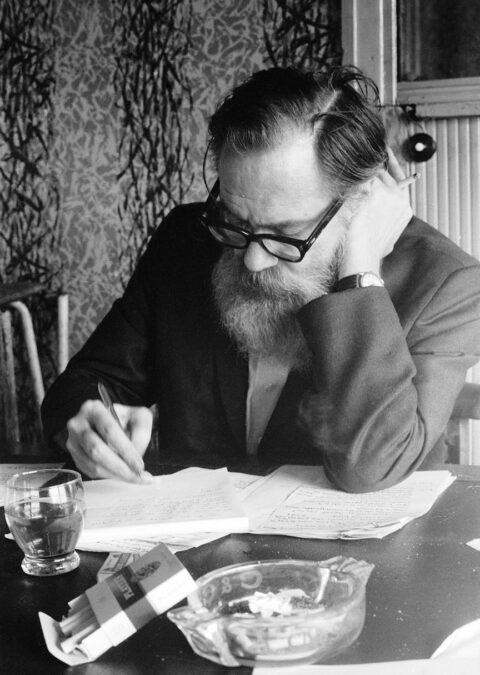 I’m disappointed that we don’t have “Dream Song #10” in Berryman’s voice. After all, no one performed Berryman better than Berryman himself. His opening remarks to a 1962 reading at Harvard — arguably his best and certainly his most sober — provide a thumbnail sketch of his prosodic rubrics for the Songs: “Each consists of three six-line stanzas; that’s eighteen lines [noted]; generally 5-5-3, 5-5-3, with various rhyme schemes.” With one crucial exception noted below, to my ear “Dream Song #10″’s end-rhymes affect the poem’s sonic texture inconspicuously, even subliminally. As for Berryman’s purported 5-5-3 stress pattern, the relative degree of each strongly stressed syllable varies so widely that the overall effect sounds closer to free verse. (Just two of its pentameters approach audibly iambic pentameter: [h]is chést / is pínched.// The én/emý / is síck; and gásps / of lóve, /after áll,/had gót / him réady.) No doubt there’s more to say about “Dream Song #10″’s prosody, but it’s not one of the Songs that sings. From here on, I’ll focus on what we can — or cannot — say for sure about the story it seems to tell, and who might or might not tell it.
The shadowy features of its presumably rural setting emerge in the first stanza. Men have furtively but routinely gathered at night, their cars parked on the rutted dirt (if they can find a space), their headlights left on, their hats pulled low. We’ll learn later that they have a “boss.” Into this mass of men a rope arrives, and in the light from one of the cars, its radio playing a popular song, an individual man is “seen up.” Exactly what has happened, what will happen next, and who does it to whom — we can ponder and surmise but can only know inexactly. Across its three stanzas, the poem deploys six third-person pronouns — and one covert first-person plural — but whether they refer to one or more participants remains anybody’s conjecture. Our inability to identify who’s who lies at the heart of the poem’s unsettling effect.
Readers familiar with The Dream Songs might make the educated guess that Henry, Berryman’s legendary antihero, accounts for at least one of those unmoored pronouns. Yet rarely in The Dream Songs is Henry not in some way named, identified, addressed, or implied. The absence of even a hint of Henry in this Song strikes me as conspicuous. If we consider Berryman’s frequent admonition to puzzled early readers that “Henry is dreaming,” then “Dream Song #10” might well record one of his dreams.
Its prismatic impression certainly suggests the illogic of a dream. Aside from the mob of uncertain antecedents, the poem is noisy with competing speech acts — assertion, confirmation, contradiction, demurral, exposition, interrogation, appeal, instruction — and replete with Berryman’s characteristic solecisms of grammar and syntax. And, well, parts of it simply don’t make much sense, to me at least. Yet for all these linguistic infidelities, the poem doesn’t cut and paste its parts into a collage (consider the teasing patchworks of #3, #19, and #32). Somewhere within “Dream Song #10″’s sinister night world lies a story — or (to coin some Berryman-speak of my own) a plot to fail to find.
Every 21st century reader I know agrees that”Dream Song #10″ concerns a lynching. For that reason alone it warrants scrutiny, given that it notes racial violence as few white poets of Berryman’s generation did. Yet if this horrendous subject matter seems clear enough, Berryman’s treatment is anything but. From the start its verbal instability fractures the picture it depicts. At different moments him, his, he, him, [h]e, and him could represent either victim or perpetrator, apprentice, bystander, or a shifting amalgam of all four.
Adding to the volatility, the pronoun is sometimes acted upon (“his chest is pinched”; “he’s stark / to be jerked onward”), sometimes active (“drove he out”), and at the poem’s end given a brief speaking role (“This’ hard work, boss”). Berryman flouts other norms of style: vantage points blur; syntax swerves, compresses, and cheats; and the diction oscillates between grotesque immediacy and rhetoric that intellectualizes — and sometimes aestheticizes — atrocity.
Do Berryman’s trademark oddities limit the poem to a sidelong glance at America’s dark historical facts, thereby pulling its punches? Or is a tortured style just right for portraying torture? Such questions, both inescapable and unanswerable, underline the stakes in Berryman’s effort to cast his characters as both victims and perpetrators, imprisoned in the agonized phantasmagoria of a nightmare’s interior morality play. Whether the attempt works or fails, what Berryman wrote about Shakespeare’s “Sonnet 144” holds true here: “Dream Song #10” is not kidding.
A morality play, of course, knows good from evil. Little in “Dream Song #10” comes across as ethically confident, starting with the evasively passive voice that speaks first: “There were strange gatherings. A vote would come / that would be no vote.” The ominous, indefinite plural suggests recurrence: these gatherings aren’t sporadic; they’re rituals. The paradox that follows — as much contradiction as paradox — evokes the pseudo-democracy of the mob, the pretense of collective decision-making without shared deliberation. In keeping with Berryman’s penchant for splicing local and national contexts — and his awareness of the widespread discrimination and racist violence continuing well into the 1960s — the mob rule’s cancellation of civic procedure echoes the brazenness of Jim Crow-era disenfranchisement, the “vote” a sham ratification of what has already been disallowed.
A kind of chanted prophecy introduces the poem’s first concrete detail: “There would come a rope. / Yes. There would come a rope.” The repetition, along with the chilling “yes,” feels like a dreaming mind’s self-talk, rehearsing the murder weapon’s arrival and thereby condoning its use. Whether a detached witness or a willing participant gives assent remains unclear. In a tight cluster of semantic and sonic doubling—vote / would come / would be / vote / would come / rope / would come / rope — democracy announces and negates itself in one internal rhyme. Likewise, the awaited rope rhymes with itself but also slant-rhymes with “vote”: election fraud shares an audible kinship with the lyncher’s noose.
In a further paradox, the crowd gathers in public but masks itself — not out of guilt but to protect its anonymity. The intrusion of a popular song — recorded by Sinatra in 1950 — blares a grotesquely apt incongruity: a lynched man’s strangled death throes figure as a monstrously animated last dance. Lynching becomes a diverting spectacle, the theatrical lighting provided by headlights. The mob, as much audience as mob, attracts more spectators than parking can accommodate, turning the madness of crowds into a tailgate traffic jam. The dirt road’s “ruts” confirm the rural setting, but the word also suggests repetition, habit, perhaps even the squalor of routinized sex. Up to this point the poem has focused on the gathering — the machinery of the mob, the conditions that authorize communal violence. The victim’s presence registers almost covertly, via a single pronoun, his murder witnessed by the eager crowd and accompanied by a pop star’s crooning.
After stanza one’s pathologies, the first three lines of stanza two execute an abrupt, disorienting — some might say disqualifying — swerve:
It is in the administration of rhetoric,
on these occasions, that — not the fathomless heart —
the thinky death consists.
Who says this? Given what we’ve just witnessed, albeit in hints and glimpses, what kind of mind would think this? Has the poem switched scenes entirely? I don’t think so. Despite its unexpected daze of abstractions, Dream Song #10 hasn’t fled the scene of the crime so much as exploited it for an abstruse, professorial lecture. Arguably, it is the sudden tonal disruption that vexes most, the war of words fought at the deepest levels of etymology. After the predominantly Germanic roots of stanza one’s strange gathering of men in their lowered hats, rope in hand and cars parked in ruts, readers confront an unexpected oration composed of elaborate syntax and multisyllabic, Latinate diction. I offer this paraphrase: on these occasions [a grossly unfit locution for racial terrorism], it is not deep feeling but thinking administered through rhetorical persuasion that constitutes literal and psychic death.
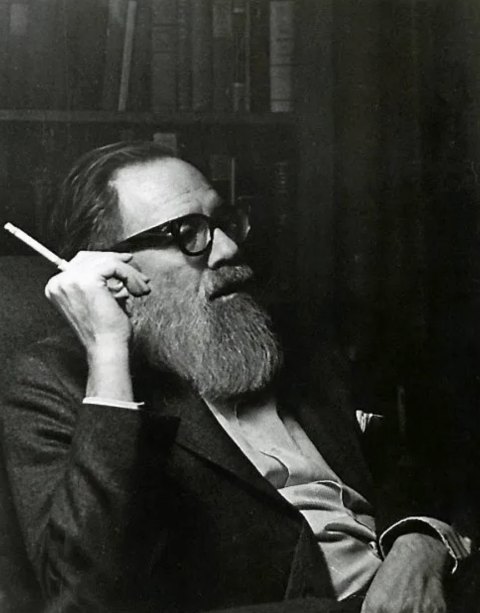 An unobjectionable enough message, if somewhat banal; the medium, however, is abhorrent. Berryman surely knows how repellant this pedantry sounds, finding it just as odious as we do. That is why he mocks it. The adjective “thinky,” both comic and scornful, derides the intellectualization by injecting a prissy and evasive neologism. It goes without saying that the mob does not act from the “fathomless heart” of a deeply felt tragic sense; saying so nullifies the point. And while few would dispute that abstractions euphemize and sanitize violence, these three lines of pompous blather dramatize an Orwellian brand of hate speech. In some circumstances, rhetoric kills.
Is this turnabout in tone and attitude a risk or a mistake? Those inclined to defend it might again adduce Berryman’s admonition: Henry is dreaming, and when the alter ego of the Regents Professor of Humanities dreams, all levels of “thinkiness” can ensue. My own feelings about the turn remain mixed; whenever I reread the poem, I see those lines approaching and cringe. In any case, the stanza abruptly shifts again, this time back into physical sensation — “his chest is pinched” — but without letting up on ambiguity. Whose chest? If “his” refers to the victim who has been “seen up” in stanza one, then the phrase strives to imagine the experience of being hanged—noose tightening, lungs compressed, breath constricted, air denied. Yet “his chest is pinched” could just as well convey the dread of witnessing, or even an apprentice lyncher’s chest tightening with shame.
From here on pronoun grammar becomes even less stable: “[t]he enemy are sick, / and so is us of” wedges the first-person plural viewpoint into the fractured syntax — and for the first and only time. Do “we” represent the poem’s governing perspective, or do “we” take part in the dream’s fugue of voices? There is a hint of Cold War paranoia — the enemy pathologized and thereby dehumanized — but a stable dramatic or ethical standpoint buckles under the incoherence of “and so is us of,” the preposition left to dangle like a bridge too far to nowhere.
If the mob of perpetrators and culpable witnesses constitutes a disease, perhaps a soul sickness infects those of us who use “thinky” locutions like “the administration of rhetoric” to describe a lynching. Whoever or whatever makes “us” sick — the enemy, the various antecedents for “him,” our involvement in these gatherings — the nine words quoted above amass their own mob, flouting rhetorical norms that might make them cohere and implicating everyone in moral contagion.
The next discrete passage bridges stanzas two and three, returning to a narrative mode but exacerbating the ambiguity:
like this one, drove he out
and gasps of love, after all, had got him ready.
Making sense of this passage involves choosing between two options, both unpalatable. It is somewhat less uncomfortable to construe “he” as a member of the mob, the “rising trysts” signifying (however perversely) the lynching itself. “Drove he out” implies agency not afforded to a victim of mob violence. Perhaps “he” has often driven to analogous secret meetings — illicit sexual encounters — and those “gasps of love” have primed him for participation in ritualized violence. In this reading, Eros and murder intermingle psychologically rather than causally.
In the far more disquieting scenario, the one “seen up” in stanza one might be the one who frequently drives out, fortified by sex, to rising trysts. Historically, racial terrorists used interracial love as a pretext for lynching. “Gasps of love” might suggest sexual breathlessness that becomes fatal breathlessness. If so, the poem’s ironies have turned savage: intimacy prepares “him” for execution, his history of “rising trysts” likened to “this one”—a monstrous slur.
Sex plays a credible part in both scenarios, as “he” is both acted upon and acting; in the indeterminate grammar governed by the dreamer’s unconscious, he occupies both positions. The passage refuses to settle the matter of identity, and this instability may be the poem’s central moral strategy. Maintaining that “he” denotes either perpetrator or victim offers some comfort. But if we accept the amorality of dreams — if “he” may be both — the poem becomes far more dangerous.
The remainder of the third stanza in no way clarifies the identity — or identities — of the characters, putting that question aside in favor of another (mercifully briefer) homily. There is a trace of fortune-cookie platitude in “however things hurt, men hurt worse,” and perhaps an impulse to console or justify. “Hurt” can function transitively (things hurt us, but men hurt us worse) or intransitively (men suffer more intensely than things suffer). Never mind that things do not suffer—unless it turns out they do.
When the story resumes, indeterminacy persists but to more ruthless effect: “[h]e’s stark / to be jerked onward” seems to jump-cut back to the scene of the lynching. The verb inescapably evokes the brutal physical force of a body hoisted on a rope. But “to be jerked onward” might just as plausibly suggest coercion that causes panic. “Stark” — with its connotations of nakedness, exposure, and vulnerability — reinforces the ambiguity that has us wondering whether “he” denotes a victim pulled upward or an ambivalent lyncher dragged into action by his peers.
The next sequence — “in the headlights he got’ keep him steady, / leak not, look out over” — intensifies the theatrics already staged in stanza one, the headlights functioning like stage lights. But the diction devolves into grunted syllables, perhaps the interior mutter of self-talk. “Keep him steady” might depict holding the victim steady beneath the rope, or steadying oneself under scrutiny. The imperative to “leak not” may express dread of unbidden urination or the shame of weeping. “Look out over” makes no sense whatsoever — which might qualify as the most appropriate utterance in these circumstances.
Meanwhile, another puzzle enters the poem. The copula absence in “he got’ keep him steady” — that is, “he [has] got [to] keep him[self] steady” — introduces the first of three instances of dialect in the final lines, the only such occurrences in the poem. Then “This’ hard work, / boss, wait’ for The Word” employs a second copula absence as well as a zero suffix, most plausibly standardized as “this waiting for the Word is hard work, boss.”
Is Berryman’s notorious caricature of Blackface vernacular at work here? The poem’s tragic occasion and mordant tone suggest otherwise. More plausibly, a southern white dialect sounds its note here — why would a mob member speak or think in Black dialect? Moreover, since Henry himself often speaks in Black dialect — and, as Berryman kept reminding his readers, Henry is dreaming — then Henry’s dream logic may underwrite the brief modulation into dialect.
However one takes (or rejects) the dialect, at least one “he” has spoken up at last, appealing (or complaining) to his “boss.” The Word he works hard to wait for reverberates with implication. When it arrives, it may direct the mob to proceed with the hanging. Or it may evoke the Word of God, a grotesque sanctification of murder, recalling the Ku Klux Klan’s Christianized ideology. Whatever its ideological brand, religious or secular, the death cult requires a leader to give the Word.
Yet the pronouns in these final lines still refuse stability. If “he” denotes the victim—condemned man calling his executioner “boss” while waiting for the divine Word—then “Dream Song #10” ventures into imaginative monstrosity. Again, any manner of evil behavior may occur in dreams, and we might follow Berryman’s own cue by indicting Henry’s unconscious.
More compelling, because more complex, is to read “he” as an apprentice lyncher — frightened, trying not to lose bodily control, speaking deferentially to a superior. The horror then moves closer to home. Waiting for a lynching becomes “hard work.” Murder becomes night labor. The sacred “Word” reduces to a procedural cue.
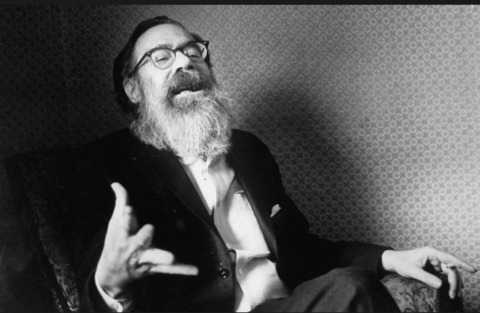 Varying this line of inquiry, my friend Joyce Peseroff imagines the mob member picturing what the victim must do: keep steady while facing death; avoid screaming or weeping, or otherwise “entertaining” his murderers; look out over the crowd and die with dignity, addressing God as Boss. Could be. And yet, because the poem persistently allows the identity of “he” to hover between victim and perpetrator, I find that I cannot completely disentangle them.
“Dream Song #10” provides no stable vantage point from which we may safely absolve or condemn. Instead it enacts what might be called nightmare ethics: a space where rhetoric, love, sickness, masculinity, racism, spectacle, compliance, and murder circulate within the same unconsciousness. The poem begins with hollow democracy — “a vote” that is “no vote” — and ends with obedience to “The Word.” Between those poles, civic language collapses into ritualized cruelty.
The headlights illuminate not only the victim but the faces of those who participate. We instinctively identify with victims of atrocity, but this poem challenges that reflex. The dreamer is dangerously free to occupy whatever position the dream demands — including complacent bystander or guilty apprentice. Read as social indictment, historical commentary, or psychological study, the poem hits hardest as a nightmare Walpurgisnacht — performed on a stage where victim, lynch mob, and spectator blur into a strange gathering in the artificial light of headlights while the car radio plays and we all wait for The Word.
Despite his famous “not the poet not me” disclaimer, everybody knows that Henry stands for Berryman. If “Dream Song #10″’s dreaming Henry stands for Berryman dreaming, and if every character in a dream represents a facet of the dreamer’s personality — the axiom of Fritz Perls’s Gestalt Therapy — then the Song represents one of Berryman’s most agonized debates between his racist and his progressive instincts. For an outrageous literalization of this debate, see “Dream Song #60,” where Henry and his unnamed partner, both fervent advocates of civil rights, dispute the degree of progress made, but in flagrantly caricatured Black dialect. The charge against The Dream Songs of racial stereotyping sticks; that seems beyond dispute.
So, why should a 21st century reader care about an opaque poem that anthologists ignore? What’s the point of trying to unknot its unknowing? Does blurring the borders between victim, perpetrator, and not-so-innocent bystander prompt us to better understand the horrors of the 20th century? Consider this testimony from Timothy Snyder’s Bloodlands: Europe Between Hitler and Stalin, which warns against well-meaning but complacently exclusive identification with the victims of atrocity:
“It is easy to sanctify policies or identities by the deaths of the victims. It is less appealing, but morally more urgent, to understand the actions of the perpetrators. The moral danger, after all, is never that one might become a victim but that one might be a perpetrator or a bystander.”
For all of Berryman’s glaring blind spots regarding American race and racism, easy sanctification of victimhood did not suit his transgressive imagination. Almost always, The Dream Songs explore the least appealing corners of his psyche, and ours — never with greater urgency than in this strange, thinky, and fugitive nightmare of a Song.