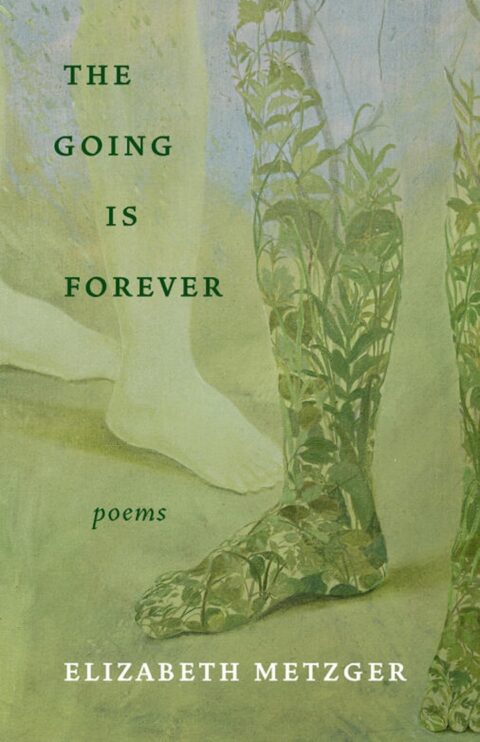
In Elizabeth Metzger’s third collection of poems, The Going Is Forever, what we can’t see, the atmosphere of chaotic flux through life, is the one sure thing. There’s an Escher-like destabilization that moves through her poems, a constant shifting of perspectives and emotional tenors that can lead to a moment of freedom. Metzger identifies this in a poem about a restaurant called “Horses,” but she is uneasy at first with the seemingly out-of-control motion it inspires: “A hologram of a horse galloping makes me anxious. / It can’t stop going nowhere. / How can I walk past it?”
 The reality of her poems is littered with moments of despair and lost momentum: a marriage ending, the death of her father, the medical issues her son faces from birth. It’s easy to understand her asking, “How can I walk past it?” but her stasis is misleading — it’s often the moment when Metzger discovers her control. In “Dinner at Horses,” she listens to the conversations around her and senses the death of her marriage, but nothing about the evening is passive: “The server places butter down / in the shape of a horse head. I melt the horses. / On all the tables horse heads melting, / our not speaking, my eyes running nowhere.” Metzger masterfully bridges the conscious and unconscious, the metaphor with the real, with one foot firmly rooted in the power of her world.
Metzger’s book begins with horses and flight, in “With Each Bird Flying, Time is Passing,” here in full:
Candled horses run across the dining table
I cannot take a bite before them
I cannot ride their passion
One child pulls herself onto my knee
The other is wrapping my arms to my sides with a scarf
If I can’t be a bird neither can you
he laughs, and the first child cries
For each life there is another you can’t have
It could have been better
I could have been generous
When the horses are gone and everyone’s fed
the unflown life comes
Flying
I fall madly in love with mine
Such idioms form connective tissue in the book — to getting back on the horse, flying in the face of, or taking flight — the persistence that Metzger knows she can tap, even if it’s not fully-realized.
Metzger charts the journey of one complicated, evolving relationship as it resonates against another from one poem to the next — with father, son, and husband. While poems are deeply invested in the life of the family, one encounters an unusual ecosystem of creatures (spirit animal, metaphor, real) along the periphery of these relationships, standing as signposts, suggesting direction. Through her relationship with them, her deeper familial interactions take on deeper meaning and continuity, even as they fall apart:
For weeks, polyester has been filling our yard.
The squirrels eviscerated a pillow from the porch
and now they’re working through a lifetime of material.
Instead of raking it, I wait to see if they’ll return.
The grass might suffer but it doesn’t seem to.
Sometimes staying is what seems reckless.
Sometimes I imagine all the pillows we’ve shared
will go to use again, cushioning a hole in nature
we are not responsible for making.
(“After Argument”)

Things continue, they persist through a “lifetime of material,” despite recurring cycles of disappointment and change. The mallards, birds, sheep, fish, trees, sunflowers, moth, crabs, horses, pelicans that the reader encounters join, cathartic or connective or both, with Metzer’s psyche.
The fluidity of Metzger’s reality, reflected in the title phrase “the going is forever,” is echoed by her child trying to grasp the idea of mortality in “Don’t Make Me,” shown here in full, through the twists and turns of miscommunication and misunderstanding:
When I told you the crab on the beach was dead you asked me what’s dead
I said This is his shell
but you must have heard soul.
a yearlong misunderstanding
a summer later unable to sleep you said No,
you told me the body’s the part that goes,
the soul stays. And I said No,
you have it backwards, the shell stays
and becomes beach again. I waited for you to ask after the soul,
where the crab goes. Practiced in my head an inconsolable hour
I don’t know or No-
where, scraping my mortal voice like bright meat
when suddenly you shot up from the covers
done crying. So
the going is forever?
In that moment, there is new understanding, and new possibilities in what it means to be. This potential for metamorphosis propels Metzger forward or backward (again, Escher-like):
Downstairs I am careful not to creak the floors and be called back. The Christmas tree lights are on. We leave them on all night. Every year someone’s tree catches on fire, which might be beautiful, I think if it weren’t in a living room. With all the mess of the season, I can’t bear to sit down. This living room might be beautiful, I think, as a memory.
(“Just a Belief”)
For Metzger, caught in this looking forward and backward — of horse heads melting, the crab just a soul—in the midst of all this movement, she is able to identify a still point that steadies her:
I put a red marble up to the pelican
between the two halves of his beak
and he kept it there for years
but I have not forgotten
Had he pierced his own breast to feed his young
Was that the story
Male wishing he had milk to give
My wishing he had a mind for me
Wooden pelican
Night watch
Guardian of the life I begged for
Am I cowardly
Will I always feel lonely
He doesn’t answer but
he never forgets me
red marble exactly where I placed it
(“Heart Gesture”)
Metzger’s vivid channeling of her own strength and the associative nature of her belief is enough. That she finds her support from an iconic wooden bird holding a hard, opaque, unmoveable kernel of self is unsurprising. Although she insists that he’s male — perhaps a synthesis of son, husband, and father — and that he has no answers, her own action and its talismanic effect, the protection it affords, remains.
*
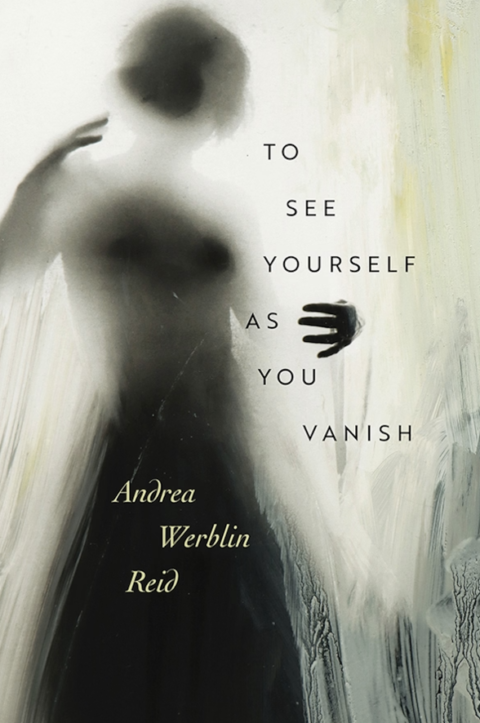 In To See Yourself as You Vanish, also a third collection, Andrea Werblin Reid not only steps out from behind the curtain of cancer diagnosis and treatment, she pulls the curtain away to show the bareness of the room — with no comforts to extend, and no time to be anything but vitally alive. Her poems are at once, inexplicably, the calm self-observation of a crisis and the stripping back of every surety. Werblin Reid gives the reader no place to rest or platitudes, keenly cataloguing the terror, anger, and anguish of losing the self one thought one knew to the reality of death on the daily.
Some of the most powerful poems call out the cuts of living with the memory of the before, knowing that the callous world prefers not to hold the dichotomy of the person living with cancer in a land that insists it is well. Other poems, like “The World of the Well,” here in full, turn their back on the life before and stand firmly in the divide, knowing the other side’s comfort is illusory:
my feeling on this is whatwhatwhatwhatwhat so i guess my feeling is a
helicopter, plus fury, plus, who decided to divvy up our world this way to
begin with?
if it makes you more comfortable, by all means monkey things in two:
one a hideous alien landscape, the other, tadpoles dreaming lily pads.
and if you see me sweating in Target from the simple act of reaching
for a box of noodles, my head in a wool cap in the middle of summer
because i don’t believe in head wraps, go ahead, stare in order to separate us.
stare and draw the line, just know when i stick out my tongue in reply
(i will) i am basically saying: you might have it too. a dodgy cell waiting
to go rogue.
or one already rogue blooming deep inside you until it becomes a tower
of rules and needles and prescriptions that will not be ignored. you
think I’m joking.
if on a lark it decides to take you, it will — slowly, unpleasantly
until you are but a powerless sketch in your teenager’s notebook.
a secret told behind your own back, a parable of shattering buttons.
 Reid is acutely aware of language as a poet with cancer. She experiences a disease the world has no adequate words for, but she keeps trying to articulate or sum up a vastly inexpressible experience, as most disease, or pain, so individually is. She offers lines that are loose and inviting despite their distress, with a precision of internal music and anaphora that mimics the currents — the chopped air of a helicopter or some fast-moving river — the writer finds herself caught in.
Werblin Reid, in the act of dying from cancer, has taken it upon herself to throw open a window to a world at once unfathomable in its tropes yet immediately fathomable in her dark humor, her examination of the process of her own vanishing, and her excoriation of the world’s responses. In “Language is a Virus,” she lays it out:
the first rule of fight metaphors is there are no fight metaphors.
the second is, will you just stop kidding yourselves? it’s not like
you didn’t already know how to be insufferable pilgrims
radiant with judgment. they say she lost her battle with —
like it was a duel she entered at dawn, like she was ever
in possession of a pistol. there is no fight against.
there is live with, for as long as humanly possible, and that’s another thing i think you
ought to examine, why some lives are more salt-in-the-wound than breath
on the beard of an iris. there is the solitary devil of her disease.
there are swing sets, volcanoes, the time she hurt her foot
tripping over rocks near the river, how about mineral then?
how about saying, she has gone to the quarry, having found
the dolomite of her dreams? having found the perfect shade
of ochre? to die is not to lose, survive is not akin to conquer. as for guarantees, there
aren’t any anyway, only sonnets
and foxes and the memory of her crinkly hand on the doorknob.
In 2022, Werblin Reid died from ovarian cancer — information I’m reluctant to include simply because the poems deny this fact with their energy. Accompanied as they are by artwork that isn’t Werblin Reid’s, which complement the work she’s done. The poems do not need the artwork, but it adds a depth that intrigues and perhaps gives the reader a moment to offload some of the intensity of the poems in the equally challenging art by Bensley and Dipré. Werblin Reid offers poems that deny her vanishing while looking hard at what we tell ourselves about both the smooth paths and shocks of our lives, and how we bear our moment, as in “Betray,” here in full:
whoever insists staying positive is —
let me stop you there, let me tell you about
this ugly algorithm that brought us all together.
rogue cells, a cowboy cell, that one cell
that fucked up everything —
it’s a useless mythology: neat but absurd.
don’t think about cured, she said, think about healed,
because cured is an island and healed is like — what?
a burning sunflower?
hope is the most ridiculous option on the table.
it’s a silent creeper, sweet-veined rosebud offering up
pinpricks of light. i wouldn’t let that in if i were you.
there’s nothing innocent about it.
These poems are like a police spotlight in darkness seeking the shadow of the person who simultaneously runs in front and is caught by it just trying to escape. I am grateful to Werblin Reid for this burning sunflower of a book, and also to her husband who brought it to publication after her death with her self-composed epitaph (from “Language is a Virus”) couched within:
she didn’t fail at being human, at least i don’t think she did
but who am i, who are we, each of us excruciatingly mortal.
*
[The Going is Forever by Elizabeth Metzger, published by Milkweed Press on September 15, 2026, 104 pages, $18.00 paperback; To See Yourself as You Vanish by Andrea Werblin Reid, published by Wesleyan University Press on September 9, 2025, 96 pages, $26.95 hardcover]