Translators’ Note
 Radu Vancu’s The Rope In Bloom comprises 24 cantos interleaved with prose poems. The cantos all begin with the same three lines (What your dead one …); in them, in a series of dreams or nightmares, Vancu revisits the scene of his father’s suicide and consults the lost soul of this loved one, who guides and advises him. The prose poems that alternate with these visitations describe the joys and terrors of the poet’s daily life as father of his own young family.
/ / / / /
What your dead one, what the best-
beloved of your dead loved ones says to you
when you have the heart to dream of him:
“We remember, but the recollections blur,
obliterated like the face of a doll
kissed for centuries by one sad little girl,
and whenever a new memory arises among us
flickering with the votive over a grave,
our caskets throng around it,
squealing like piglets after their mother,
and we take in the memory like a hit film,
a Titanic foundering before our eyes
on the iceberg of a lit coffin. One of the more
fainthearted caskets whimpers, a sign of memories
still fresh. We’ll gather at his place next time.
Another coffin slams into the dreaming one,
like when you smack the television
to adjust the picture. It’s all over with him,
blindly he veers back to his place,
we look on with a lump in our throats,
our turn will come.
We return to the blockbuster and watch, docile,
until memories of you quit the web of flame,
but we haven’t even reached the last scene
before the audience starts clapping, chattering,
wooden faces afire with emotion, rating
& ranking & giggling & rolling their eyes.
For a time after we return to our plots,
a sea of low flame ripples over us
like grass on a contented grave.”
You want to sleep, but sleep is odious,
above you the dark ripples
like grass on an empty grave.
[What’s truly unbearable: not the dream so much as the waking. Not the terror of those minutes just after, gasping in the dark, trying not to wake the others; the terror passes. The ordeal comes in the morning, when adorable little routines cease being routine — every little thing, however little, carries barbaric resonance. When you undo a bib, for example, you realize that’s also how you once undid a noose. Each single gesture is charged with meaning and, as if your eyelids had been sliced away, with excess of clarity you perceive a corresponding excess of sense. Each dream unearths another layer of the world of light and paranoia. After each dream, the universe is sentimentalized, horribly.]
⟐ ⟐ ⟐ ⟐ ⟐
Ce-ți spune unul dintre morții tăi
cei mai dragi, cel mai iubit dintre morți,
când te lasă inima să-l visezi:
„Ne amintim, dar amintirile sunt tot mai neclare,
tot mai șterse, ca fețele unor păpuși
sărutate cu miile de ani de aceeași fetiță tristă,
iar când unuia îi răsare o amintire nouă
arzând cu flacără deasupra mormântului,
coșciugele noastre se bulucesc în jurul lui,
guițând precum purcelușii când aleargă după mama lor,
și ne uităm la amintirea aia ca la un blockbuster,
ca la un Titanic scufundat sub ochii noștri
de aisbergul sicriului iluminat. Câte un coșciug
mai slab de înger smiorcăie, semn că mai are amintiri
proaspete. La el ne vom aduna data viitoare.
Altul izbește cu colțul sicriului în sicriul care visează,
ca și când i-ar trage televizorului o palmă
ca să-i regleze imaginea. Cu el s-a terminat,
se întoarce pe bâjbâite la locul lui,
îl privim cu un nod în gât,
o să vină și rândul nostru.
Ne întoarcem la film, stăm cuminți & atenți
până dispar de pe pânza flăcării amintirile cu voi,
nici nu se termină bine ultimul cadru
că spectatorii încep să aplaude & să vorbească iute,
cu obrajii de lemn încinși de emoție, fac topuri
& pun note, chicotesc & dau ochii peste cap.
După ce ne întoarcem la gropile noastre,
o mare de flăcărui foșnește o vreme peste noi
ca iarba peste un mormânt fericit.”
Vrei să adormi iar, ți-e groază să adormi iar,
întunericul foșnește deasupra ta
ca iarba peste un mormânt gol.
[Ce-i cu adevărat insuportabil: nu atât visul, cât trezirea. Și nu atât spaima din minutele de după, când respiri dispneic pe întuneric, încercând să nu-i trezești; spaima trece. Greul vine dimineața, când micile rutine adorabile refuză să mai fie rutine — fiecare lucrușor, cât de mic, are reverberații barbare. Când desfaci o bavețică, de pildă, îți dai seama că tot așa ai desfăcut un ștreang. Absolut fie care gest e hipersemantizat, parcă ți s-au retezat pleoapele și vezi, cu un exces de claritate, un exces corespunzător de sensuri. Cu fiecare vis, se mai excavează un strat din lumea de lumină & paranoia. După fiecare vis, universul e oribil de sentimentalizat.]
/ / / / /
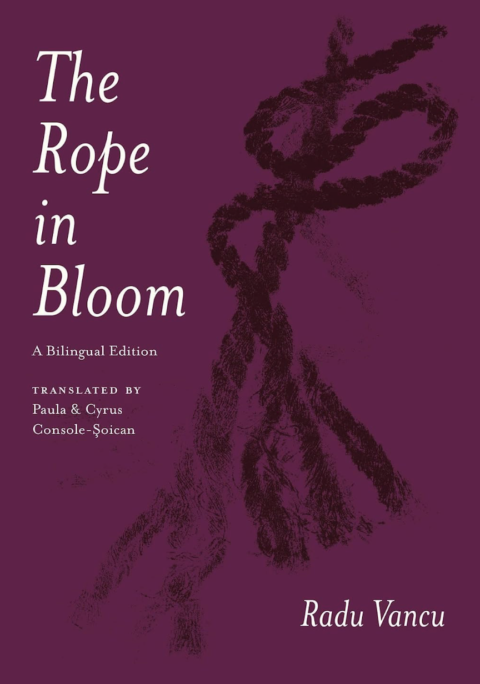 The Rope in Bloom by Radu Vancu is published by the University of Chicago Press, with whose permission the excerpt appears here. To obtain a copy directly from the press, click here.