In 1989, I was a five-year old celebrating Christmas in the suburbs of Buffalo, NY when the Romanian Communist dictator Nicolae Ceaușescu and his wife were executed by firing squad. Relatively safe in my middle-class, capitalist upbringing, I would understand in a few years what a dictator is, what all the fuss was about when the Berlin Wall fell. I had text books, encyclopedias, documentaries, and eventually the internet. But these facts, lying cold on a page or scrolled through on a website, did little to impart what living through a totalitarian regime might feel like. Although the results of the 1989 Romanian Revolution and the end of Ceaușescu’s reign have been well documented, such histories do little to help one envisage living under a totalitarian regime — the daily anxieties, the gaslighting and scaremongering, the precarity of truth-telling. In Astronaut!, Oana Aristide taps into the frustrations, precocity, and innocence of childhood to lead readers into the dread experienced during Ceaușescu’s regime.
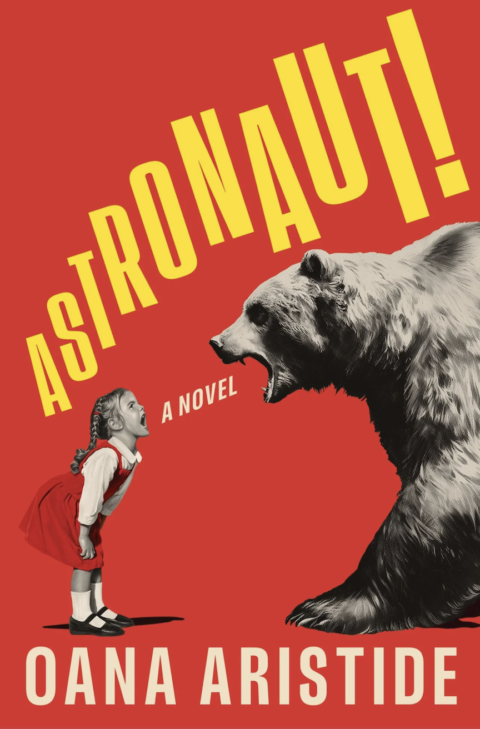 One of the Soviet bloc’s most oppressive leaders, Ceaușescu became president of Communist Romania in 1967. While his resistance to Soviet influence and his pursuit of independent foreign policy initially made him a popular leader, his reign was marked by human rights abuses, unfavorable economic policies that led to a sharp decline in living standards, food shortages, and strict control of the media and free speech. There was rampant paranoia among neighbors, as a large number of civilians served as informants to the Securitate, Ceaușescu’s secret police. The paranoia lends itself to the suspense and absurd humor in Astronaut!, which is both a detective story and coming-of-age tale. Aristide was born in Transylvania but spent her childhood in communist Romania, and she imbues her protagonist, eight-year old Lia, with her own experiences during the final year of Ceaușescu’s reign.
Written in close-third person, Lia’s perspective serves as a key for readers unaccustomed to the self-censorship demanded by a government, and the dissonance of secretly hating while opening praising a dictator who presents as a hero. Suspicion and lies, to Lia, are understood as a series of games everyone must play, a set of unwritten rules everyone must abide by. “Sometimes it’s like they are trying to keep a secret from her, but at the same time they’re angry that she doesn’t guess what it is,” she thinks, after she is brought home by the shopkeeper, Comrade Blaga, for attempting to buy a yellow vase for her mother’s birthday, using foreign currency her parents had kept hidden. Lia believed was doing something positive, and therefore can’t understand why both Blaga and her mother, when they arrive at her home, are angry with her. But as adults, we understand parental anger as inspired fear. In this instance, we learn that the shopkeeper is an informant, and if he chooses to disclose that Lia’s parents have foreign currency, they could face imprisonment or worse. In a nuanced moment, Blaga appears after speaking to her mother in private, announcing that her mother will come to his home “now and again” to help him care for his plants. Expecting worse punishment, Lia buries her face in her mother’s coat, then hears Blaga say, “Spare me that face, Comrade … Count yourself lucky I’ve no interest in little girls.” It’s painful to realize what her mother is willing to do to protect her family.
Despite the obvious suffering imposed by bad economic policies and intolerance to dissent, citizens dared not criticize “dear leader” out of fear. They line up and wave their flags, sing their songs, project an image of prosperity while rotting beneath the surface. Lia, acutely aware of this dissonance, wonders, “How do mothers and fathers kiss and hug their children again after they beat them? It must be strange.”
One of the most poignant collisions of humor and tragedy, and from which the novel takes its title, occurs when Lia draws a picture of an astronaut during class, labeling it “astronaut”: “She gives him a light blue helmet and matching spacesuit, and he’s smiling through his visor. Why the smile? Because he has just realised that the view from outer space is like being deep inside a Christmas tree. And he is never afraid.” Inside a Christmas tree looking out, covered in colorful ornaments, is an image expressing the whimsical characteristic of childhood. But the ingenuous drawing is at odds with the rules. Upon seeing the drawing, her teacher tells her she must relabel the drawing “cosmonaut,” the correct name for spacemen from their country. Not intending to be subversive, Lia believes her spaceman isn’t necessarily from Romania. And certainly, the teacher didn’t intend for her to ruin the drawing by crossing out her work. So, Lia adds a second man, labeling him “cosmonaut.” She assumes this will be sufficient — but upon seeing it, the teacher grabs an eraser and rubs out the offending word, smearing the black color all over the the drawing:
“‘No,’ Lia says out loud, without meaning to. At the first smack of the ruler she tries not to cry, at the second not to pee …Lia is shaking. Her palms want her to look at them. She doesn’t want to look at them, she wants to close her eyes. But if she closes her eyes she will pee for sure.”
While childhood punishment for an innocent transgression usually functions as a passing teaching-moment, this one is rendered all the more ghastly once what was actually transgressed is grasped — a definition of a word, and a correct one at that. Soon after, Lia watches a communist propaganda film featuring students distributing pamphlets. Fascinated, she asks her mother what a pamphlet is, and her mother replies: “The workers were suppressed by fascists and capitalists, so these brave youngsters spread their ideas by publishing pamphlets […] They wrote down what they were upset about, usually the fascist government, and the horrible things these fascists were doing. They tried to convince everyone to join them in their fight.” Lia connects this to the injustice of her astronaut drawing, and decides to make her own pamphlets, which simply read “Astronaut!” When a neighbor notices her hiding the pamphlets outside in various places, she collects them and brings them to Lia’s parents. Once again, Lia is punished, leaving her feeling “that Mother and Dad do not understand, she herself does not understand, no one anywhere has ever understood anything.” The confusion and disorientation of trying to adhere to a scripted, harmful reality is dramatically depicted through Lia’s plight. Her innocence balks at the rules everyone around her seems to blindly follow, rules that are supposed to be enforced through law.
 [left — Oana Aristede] Were Aristide only to have given us a child’s point of view, she might have diluted an otherwise frightening historic period into a callow narrative. But Lia’s chapters alternate with those of Constantin, a beleaguered police officer who has personal reasons to be skeptical of the regime whose rules he must enforce. Tasked with solving the mystery behind a string of horrific murders happening across the country, Constantin must engage in his own perilous truth-telling. Towards the end, Constantin and Lia’s paths intersect, allowing us to understand the gravity of Lia’s day to day existence and that children and adults suffered differently.
Although Lia’s gaffes start to become predictable toward the later half of the novel, Aristede wisely pans out from the timeless and familiar misadventures of childhood to remind readers of the historic context in which they take place. While Lia’s childish drawings could be regarded as a mere hobby, a later comment by Comrade Mantea, an older neighbor known for his anti-regime attitude and whom Lia befriends, adds weight to her creations: “We all complain of having to queue for basic food, the cold in winter, of not being free to speak our minds, but what about culture, what about music and art? That all goes on elsewhere—people collaborate and are inspired by each other’s works and build on previous efforts…In arts, in science. But we are stuck! Someone pressed the ‘tread water’ button on us. Isn’t this yet another form of torture?” In this sense, Lia prevails in a way others cannot. Her art allows her to swim, not simply tread, offering a glimpse at how an artist’s interpretation of their world can serve as a small, yet necessary, act of subversion. Interestingly, art also plays a large role in Aristede’s first novel, Under the Blue (2021), a dystopian road trip novel that is also a sort of historical fiction, as it imagines a global pandemic with similarities to Covid- 19. Her protagonist is a reclusive painter who becomes one of the lone survivors, signaling the importance of culture as a tonic to an ill civilization.
A novel about childhood almost certainly evokes one’s own, and Aristede leverages this portal to draw her readers into a past that, even though it may be radically different, is one they can find parallels within. Lia’s character challenged and expanded my own understanding of this particular historic period, even causing it to resonate with our current political moment in America. Although Lia’s transgressions often prove entertaining, they quickly remind us that there is nothing funny about navigating life under a totalitarian regime, nor having to indulge the dangerous cult of a dictator’s personality.
[Published by W. W. Norton on July 14, 2026, 272 pages, $27.99 hardcover]