Revisiting Modern Poetry
When questions and doubts surface about my writing life, often triggered by the harrowing reality of our world, I return to Diane Seuss’s poem “Poetry,” whose speaker bluntly asks, “What can poetry be now?” A daunting question, especially for this reader. But no matter the art in play, confronting the value of one’s work requires an unforgiving candor and a willingness to accept answers that may cause — or even demand — uncertainty. Now a poet in her late 60’s, Seuss, like many at this juncture, queries her life’s calling — her poetry, a “dog I’ve walked and walked / to death.” She asks the questions that arise when one has time and temperament to look back and reflect.
Seuss reconsiders her past to conceive how she may have arrived at this point. The speaker in the first poem, “Little Fugue State,” acknowledges that, for a long time, she did not know who she was. In this place of ignorance, she did not know either “where my body was, nor what it called / itself.” She now recognizes how long she wandered “through underbrush,” all the time unaware of what her “scrawling meant” or even this “scrawl here.” She lived in a “little fugue state,” and the questions she raises move like a fugue through the 40 poems that follow. She shares images of her childhood, her compulsion to write, the names of poets she read and studied, the courses she took; in short, she looks at the “how and where you are made, / and what / materials were at hand for the markers.” This probe leads to a reckoning that she cannot “curl now within the confines / of a poem.” Poetry may no longer be cocoon to hide in.
 In “Poetry,” the poem that comprises the sixth part of the collection, she remarks on what poets cannot offer; they have “no prescriptions” to cure readers’ needs. So, what can their poems provide? Maybe “truth, yes, delivered / with clarity,” as long poets “err[s] / on the side of humility.” But this truth “should sting,” she adds, “like a major bee, not a sweat bee.” They may offer beauty, “a problematic word, / one to be side-eyed lest it turn you / to stone or salt.” She already knows that “flowers / are beautiful and blood clots are ugly,” so don’t remind her. Beauty, like truth, is nuanced; it “comes or it doesn’t.” Perhaps the key to beauty, she suggests, is the “drawing near… / without platitudes / … to that sheeted edge” of death. Perhaps, at that point, poetry may be of value. However, despite this acknowledgement, she avers that it can never be considered “wise.” Although readers might seek “wisdom” and insights, they shouldn’t delude themselves into thinking they’ll find it, but instead be receptive to what is actually there.
Seuss returns to her argument in the later poem “Against Poetry.” The speaker is ready to share more of the art’s deficits: poetry “cannot perceive you,” and thereby denies you “a reality.” It will cut you if it “sleeps with you.” And, if it is a “love poem,” it “does not necessarily love / you.” These acknowledgements lead to a frank assertion: “Lately,” she admits, “I’ve wondered about poetry’s / efficacy.” The period at the end of that short declarative statement underscores the questions every writer asks: Why do I write? What is it worth? Several lines down, the speaker concedes that it is “fearsome, / to doubt your life’s foundation.” But like any good argument, she doesn’t stop here.
Presenting her reasoning clearly and logically, she sweeps us along. Although she determines a poem may be “valuable,” despite its absence of wisdom, the key problem she finds is that “lately everything / seems illustrative … / as if the world is a cunning metaphor.” As she investigates this concern, she seeks a “correlation” between poetry and art. What is the difference between a great painting and an illustration, she wonders, before responding: perhaps the key difference is the “uselessness [of] art.” A painting contains no inherent usefulness; an illustration serves a purpose. A painting is therefore “not valueless,” like poetry. True, but this insight does not quell the speaker’s doubts. She considers:
… to live within
a poem is to entrap oneself
in an architecture constructed upon
outdated theories of composition.
With poetry’s “cocoon” no longer viable, she views her work as built on obsolete foundations. She recognizes that she uses “the old language.” Perhaps poetry, like “furniture, having been built at the behest / of another era,” now rests on “trembling legs”; her poetry, like the poetry that came before, was based on “a principle / … that forefronts beauty,” a principle that seems no longer relevant. Maybe that’s why poetry today is more “illustrative,” rather than elevated, to an “essential artfulness” or value.
It’s possible that poetry will evolve in ways the speaker does not “yet have / the language for.” Good or bad, “an academy of silences” or “a catacomb / of cluster flies,” whatever future poetry might look like, she admits, is beyond her. She lives in this aging “body” now, one that, at this point in her life, “compresses your / soul,” rather than “liberates.” She remembers when she was young, “the whole world / came streaming in though / the structure of my senses.” Now it no longer does. But perhaps, “the body is the soul’s metaphor” and “to escape it / is to escape the service / economy.” The speaker seems to find an answer to this question, and in doing so, offers herself a way out. Bypass the illustrative, “dissolve analogy,” and only then, like a Buddhist seeking enlightenment, will you “attain uselessness.”
 The concluding section is a tribute to poets who influenced the speaker when she was young and hungry. In “Romantic Poetry,” she recalls the passion she felt for John Keats, as when in Rome she imagined “staining” his death mask “with the lipstick on my lips.” Ah, to be that young again and feel the “tingle in the spine, / the erotic charge” of a poet’s words that change you forever. But that “erotic charge” cannot be relived. Today, the speaker has a “cynicism … a go-to I no longer have / the energy to resist.” In the poem that follows, “High Romance,” she imagines what Keats, the poet from whom she caught “the disease,” must have realized after his death — that his “words / formed from ink melted in the rain,” and his love for his beloved Fanny “had been an invention of the mind.” This must be the gift of death: detachment and an objectivity that recognizes “invention.” The speaker allows, however, that this objectivity could be considered “beautiful.”
So what does this mean for Keats’ love for Fanny? In “Love Letter,” the speaker wrestles with another concern: what happens to love, which is, for her now, a “past-tense event.” Once she believed that “getting and keeping / love required lace,” via commitment to another, one which, in the eyes of the idealistic young, would last forever. But today, she does “not own lace / curtains” and is wary of the word “love.” She considers using the word “affinity” instead, a word bequeathed by J. D. Salinger, another favorite author from her youth. But she cannot shake off the word and, instead, will be “married to the world.” After all, she has confronted the truths of her life and “worked it all” out with us — sharing a generous vulnerability, a “kind of nakedness,” with her readers.
But before we can accept this book, her gift, we must know who is giving it. In the penultimate poem, “Gertrude Stein,” the speaker perceives herself in a “crystal cathedral moment” of honesty and clarity. Today she is a woman alone, brushing her dog in her “shack” of a home, “beyond sex or reason — / [with] a numbness that had set in.” She is the Gertrude Stein of “Picasso’s portrait … // … a draped artifact.” But despite her diminished portraiture, the speaker realizes, “with fascination — and a degree / of sadness and even objectivity,” that throughout her life, she has loved, as she “had once loved Tender Buttons — myself.”
Where have we landed at the end of the book? Was her lifelong commitment to poetry worth the effort? Seuss returns to Keats, who may have once inspired her, but who was not, according to a scholar friend, someone the speaker could have loved had she known him. His personal habits were repulsive: “He lied, / and rarely washed / his hair.” He “wiped his ass / with leaves or with his hand.” Her diction is coarse: “The top of his head would have barely / reached your tits.” We had been warned earlier that “truth should sting,” and for those of us who still love him, this does. But poetry — and life — contain multitudes, per Whitman. It contains the beautiful and the ugly, the “flowers” and the “clots.” She knows — as we do — that “love does not conquer / all,” despite that, even with that knowledge, we still seek it. Poetry may not offer wisdom, although that could be an argument for another time, but it offers her — and us — Keat’s “nightingale.” That “nightingale” is what some of us need to keep going.
* * *
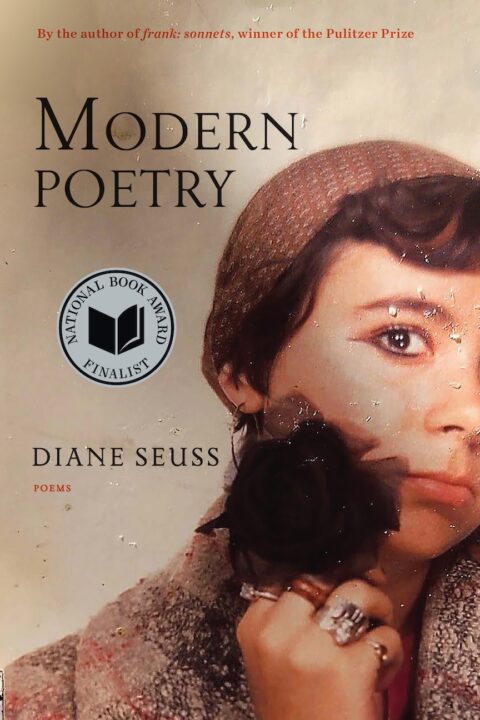
Modern Poetry by Diane Seuss was published on November 19, 2024 by Graywolf Press.