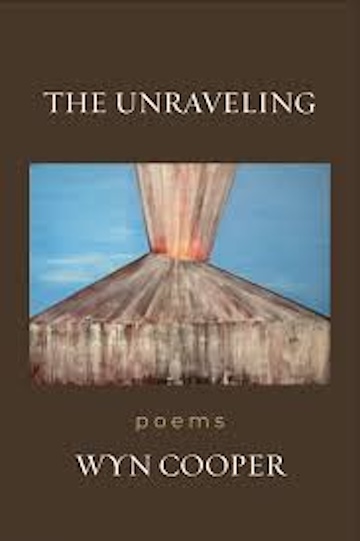
At the Edge of the Line: on Wyn Cooper’s The Unravelling
What does it mean for a poem to lose its footing, and what does it mean to say that it has without losing one’s own? In Wyn Cooper’s The Unravelling, the question settles into the lines, into their surfaces, into the steadiness with which they proceed. “I close in on facts fine as sugar / poured from a bottle labeled Salt, / comprehend nothing.” Already the condition is clear. Misreading is not accidental. Misreading is in the atmosphere, even as the sentence that holds that atmosphere remains lucid, intact, answerable to itself. We understand the failure.
The poems proceed by accrual. Signals arrive without resolution. Objects appear as unyielding. A note emerges—“its paper faded as the globe / on my desk. It’s unreadable” — and yet that unreadability is perfectly conveyed. The sentence carries it cleanly. Even loss is precise, locatable: “It stops where a country used to be.” The line knows where it stands, even as what it names has disappeared.
Disorientation is the subject. Orientation is the method.
From the outset, identity is handled as perimeter. “I am not the girl in the picture … / I am not a view from the island” — a stripping away that does not dissolve the speaker so much as re-situate her at the edge of what can be claimed. What remains is boundary, unmistakable: “I am yellow caution tape / strung from pole to pole: / Police line do not cross.” The image instructs. It establishes a relation: here and not here, inside and out. The poem tells us exactly where we stand in relation to what we cannot enter.
To write disorientation from this position is to write from just beyond it: close enough to register, not so close as to be overtaken.
The book fills with scenes of misfiring systems, stalled transmissions, partial recognitions. In “The News,” communication collapses into abstraction:
all lines disconnected,
all sentences muted,
the end of telegraphed thought:
story that ends with STOP.
The rhetoric is absolute, and yet the sentence continues to function, to deliver its claim with clarity. The breakdown is described from within a structure that does not break.
This pattern recurs. In “We Can’t Follow These,” confusion is staged and contained:
which leads to confusion
or in his case
to book publication.
The line pivots with ease. The joke depends on control. Even the admission — “we can’t follow these” — arrives in a form we follow without difficulty. The poem acknowledges disorientation while preserving the reader’s orientation to it, its language remaining clear where the experience it names does not.
 One thinks of The Rings of Saturn, which offers a similar paradox: a literature of disorientation that never quite disorients. The reader is guided, almost tenderly, through ruin and fracture without being subjected to them. One feels the instability of the world, but not a corresponding instability in the sentence. The syntax holds; the mind remains oriented even as it contemplates what cannot be fully grasped.
One thinks, too, of Mark Strand, whose work moves through absence and dislocation with an equally unwavering composure. The difference is that, where Strand’s clarity opens into a kind of interior vertigo, his sentences so controlled they begin to feel like chambers in which the self echoes and thins — Cooper’s lines tend to remain at the level of articulation. The experience is named, deftly, often memorably, if less often inhabited.
Strand can write, in “Keeping Things Whole,” that “wherever I am / I am what is missing,” and the line does not simply describe absence; it produces it. The vacancy widens as the sentence completes itself. The reader is not guided through disorientation so much as quietly placed within it.
By contrast, Cooper’s poems more often hold disorientation at a slight remove. They render it with precision, even wit, while stopping short of allowing it to alter the terms of their own making.
At times, the poems seem to recognize this distance. They circle their own condition, as if aware that to describe a fall is not to fall. The language remains composed, even when what it carries is not.
There are, however, moments when the pressure increases. In “Pandemonic,” sound begins to corrode: “phonemes that rust in gin’s soft rain.”
Here the breakdown enters the level of articulation. The line feels, briefly, less secure in its own medium. And yet it resolves. The syntax completes its arc. Disturbance is registered, if not allowed to alter the terms of its registration.
Or in “Waves,” where repetition loosens the line’s grip:
they cannot go they cannot row
they cannot find a boat or float
or swim or drift across the bay
The sentence extends itself, thins its breath, approaches drift. For a moment, the poem risks miming the motion it describes. However, the risk is not sustained. The poem gathers itself, returns to directive language — “not here not here / go back go row go swirl away” —and the reader is returned to ground.
Again and again, the poems approach the threshold of disorientation and step back.
This stepping back transcends the merely technical. It is an election. In “Along the Coast,” instability becomes ambient — “the molecules feel more chaotic here” — but the poem answers with stillness: “we sit in silence as doorless Jeeps / drive slowly along the graveled beach.” The poem does not dissolve into the chaos it registers. It remains attentive, intact.
To hold ground in a field of drift is not neutral. It is a decision: to remain answerable, to remain coherent, to continue to speak.
In “Detection,” the search yields almost nothing:
he stoops to the ground
but finds only cones, their scales
metallic, closed tight around seeds
The object refuses to yield. The instrument fails. And yet the poem continues to look, to describe, to render the failure as something knowable. The act of observation remains unchanged by what resists it.
One begins to sense that the book’s fidelity is to the mind that observes it. The consciousness here remains intact: able to register, to organize, to make intelligible even that which cannot be understood.
To allow otherwise would require a different kind of risk: to admit it into the structure of the poem — to allow the sentence to falter, to allow meaning not to arrive.
 “Language can’t corrupt it,” one poem insists — and the insistence holds. Language remains the stabilizing force, even when what it carries is instability.
The poems stand at the edge of unraveling and describe what they see. They do not step into it. They do not quite allow what exceeds them to interrupt their own terms.
And yet the edge exerts its pressure. To stand there, repeatedly, is to feel what is being kept at bay. The poems approach, withdraw, approach again. They remain intact, but not untouched.
The tension gathers between clarity and surrender, between the sentence that says “all lines disconnected” and the possibility of a line that cannot complete itself. Between knowing and being altered by what cannot be known.
This is not only an aesthetic distinction. It is a question of fidelity: whether a poem answers what it encounters by rendering it intelligible, or by allowing itself to be changed by it. As Emmanuel Levinas writes, “the Other remains infinitely transcendent, infinitely foreign.” To encounter such alterity is not to be unsettled by it: to be placed, however briefly, outside one’s own terms.
Here, the poems answer. They remain articulate in the face of inarticulacy. They preserve the line.
And so the final pressure turns.
If meaning fails in the world of these poems, and the poem continues to mean, then the poem becomes the last functioning system. The last intact structure. The last place where connection holds.
Which is to say: the unraveling stops at the edge of the line.
What holds the line in place — what keeps it from yielding to what it names — begins to feel less like stability than like a limit: an event horizon the poem does not cross, a threshold it does not allow to alter it.
The line does not break.
But neither, finally, does it quite allow itself to be broken.
[Published by White Pine Press on April 28, 2026, 75 pages, $19.00 paperback]