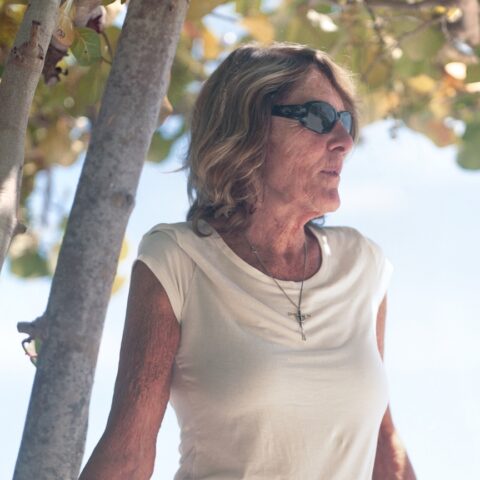
Maybe you heard about the sunglasses she wears day and night, indoors and out. Maybe a workshop instructor distributed her famous list, the Eight Essential Attributes of the Short Story — “A clean clear surface with much disturbance below … an anagogical level … an animal within to give its blessing.” Whenever the muse needs feeding, I turn to a recording of her essay “Why I Write.”
For decades, Joy Williams has inspired cultish devotion, often in the context of fiction workshops, meaning among writers, for her work tends to be a little too strange, dark and unyielding for the greater reading public, particularly in an era dominated by genre fiction. But if you know, you know. Welcome to the Cult of Joy and Williams’ new collection, The Pelican Child, where we fiend for the “sentences that stand strikingly alone,” the “interior voices that become wildly erratically exterior,” for stories that “transcend the naturalness and accessibility of the their situation and language,” the stories that offer consolation only from “unexpected quarters,” but more often offer no consolation at all. “Health,” “Bromeliads,” “Honored Guest,” “Brass,” “Escapes” — these are some of the finest short stories in the last century of American literature, all heartbreaking and beautiful and elusive and true. As a character puts it, in reference to the artwork of a capuchin monkey, “she presented the mystery in terms of mystery. And is that not substance! Is that not meaning,” exclamations that apply quite well to Williams’ fiction. Forget Hemingway, she ranks with the real big dogs: Kafka, Tolstoy, Woolf. Intelligent and fierce, but also playful and surprisingly tender, Williams is the German Shepherd of literature.
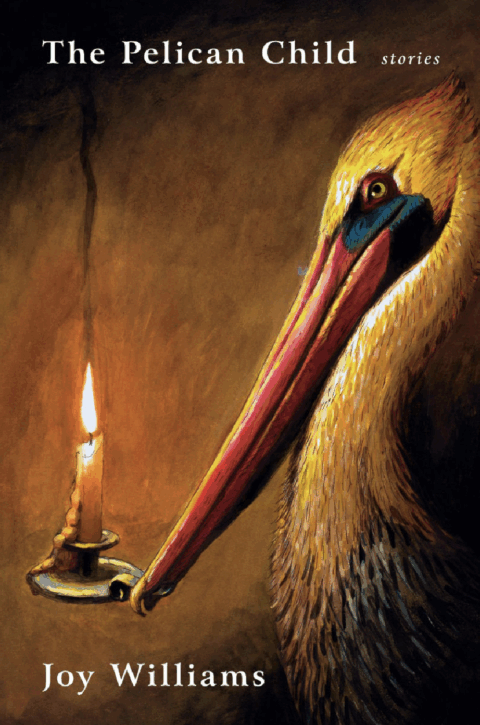 I bring all this up because if you’re in the cult already, there’s a chance you’ll experience a tinge of disappointment when you open The Pelican Child and discover that all of the stories have appeared previously, mostly in The New Yorker. By the time an advanced reader copy came into my possession, I’d read all but two of the stories. My disappointment proved to be short-lived, however, and foolish. Williams’ stories rarely give themselves up entirely on the first read — they tend to remain disturbing and irreducible upon second, third and thirtieth reading. There is no place like the Joy Williams story.
Two of the stories in The Pelican Child — “Stuff” and “After the Haiku Period” — contain echoes of her latest novel, Harrow (2021), and there’s a late style emerging in these books, not on the level of the sentences, which have always been precise yet wild and remain so, but in Williams’ attitudes and concerns.
“Stuff” begins with a doctor’s visit where Henry, a sweet but talentless columnist for the local paper, learns he has lung cancer. Although there’s been a mistake, the doctor having read from the wrong file belonging to an older patient, there’s no relief: “You have lung cancer as well, a bit more advanced, actually,” the doctor tells him. “Sorry about the mix-up.” For a second Henry hopes to parlay this terminal diagnosis into a waived parking fee before recognizing that “if the recently condemned weren’t required to pay their fair share, the lot would bring in no money at all.” Such is the world we live in: the parking lot takes precedence.
Later, at his mother’s nursing home, Henry notices a harrow in the corner of her cluttered room. In the Bible, the harrow symbolizes spiritual readiness, the preparation of the heart and soul for divine truth. The harrow also represents agriculture, of course, that crucial development which shifted humankind’s relationship to the planet from symbiotic to one of increasing exploitation, ultimately leading to the current situation: global capitalism, environmental catastrophe. What begins with the harrow, ends, as Williams has it in her novel, with the last living tree felled for a soccer field and Disney World humming along as usual in a world totally surrendered to the artificial.
I suspect that “After the Haiku Period” might’ve been exiled from Harrow, too, not because a harrow figures into it, but because it depicts elderly people committing an act of eco-terrorism — a pair of twin heiresses, in this case, attempting to atone for their oil tycoon father. Entitled and quite at ease with luxury, Candida and Camilla had nonetheless “long harbored the desire to murder their father” in order to “make the modest point that greed and desecration do not always go unpunished.” Unfortunately, “Daddy Midas,” so nicknamed because “everything he touched turned into some ghastly energy source,” died of a heart attack before they had the chance, so they decide instead to stickup a slaughterhouse. “We hope that our inevitable deaths … might atone in their small ways for the savagery wreaked on the innocent here every hour, every minute of the day,” they tell their ESL hostages, who are confused by the statement, but not because of the language barrier. “An atonement is a sacrifice offered, but will it be received? And by whom?” questions one. “Atonement is made by a sacrifice of inestimable value. Its sufficiency is infinite. Your act will be sufficient then?” The twins have no answer. Of course their act will not meet the criteria. Instead, they pivot and ask the hostages if they experience despair here at the slaughterhouse. “Despair is only an individual’s lack of vision,” says the spokesperson, and the others agree, “Si, si.”
Williams has mourned and scorned the slaughterhouse and lamented the destruction humanity has wrought so casually on the planet elsewhere in her fiction, but it may surprise some readers to discover her attitude toward renewable energy. In “Chicken Hill,” a stand of cottonwoods is removed for the installation of “ugly … ruthless, withholding” solar panels. Elsewhere she’s mentioned “paving the desert over” with panels and wind farms. Williams reacts to these attempts to transfigure natural forces for the sake of sustainability with a sneer. “Sustaining what?” she seems to ask. Doesn’t sustainability mean sustaining some version of the status quo, which means sustaining the destruction inherent to the imperative of endless growth in a global consumer society? Sustaining an unacceptable arrangement, in other words, from a stewardship perspective.
 There’s an emerging genre that some people call “Cli-Fi,” but unlike most writers pondering the consequences of climate change, Williams doesn’t worry much about the continuation of the human race, not in the material sense. In Concerning the Future of Souls, she subverts T.S. Eliot’s plea, “[that] the judgment not be too heavy upon us.” “Why not?” she asks. In The Pelican Child, she continues to explore the spiritual situation of a degraded world, the destruction of which every human being has participated in, however actively or passively. Never has Williams seemed more wearied by humanity or less concerned with the interpersonal dramas that populate most contemporary American fiction, ie., the complications of romantic love, parenthood, friendship, work, race and class. Though she maintains her singularly charming high/low register —existentialism in dive bars — never has her misanthropic streak been more savage or appropriate.
Terminal situations abound in The Pelican Child. The Christmas trees in the lot have no scent — “Some beetle’s been after them in the field. You’re whiffing nostalgia, my friend,” Henry’s told — everything “appear[s] worn and shorn,” the Great Barrier Reef is dead, the reservoirs are unreplenished, the cottonwoods have been removed for the solar panels, the child is dead, the grief unending. It might be William’s funniest collection, too. Throughout these stories, Cult of Joy followers will be pleased to find the wry humor and disturbances they’ve come to expect from Williams’: the sassy metaphysical children, the ornery dialogue concerning quirks of animal behavior. There’s another appearance by the bird-slaughtering artist John James Audubon, another semi-affectionate reference to Ted Kaczynski, many invocations of poets and mystics, Arizona and Florida, anamnesis and Gnosticism, the obscure and the biblical. In The Pelican Child, it’s all death, time, ghosts, grief. Spi-fi. My-fi. I suggest that un- or newly initiated followers begin with the more grounded stories here — “My First Car,” “The Beach House,” “Stuff,” and “After the Haiku Period” — and that they take the time to explore key references to folklore and poetry in “Flour,” “The Fellow,” and the title story. In “George and Susan,” a charmingly bizarre story, the eccentric ghost of “Fourth Way” mystic George Gurdjieff, who never traveled to the United States in his lifetime, makes a pilgrimage to the childhood home of Susan Sontag in Tucson, Arizona, and I recommend a scan of Gurdjieff’s Wikipedia before diving into that one if you’re not already acquainted.
You could reasonably categorize “Nettle” and “George and Susan” as ghost stories. “The Fellow,” too. Now that I’m thinking about it, “Flour” qualifies as well. Also “Stuff.” “Chicken Hill” and “The Beach House,” too, maybe, though it’s a bit of a stretch with those two.
“Ghost story” isn’t quite right, though. In the traditional ghost story, a presence from beyond the grave shows up to harass the living and explode assumptions about material existence. In these stories, Williams achieves a different and more lasting sort of horror — she probes the boundary between life and death in order to reveal its porousness. “I believe that all things — every moment, every vision, every departure and arrival — possess the celestial, the terrestrial, and the chthonic,” states the narrator in “Flour,” and that’s certainly true of the stories in the Pelican Child. The sky, the ground, and the underworld are in every sentence. These are stories like wine, not water, that rich blend savored by the cult, mystical terror combined with descriptive clarity and strange humor, and all those sparkling sentences. Williams has the daring and the vision to venture farther into the cloud of unknowing than most, certainly farther than fiction writers tend to go, especially Americans, and show us the darkness and the light therein. There is light here. Yes, behold, in these stories, that “great cold elemental grace that knows us,” which Joy Williams has served once more, like no other.
[Published by Alfred A. Knopf on November 18, 2025, 160 pages, $27.00 hardcover]