on Make It Broken: Toward a Poetics of Late Modernism, essays by Patrick Pritchett
Reflecting on the savagery of war in Poland and his brother’s execution by the Gestapo, Tadeusz Różewicz said, “I felt that something had forever ended for me and for mankind, something that neither religion nor science nor art had succeeded in protecting.” The war narrowed and deepened his vision to a grim focus on depravity – and he perceived the poet as a figure sufficiently diminished to reflect the spiritual, philosophical and aesthetic bankruptcy of the West itself. His perspective was especially harsh regarding the privileges accorded to art. If truth and falsehood are just words, then how and why does the poet sustain their profession? The “why” — to speak through the ruins of language in order to prove that what survives is capable of at least a hopeless decency. The “how” – to prefer the seen and the envisioned over metaphor and lofty notions, keeping the rhythm familiar, the tone even but pressurized. For other post-war European poets such as Paul Celan, Amelia Rosselli or Robert Desnos, the “how” was an even more distressed and jagged utterance, stung by trauma.
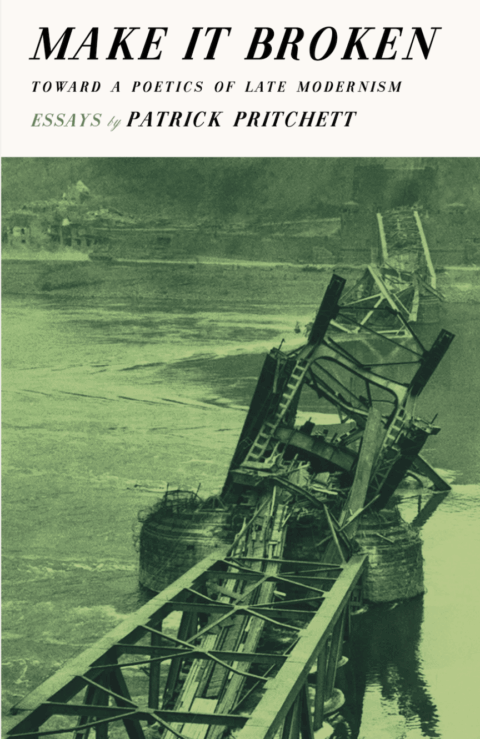 But what about contemporaneous American poets? In Make It Broken: Toward a Poetics of Late Modernism, Patrick Pritchett looks into “a small group of aesthetically affiliated poets who have carried forward a constructivist Poundian aesthetics of montage and constellation, not to forge a retrograde cultural gestalt, but to investigate the ruptures and fissures of a postwar world.” They are the “late Objectivists,” as Rachel Blau DuPlessis has labeled them, “operating,” says Pritchett, “alongside postmodernism’s aesthetics of exhaustion and depletion albeit in a more vibrant register.” David Nasaw’s new and long overdue study on post-WWII trauma, The Wounded Generation, reinforces what Charles Bernstein asserted in his 1992 essay, “The Second World War and Postmodern Memory,” quoted by Pritchett: “we are just beginning to come out of the shock enough to try to make sense of the experience.”
Through felicitous citations and incisive observations, Pritchett gives us selective readings of work by George Oppen, Lorine Niedecker, Ronald Johnson, Michael Palmer, DuPlessis, John Taggart, Gustav Sobin and Fanny Howe. The text’s eight essays were first published in 2008-2019 (one was a keynote address), but they speak as a unified, spirited study. Yet though these figures surely were shaken by the violent scope of the war, the reaching towards “a more vibrant register” is the vital gesture here. Ever suspicious of the heroic, self-crediting, afflicted first-person and what Lyn Hejinian disparaged elsewhere as ”the smug pretension to universality and its tendency to cast the poet as guardian to Truth” (even though all poetry cohorts are quite capable of sententiousness), Pritchett allows us to hear what emerged when these poets rejected “transcendent summations” in favor of “radical discontinuity.” So when discussing Oppen, Pritchett listens for his melancholy (“an ethical stance that stakes its authority on the safeguarding of loss”) and his clarity (“not synonymous with mere intelligibility”).
Oppen was wounded during the Battle of the Bulge. On the home front, Lorine Niedecker was wounded by Louis Zukovsky. Her output makes the case for a reconstituted first-person with speech that “perversely persists as nothing: a flat out refusal, a resistance toward an externally determined subject position as the rejected lover, the ignored wife, the childless mother, that is itself an irreducible position of selfhood.” Pritchett hears a blues riff in her work, the minimal made definitive, an abject telling of discontinuities. But again, the first-person has been salvaged if shaken, smuggled out of Objectivist headquarters.
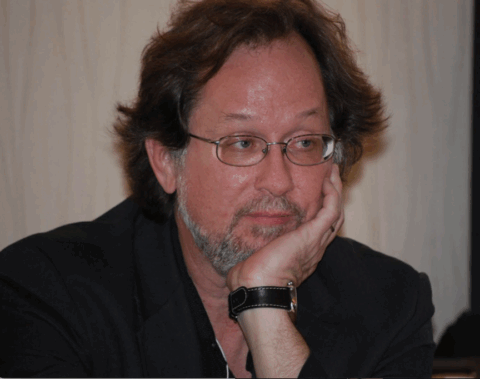 [left — Patrick Pritchett] In the essay on Michael Palmer’s work, one hears about “finding a language for the disaster that does not betray it by reducing it to an artifact for aesthetic consumption” and “the extreme difficulty poetry finds itself confronted with: that it is not outside of history, offering consolation for a century’s enormous suffering, but part of its wreckage.” And in the final piece on Fanny Howe’s “formally radical and spiritually committed” work, “make it broken” appears this way: “A poetics of rubble, of failure, involves a rejection of aesthetics as such. It is built around a form of writing that incorporates the logic of failure: writing can never be adequate to experience.” Howe’s inclusion of familial and global history revives Pritchett’s emphasis on the writer’s awareness of atrocity – even as a poem may insist on its stubborn, estranged capacity to signify acknowledgements from the residue of experience.
If I were teaching in an MFA program, Make It Broken would be required reading. If “to test meaning is to save it from rhetorical abuse,” then even (no, especially) our workshop’s most popular poetic maneuvers are candidates for evaluation. Pritchett’s allusive essays direct one’s attention to the sources of poetry – and how these masters shaped unique, troubled, obstinately vital responses to the damaged humanity they knew they were part of. (A useful exercise for students might be a comparison of the late Objectivists’ modes versus that of someone like Anthony Hecht, who witnessed the liberation of the Nazi camps.) But also, the essays represent Pritchett’s own path toward discovery, recognition of his impulses, and naming of potential techniques – and the collection’s ethos and liveliness reflect Pritchett’s desire not only to point out what he admires but to specify why he is drawn to it.
[Published by Black Square Editions on December 30, 2024, 234 pages, $30.00 paperback]
◆ ◆ ◆ ◆ ◆
on Art Is: A Journey Into the Light by Makoto Fujimura
At the close of a commencement address titled “The Aroma of the New,” delivered at Belhaven University in 2011, Makoto Fujimura said, “Come and dance, play and paint upon your Ground Zero ashes. That is how we must now love the world.” This exhortation represents the core of Art and Faith (Yale, 2020) – the conviction that art and music embody “the aroma of the New … the world that ought to be.” But this isn’t a simplistically sanguine vision. Fujimura also asks us to accept that “beauty and trauma are forced to dwell together.” He had just returned from a visit to Japan where he witnessed the remains of the earthquake and tsunami that caused the nuclear accident at Fukushima.
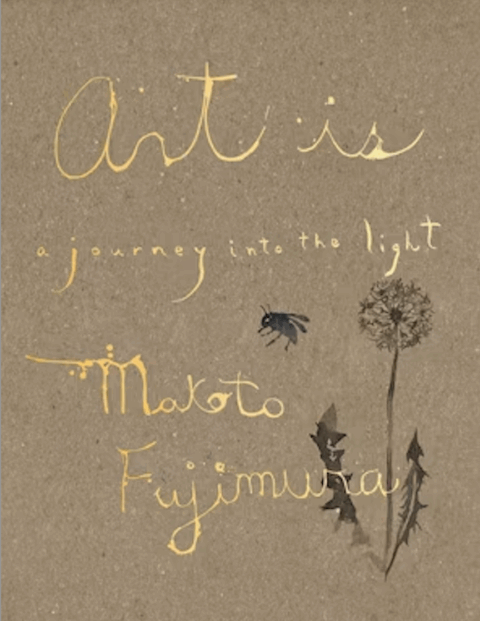 In his new book, Art Is, Fujimura reminds us that on September 11, 2001, he was trapped in a subway car beneath Lower Manhattan as the Twin Towers collapsed above. His apartment was located just three blocks from the site. He continues to insist that art is our most fulfilling and constructive response to violent upheaval – and that the latter’s persistence keeps us asking: “How can I create beauty, describe the wonderments of what I see, when my own heart is darkened, broken, and shattered?” His reply is also his method – the practice of Nihonga, a traditional Japanese art form that originated in the 16th century, in which the painter uses pulverized pigments made from “minerals such as azurite and malachite, mixed in a glue made from cow hides and bones. The pigments are prismatic, refracting lights of microscopic rainbow hues, especially when they are layered over time. My art, therefore, is ‘slow art,’ requiring more than a hundred layers before I start to paint any movement or images, and then the surface will sometime rest over years before the images reveal themselves.”
Born in Boston in 1960, Fujimura traveled as a boy with his Japanese parents to Sweden, Japan, then back to New Jersey, wherever his father’s work as a linguist and speech scientist took them. Although he describes himself as “exiled even from the culture of my roots,” he prefers to regard his status as affording “a portal into a new journey of blended identities, exilic consciousness, and appreciation for all cultures.” But again, this isn’t all sweetness and light. In fact, the blending he describes points to the most provocative point of his narrative — namely, that binaries are impeding our ability to enjoy and value our lives and world – and they are enervating our art.
Fujimura perceives himself as exiled not only from his native roots, but also from the church and the art world. “In recent times, the church has imitated culture rather than influencing culture,” he says, “creating secret power chambers to hide moral failures and protect abusers in leadership.” His admonitions about binary culture are even more sustained. “I have set up my life so that I can create into the gaps … and in-between places where machine algorithms of culture wars cannot reach,” he says, denouncing “the prevalent false binaries … oppositions of politics, race, and the ‘we-versus-them’ mentality.” As for the art world, he sees it as disinterested in the “deeper realm of processing the nuances of visual reality.”
 As an antidote, he evokes the spirit of Sen no Rikyū (15122-91), the Japanese tea master whose “liturgy of tea highlighted the importance of restraint and silence. He mastered the art of beholding as a path to communicating peace.” It was Rikyū who incorporated “the beauty in the broken and worn form of wabi-sabi art … into what we know today to be the Japanese aesthetic.” Fujimura, who notes that Rikyū was persecuted for both his Christian faith (though it is generally believed that he was “strongly influenced” by Christianity) and his clash with political forces (though this is still debated by historians), apparently is still provoked and motivated by the misdeeds and spurnings of his own church and art world.
“My art is an elegiac response to the experiences of pulverization, the traumas of our times,” he writes, just as Rikyū inspired “an aesthetic of lament and response created during times of feudal war.” I read Art Is immediately after finishing Patrick Pritchett’s Make It Broken (see above) – in my ear, they speak to each other. In enjoying both books, it became clearer to me why I’m gratified by poetry that sustains the impulse spurring the late Objectivists and their heirs. Peter Gizzi has described the elegy as “a way to transform a broken heart in a fierce world into a fierce heart in a broken world.” Isn’t this what Makoto Fujimura has aspired to and achieved?
Fujimura claims that artists today are hooked on their polemics and ignore “overwhelming sensory information flowing in” as if such information is scarce. He wants “granular attentiveness.” There are many statements here beginning with “art is” and “my art is.” In the end, he makes it simple: “Art is finding the light in the darkest of realms.”
[Published by Yale University Press on October 21, 2025, $30.00 hardcover]
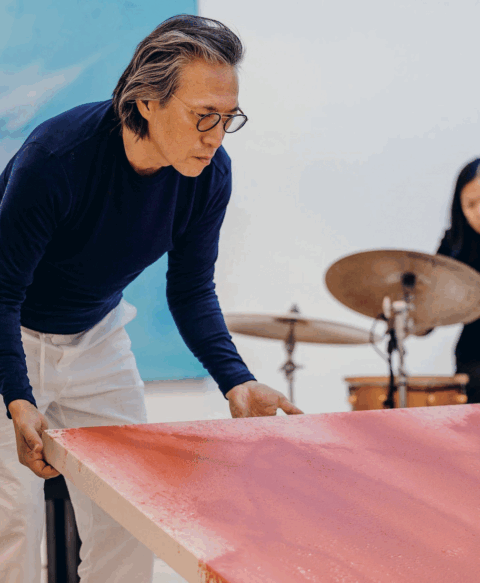
Photo: Makoto Fujimura “Live Painting” in collaboration with percussionist Susie Ibarra, 12/2021. Credit: Windrider Productions, shown here with permission of Yale University Press
◆ ◆ ◆ ◆ ◆
on The Name on the Wall by Hervé Le Tellier, autofiction translated from the French by Adriana Hunter
“I was looking for a ‘childhood home,’ I’d explained to the real estate agent … where I could invent some roots for myself,” writes Hervé Le Tellier on page one of his speculative memoir, The Name on the Wall, published by Gallimard in 2024 as Le nom sur le mur. But Le Tellier had already written a childhood memoir, All Happy Families (2019, Other Press), so I wondered at the outset about his motive for reviving memories of his youth. As it turns out, The Name on the Wall is inspired by a single boyhood recollection. “When an event upends our whole existence, it’s often only years later that we can evaluate it,” he writes. “I was ejected from childhood by a movie, Alain Resnais’s Night and Fog … I was twelve years old and was reduced to questions and anger.” Resnais’ documentary film, produced in 1955, incorporated film of the liberation of the Nazi death camps and footage of what remains of those sites.
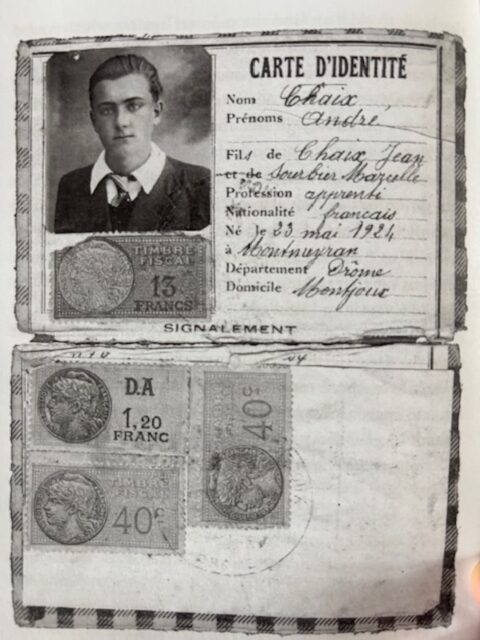 In March 2020, Le Tellier acquires his new childhood home, “a couple of hundred years old,” in the village of La Paillette, a hamlet in the village of Montjoux (population 333 in 2020), in the Drôme region of southwest Provençal France. The former owner, a ceramicist, had affixed a series of decorative glazed slabs on the front outer wall of this former inn, and when they were removed, a name appeared, “carved with a sharp point into the greige render: ANDRÉ CHAIX.” A monument in the village square, dedicated to locals “who died for France,” included the name André Chaix, born May 1924, died August 1944. Le Tellier soon learns that Chaix, a Maquisard, was killed by the Germans in Dieulefit, a town located about three kilometers from La Paillette.
Le Tellier then retraces his path towards the discovery of facts about Chaix – the region’s archives, employment records (Chair worked in a bakery), family history, military data. He finds Chaix’s love letters to his fiancée, Simone Reynier, plus a few photographs provided by Chaix’s family. Le Tellier introduces additional characters, such as Simone’s father Célestin Reynier, also a member of the French underground. The activities of the local Maquis are described. All of this is interesting, but Le Tellier is just getting started.
The “questions and anger” Le Tellier felt as a youth now drive him deeper into the war era’s lingering presence. “Nazism is not a page like any other in the history of humankind,” he says. “All the better if it’s impossible to discuss it serenely.” Initially at least, Le Tellier is addressing a French audience which, he implies, hasn’t fully acknowledged its behavior during the Occupation. The French government didn’t admit its complicity with the Germans until Jacques Chirac’s 1995 speech, and only in 2017 did Emmanuel Macron confess that French police, not the Germans, led the round up of the Jews into the Vel d’Hiver in 1942. In his earlier memoir, Le Tellier noted that his mother denied recalling the disappearance of Jews.
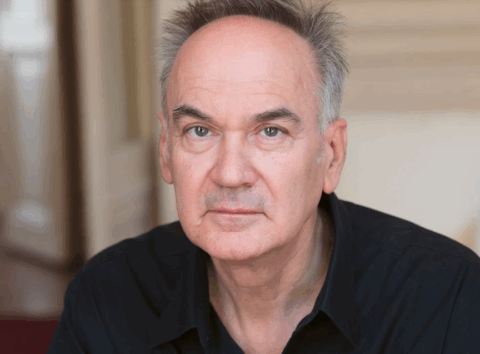 As an Oulipian, Le Tellier frees his narrative approach to privilege impulse and instinct. Once he reaches his true subject, the text leaps about from one historical event to another. But his urgency is steadfast. Imagining the courtship of André and Simone, he writes, “It was only natural that life should go on even if, as Walter Benjamin said, ‘That things are status quo is the catastrophe.’” And about himself: “Had I lived in those times and written novels, I would most likely have tried to get them published, weary of waiting for a hypothetical liberation of France.” He observes that nearly 200 movies were shot in France during the Occupation; the first draft of Jules et Jim was written in Dieulefit by Henri Roché, who is the main subject of a chapter here.
Le Tellier then returns to tell us about the experiences of André Chaix in the Maquis, and then his death. “I don’t know who wrote ANDRÉ CHAIX on the wall; nor do any of the people I was able to ask … What I do know is that, without that name caved on a wall, without André Chaix as my plumbline, I wouldn’t have known how to explore an age when generosity and courage lived so unusually side by side with selfishness and despicable behavior.” Given his parents’ dismissal of wartime France’s welcome mat for the Nazis, he now sees that his search for a boyhood home “is my way of grieving an impossible longing for a line of descent” that could offer an example for how to conduct oneself during our new age of strident nationalism.
[Published by Other Press on November 11, 2025, 154 pages, $16.99US/$22.95CAN paperback]
To read Ron Slate’s On The Seawall review of Le Tellier’s memoir All Happy Families, click here.
◆ ◆ ◆ ◆ ◆
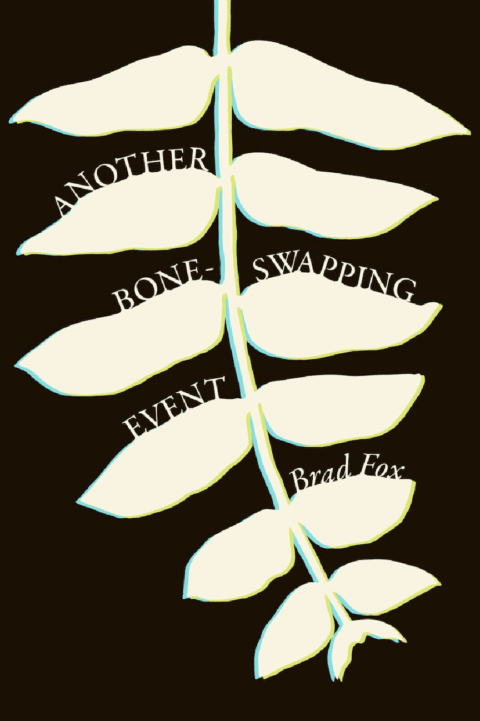
on Another Bone-Swapping Event, a memoir by Brad Fox
After exchanging vows in Istanbul in 2011, Brad Fox and his wife Ezster Domjan tried for a decade to have a child, but after series of miscarriages and failed IVF, Ezster decided to end their attempts. They both participated in ayahuasca ceremonies in New York. A mental health practitioner, Ezster (born in Budapest) then accepted an invitation to travel to Peru and spend ten days with a curandero named Miguel. Later, she convinced Brad to accompany her on a return trip for a 10-day diet of vegetal psychedelics. They flew to Peru in January 2000 just as the Covid pandemic spread to North America. More than a year later, they were still in Peru, stranded by travel restrictions. Another Bone-Swapping Event is Fox’s captivating memoir of that period. Truly, I became his co-captive.
 Prior to the trip, Fox worked for NGOs in the Balkans and traveled through Europe and Central America. “Now back in New York in my mid-forties, on the tail end of a graduate school fellowship as I finished by Ph.D., I was a mess of anxiety and insomnia and addictive tendencies,” he writes. Those drawn to ayacuasca are usually trying to jump start a change of some sort. As the psychologist Adam Phillips puts it, ”Wanting to change is as much about our wanting, and how we describe it, as it is about the changes we want. Getting better means working out what we want to get better at.” Fox does indicate what troubles him: “I thought about the veil of frustration that had troubled me, whatever it was that had kept the forces within me swirling in confusion, so much work and so little fruition … We’re all so acutely aware of our failings. What if something could make us better?” But in this narrative, unlike most memoirs these days, Fox isn’t interested in decanting a damaged psyche for our empathic delectation.
This is because Another Bone-Swapping Event is both the record and the embodied result of change-seeking. Fox has also worked as a journalist, and here his mode can be repertorial and reserved. His diction is lean, his phrasing precise. His near-tonelessness allows a sudden observation, perhaps a few sentences about a passing moment in the Peruvian jungle, to take on weight. He must have taken notes continually, from the moment he and Ezster, along with their friends, left the town of Tarapoto to make the four-hour trek to the mountaintop clearing called Julianpampa, having crossed 14 streams along the way. There the curandero, Miguel Tapullima Cachique, along with family members and assistants, administers the diet and keeps everyone comfortable and fed in their malocas or communal longhouses.
After the initial experiences with different hallucinogens, Fox says, “It was as if we were given a chance to see the layer of connectivity that undergirds our existence, as real or realer than we are.” In the flow of days that follows, this “connectivity” becomes the narrative’s leitmotif as Fox describes daily routines, the continuation of diets, and a few trips down the mountain to Tarapoto. While reading, I kept wondering about the relationship between Fox and Ezster: “We’d been consistent and we’d been passionate, but with her stunned by childlessness and feeling frustrated with writing and struggling with my depressive, anxiety-ridden tendencies, we’d both begun to roam in our own world.” They sleep separately yet seem to be amicable – but what exactly is the nature of their “connection” at this point? Fox wonders about it, and so do we. “It was impossible not to ask who we would be to each other now that all the parameters were different,” he writes. Again, Fox won’t yield to facile conclusions – while the story itself, or rather his mix of reticence and meticulousness in telling it, yields an uneasy yet spirited sense of the moment. He realizes, after one ceremony, that “you will never be normal again. That way of being is over” – but what supercedes it?
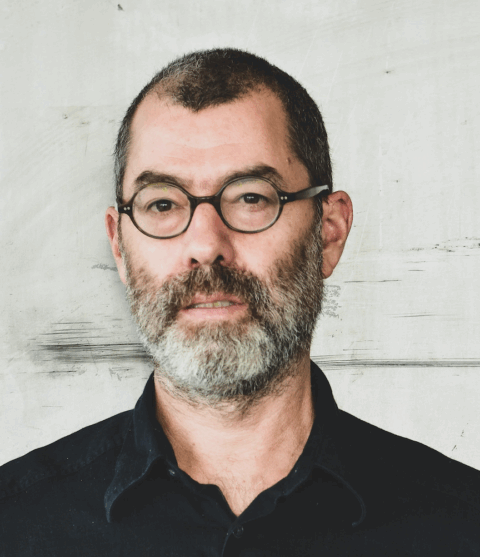 Another Bone-Swapping Event sometimes strikes me as Fox’s own Ecclesiastes, especially after one ceremony during which he registered “the futility of all human effort and striving but especially my own.” There are moments when all of humankind is under indictment, as Fox regards himself and other “foreign seekers” with “shame and derision … who allow local guys to drag our stuff up the mountain because we can’t be expected to carry it ourselves … sheltered Americans who flit from interest to interest, spoiled Russians so removed from the depth and poetry of their traditions, so demented by influxes of money …” Frequently, one of the dieting participants would scream non-stop, and at least one time the screamer was Fox: “It was the scream that brought understanding across the horizon of nothingness into my body, so it could be something I know … I could feel it pulse through me, could see the situation, that rare thing that was survival, the arc of a life in its fullness, of eras and continents and the end of things lit up in its reflection.” Beauty and terror. And later: “But there was an edge to my enthusiasm, as if I were taking credit for these visions rather than simply receiving them. I had to remind myself to calm down.”
Aside from the psychedelic experiences, there is much else to observe of Peru and Quechua culture and local folklore – and several characters to keep track of and learn about. Toward the end of the tale, Ezster and Fox are the last remaining visitors. He tells us about reading Cuban novelist Alejo Carpentier’s Las pasos perdidos, the story of a musicologist who travels to the Amazon to gather instruments. Fox writes, “Is it a story of failure, of a man who misses his sole chance to transform himself and recover his full humanity? Maybe not. Maybe it’s a story about life as it is, as it’s lived, where transformation arrives via mistakes and errancy, never the way one planned or expected or would have even known to want.” The same question with all the resulting ‘maybes’ may be asked of his probing, engrossing memoir.
[Published by Astra House on November 4, 2025, 336 pages, $29.00 hardcover]
To read Ron Slate’s On The Seawall review of Brad Fox’s novel To Remain Nameless (2020), click here.