What can we learn from a novel’s epigraph? Avigayl Sharp’s Offseason begins with two. One is from Sigmund Freud’s Civilization and Its Discontents, an appropriate choice for a novel whose protagonist has a fraught relationship with her own therapist. But it’s the quote that precedes it that feels like a challenge has been accepted. That’s because it’s from Muriel Spark’s The Prime of Miss Jean Brodie, one of the defining novels of teachers and students written in the last century. Seeing this quote before delving into Sharp’s novel is to recognize a statement of purpose, a message from Sharp that she knows the territory she’s entered into and the literary works that have come before.
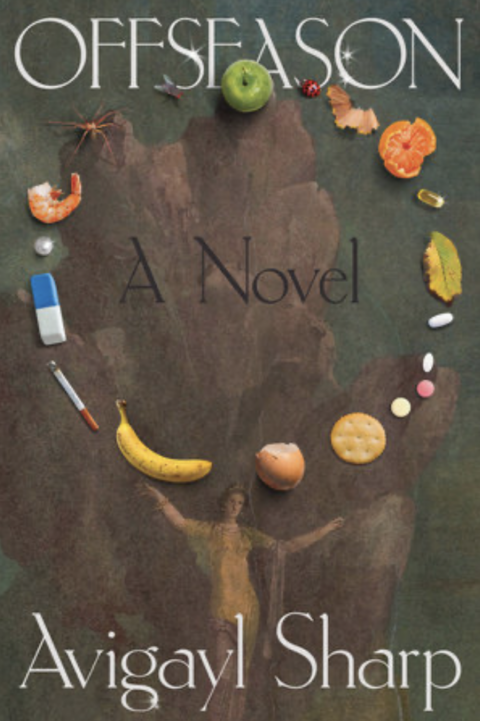 Given that Offseason’s unnamed narrator is teaching literature at a prep school for girls, this knowledge of literary history isn’t just something that informed the novel’s creation. It’s also part of the story Sharp is telling, as the narrator attempts to make the case for the importance of Charles Dickens’s Bleak House to her students. Because Sharp is well-versed in her chosen discipline, these observations feel idiosyncratic and specific. And because Offseason is a comic novel, they are often hilarious, because this novel’s narrator is not terribly good at her job. Or her personal relationships. Or keeping some of her less savory opinions, including an obsession with a certain authoritarian leader of the Soviet Union, to herself.
From Offseason’s early pages, Sharp makes it clear that this will not be a story of an unconventional teacher inspiring a group of misfit students to attain new heights in their chosen area of study. Here’s one especially candid moment:
“There were certain thinkers who might claim that I had never had sex, though I was not one of those thinkers. I was pretty sure I had had sex on many occasions. I was twenty-eight years old.”
Instead, readers may suspect that Sharp is after something very different here: not the story of a talented instructor opening their pupils to new horizons, but instead the story of someone who leaves a trail of damage in her wake. The narrator’s fondness for Stalin is one hint that that’s where Sharp is going with this, as is the narrator’s insistence on dedicating an entire semester to the study of one book: Charles Dickens’s Bleak House — otherwise known as the one where spontaneous human combustion is a plot point.
But that isn’t quite where Sharp is going with this story This novel has little use for moralizing, but neither is it unaware that it’s telling the story of a deeply flawed teacher guiding the education of deeply flawed students. And it’s here that Sharp engages in another subtle yet significant swerve. At one point in the first half of the novel, the narrator looks back on her time in high school, and of some of the deplorable acts that her teachers had carried out. Except that the narrator has a penchant for oversharing, which leads us to a place like this:
“If my friend wanted, I could explain to her my theories about which of our teachers, exactly, had been pedophiles and which had been ephebophiles. I thought I had a pretty good sense at this point, because in the years since the scandals broke I had closely studied the physical traits of each victim. I had thought about their bodies, I said, almost every day. No, my friend said, she did not want me to explain my theories.”
 If you are Very Online, you may well have seen a version of this argument made by some generally tiresome people, either those who feel the need to be pedantic while discussing utterly horrific behavior or a certain flavor of edgelord. At first, I wondered if this was Sharp’s intention; there is, after all, a long history of literary provocation, and plenty of protagonists who delight in getting a rise out of their audience.
Throughout the novel, the narrator recalls a traumatic event in her own past, one which places her own attempts to hash out the best phrase to use to describe statutory rape in a new context. (Earlier this year, Gideon Leek pointed to Offseason as part of a larger “post-trauma plot” group of books in an essay for Vulture.) And it makes the attention-grabbing elements of her high school recollections read differently as well; for all that she is far from the world’s greatest teacher — something a late-novel conversation makes clear — she is, at the very least, trying. And unlike Jean Brodie, the narrator is unlikely to talk up the relative merits of fascism to her students — though her admiration for Stalin is a red flag, both figuratively and literally.
Offseason’s narrator’s penchant for oversharing only goes so far. On the very first page, the narrator is cagey about where all of this is taking place, with references to “a major coastal metropolis in the Northeast” and a “remote tourist town.” The narrator’s own name is never revealed, and she makes numerous references to her consumption of “methamphetamine’s cousin.” Meanwhile, the references to Bleak House bring Offseason close to something like Ali Smith’s Artful: a novel in which a fictional character’s discourse on a real work of art has a significant impact.
Even as it wrestles with questions of violence — interpersonal, institutional, and historical — Offseason has moments of hilarity. Of one character, the narrator observes, “It was the longest speech I had ever heard her make. Perhaps she had recently been prescribed methamphetamine’s cousin.” Earlier, the narrator describes her living space as “designed for a person who would always live alone, or perhaps for a couple that enjoyed shitting in front of one another.” This novel is often brutally sad; it’s also often brutally funny. It’s neither a comic novel or a tragedy; instead, it’s something much stranger. And for all of its stylization, that quality helps Offseason feel that much more like life, in all its fits and starts.
[Published by Astra House on May 5, 2026, 304 pages, $28.00 hardcover]