
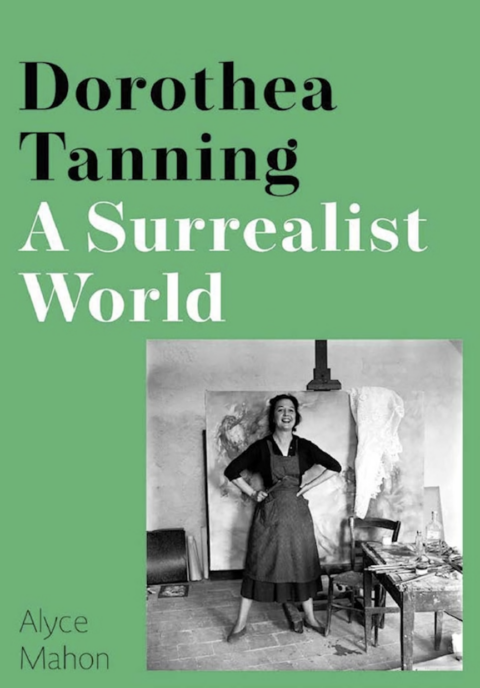
on Dorothea Tanning: A Surrrealist World by Alyce Mahon
In 2004 at age 94, the painter and sculptor Dorothea Tanning published A Table of Content, the first of her two poetry collections. Her poem “Sequestrienne” begins, “Don’t look at me / for answers. What am I but / a sobriquet, / a teeth-grinder, / grinder of color, / and vanishing point?” She produced two memoirs, the second and longest of which is Between Lives (2001), briskly anecdotal, a flare of colorful remembrance before vanishing. But don’t bother looking for much self-revelation. Nevertheless, in Dorothea Tanning: A Surrealist World, Alyce Mahon deftly employs those memoirs and an array of source materials to track the life as it encountered and reacted to its influences, and to specify how Tanning developed new modes of expression. When Tanning calls herself a “sobriquet” in the poem, I’m guessing she refers to “Surrealist,” the epithet typically used to introduce her, and which she dismissed in her later years.
 In Between Lives, Tanning describes the moment in 1936 when she first encountered Surrealist and Dada works at the Museum of Modern Art: “But here, here in the museum, is the real explosion, rocking me on my run-over heels. Here is the infinitely faceted world I must have been waiting for. Here is the limitless expanse of POSSIBILITY … signposts so imperious, so laden, so seductive, and yes, so perverse that, like the insidious revelations of the Galesburg Public Library, they would possess me utterly.” Here are the two poles – the environs of her youth and the urge for freedom — that generate a third thing. Galesburg, Illinois was Tanning’s hometown; she worked at the public library where the head librarian — “a resolute, imposing woman, wearing a pince-nez that trembled on her nose when she walked, would sometimes flush me out herself, in a perfect towering rage” – had marked those books “unfit for minors” with a red cross, thus making it easy for Tanning to pick them out and read. The librarian is the gothic; the books offered freedom, as did Surrealism. Furthermore, the books she read then – by Poe, Coleridge, De Quincy, Whitman, Hawthorne, Flaubert – often portrayed a divided world in the grip of the writer’s agitated imagination.
Mahon follows Tanning from Galesburg to Chicago, New York, Arizona, Paris and back to New York, demonstrating “her rejection of homogenous space, classical perspective and the rationalized world order, and how instead she offers a heterogenous world of constantly shifting, almost kaleidoscopic, perspectives that demand our active participation.” Neither Mahon, nor any other art historian, has much to say about Tanning’s work prior to 1941 when Julien Levy brought her oils into his New York gallery. Mahon fills in this early period with an historical perspective on the activity and artists Tanning would have been aware of during her years in Chicago (1930-34) – Dali, Stein, Picasso, Kandinsky, Klee, Miró, Man Ray and many others. Mahon also notes the work of Gertrude Abercrombie (1909-77) whose paintings, though never mentioned by Tanning, featured the bleak landscapes and yearning for “a green world” that typified Tanning’s oeuvre.
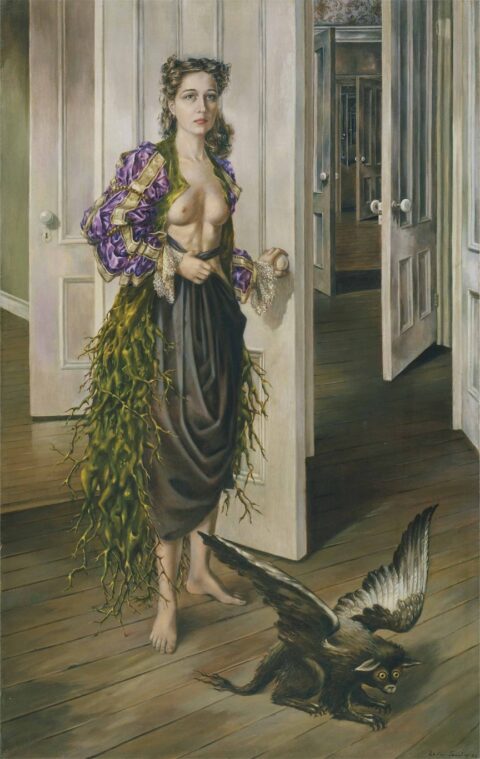
[Above — Birthday (1942)] Mahon emphasizes Tanning’s regard for Surrealism as “the pursuit of freedom tout court – it was not to be restrained by postmodernist or feminist critiques of sexual or gender politics.” And so, while the female body appears boldly in various spaces, prepared to step forward or toward the unknown, Mahon directs our attention to Tanning’s “ecopoetics” and her landscapes. But in 1942, Birthday marked Tanning’s entrance to and embrace by the Surrealists in New York. With the “Amazon warrior-like” figure, “Tanning now rips open her own clothing so the bodice of the costume reveals her own bare breasts.” A hybrid winged creature at her feet is a famulus or “magical assistant.” The open doors beckon. Tanning had just ended her six-month marriage to Homer Shannon – and met Max Ernst whom she married, in a double ceremony in 1946 in Beverly Hills, with Man Ray and Juliet Browner.
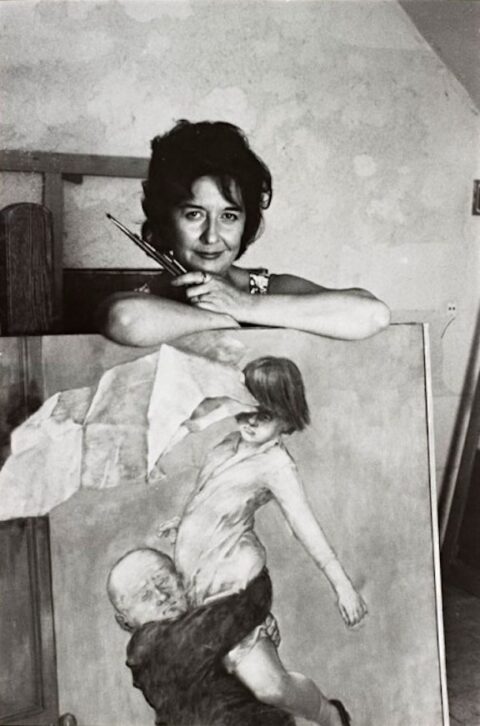 In a 1990 interview published in Bomb Magazine, Tanning assessed her work of the 1940’s and 50’s as having been produced by “someone who doesn’t think as much about the techniques of painting as about what’s being painted … determined by trance, not chance.” She brushed off a question about the source of “psychosexual aggressiveness“ (“I wish I knew”) and responded simply: “I’ve always been drawn towards esoteric phenomena: the illogical, the inexpressible, the impossible.” Mahon takes us through Tanning’s new investments in technique – even as the artist remained loyal to Surrealism as “a way of thinking and living.”
Mahon is a companionable docent, shifting her mode between offering astute observations on individual works of art, and portraying the milieu and characters that comprised Tanning’s world. “Across a 70-year career,” she writes, “Tanning’s paintings, designs, experiments in film, soft sculptures and writings repeatedly opened up spaces of never-before-seen landscapes, built around her ambition ‘to lead the eye into spaces that hid, revealed, transformed all at once and where there would be some never-before-seen image, as if it appeared with no help from me.’”
[Published by Yale University Press on April 14, 2026, 261 pages, $45.00 hardcover.
⟐ ⟐ ⟐
on Diaries by Josef Koudelka, selected by Tomáš Pospěch and translated from the Czech by Derek and Marzia Paton
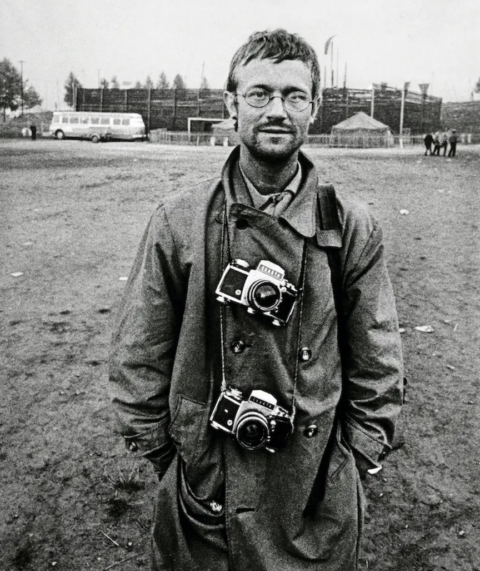
In 2014, Aperture published a revised and expanded edition of Josef Koudelka’s 1988 photo collection Exiles, with a new introduction by Czesław Miłosz. “Among the misfortunes of exile, anxiety of the unfamiliar holds a prominent place,” Miłosz wrote. “Then slowly we come to the realization that exile is not just a physical phenomenon of crossing state borders, for it grows on us, transforms us from within, and becomes our fate.” Born in 1938 in the Czech town of Boskovice, Koudelka took photographs of the nomadic Roma people in Romania, Hungary, Czechoslovakia, France and Spain during the mid-1960s, ultimately giving up his aeronautical engineering job in 1967. Returning to Prague from Romania just two days before the Soviet invasion in August 1968, he took his most famous photo, “Wenceslas Square, Prague, 22 August 1968, 5:01 PM,” depicting the exact moment the Russians arrived. In 1970, Koudelka fled to England; in 1987, he became a French citizen, returning to the Czech Republic for the first time in 1990. During those 17 stateless years, he traveled throughout Europe with his camera. But one could say that even before his own exile began, his visits to the wandering Roma people indicated his affinity for exilic life. By his own account, he preferred a sleeping bag to a mattress; “Never think about where you’re going to sleep in the evening” [2 June 1997 Markkleeberg].
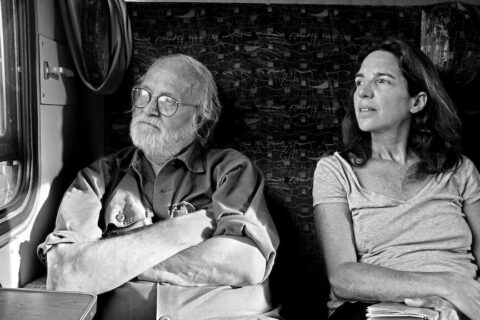
[above — Koudelka with Melissa Harris, 2014, on a train to Boskovice. Photo by Lucina Hartley]
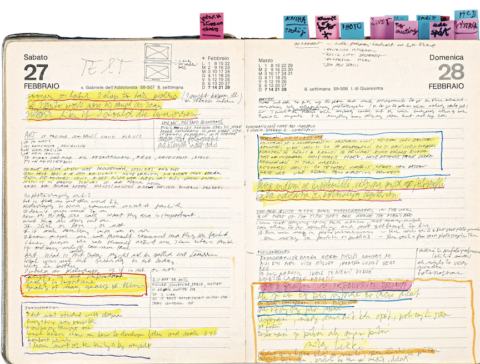
Koudelka’s biographer, Melissa Harris, has noted how reserved he is – and that while being interviewed by her, he would refer to his diaries to confirm facts and impressions. He kept a diary for more than 50 years. “My diaries are notes, written out of personal necessity,” he writes in the introduction to Diaries. “After I realized that they are too personal, I considered destroying them to make sure that nobody would read them.” But Harris and Tomáš Pospěch, a photographer who has acted as the curator of Koudelka’s 2,300 prints at the Museum of Decorative Arts in Prague, convinced him to allow them to mine the diaries for the biography and catalogs. In 2021, a generous selection from the diaries was published in Prague, and now we have a version for anglophones, selected by Pospěch.
 “You’re alone, on your own in this world” [20 May 1985]. I am struck throughout by Koudelka’s urgency of expression, self-exhortations, assertions and critiques, astute observations, sometimes tart: “By going to Lourdes, one learns to hate religion, priests, those fat wheeler-dealers in faith” [4 September 1973]. On every page, it seems, there is advice for artists of every sort: “If you want to be a photographer, you can’t be intelligent above a certain level. Your concept would come into conflict with your photography” [23 June 1980]. “I guess I’m not a reporter — I don’t depict reality — as it is — as objectively as possible. On the contrary, I use reality” [7 May 1976]. He may reflect on his development, in this case, considering the changes in post-Soviet eastern Europe: “I became the photographer I am, not only because I was interested in photography, but also because I was interested in a certain world. And that world is now ending. The new world is beginning. I’m not judging. I’m not saying the old one was better, but it was different and, as a person, I identify with certain qualities of the old world and also with what I’ve always been interested in capturing: what will be lost, what will no longer exist” [31 May 1996, Bucharest]. Others are quoted; on 2 June 1992, he transcribed a long passage from Bohumil Hrabal’s notebook on how when playing soccer, one is “really relaxed … which proceeds from one minute to the next in full concentration.” He queries himself: “With the development of digital photography, now everybody takes thousands of pictures. Is it good for the world?” Then he responds, “I don’t know what’s good for the world. I am trying to learn what’s good for me” [30 September 2005, Budapest].
“Every photographer (even the best) takes bad photos,” he says, then tells a story about Robert Frank: “I was told that one day a buyer from the Marlborough Gallery, an important New York gallery, paid a visit to RF, and saw photos lying there that were not good, cast aside by Frank, rejected. He looked at them, and asked, How much do you want for them? I’ll buy them. Frank needed money, and as a joke asked a huge price, The buyer pulled out the money and paid. Now, there is an exhibition of those photographs in Valencia and Paris” [10-11 March 1978]. For Koudelka, every action of the artist entails an assessment, often severe. His photos often reflect scenes of waste, disuse, and neglect. “Take photographs of the current state of heavy industry,” he writes, “mines – panoramas – the industrial landscape – take them until their complete destruction. They say: 1 million people have to change jobs – it will be analogous to what happened in the West, in Lorraine” [undated, early 1990]. The moral imperative is to notice, to peer at what we have done.
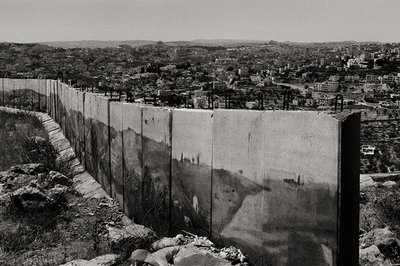
Between 2008 and 2012, Koudelka was invited to visit Israel along with several other photographers. He shot pictures of landscapes in Palestine and Israel, culminating in the publication of Wall (Aperture, 2013). In the diary, he writes, “I am going there: so that I can find out, so that I form an opinion, and so that I can decide: 1/ whether what I find there interests me; 2/ whether I can do something good there; 3/ whether I want to be involved in a project about a country whose policies I don’t agree with.” Koudelka is known for saying “photography is a subtractive art” – and in his Palestine/Israel images, it is The Wall that he focuses on, the harsh structure that separates what should be whole.
Koudelka gained immense freedom upon leaving his own country. As Tomáš Pospěch writes in his essay at the end of Diairies, “He became a vagabond, partly because of circumstances, partly because of his convictions.” And as Miłosz knew, the expatriate artist “cannot isolate his fate from the fate of those masses” who face “harsh economic necessities, or political prosecution … he only wonders whether this is not an image, more and more generalized, of the human condition.”
[Published by Aperture on May 12, 2026, 472 pages, 89 photos, $60.00 hardcover]
to read Ron Slate’s review of Josef Koudelka: Nationality Doubtful (Yale, 2014), click here.
⟐ ⟐ ⟐
on The War That Made the Middle East: World War I and the End of the Ottoman Empire by Mustafa Aksakal
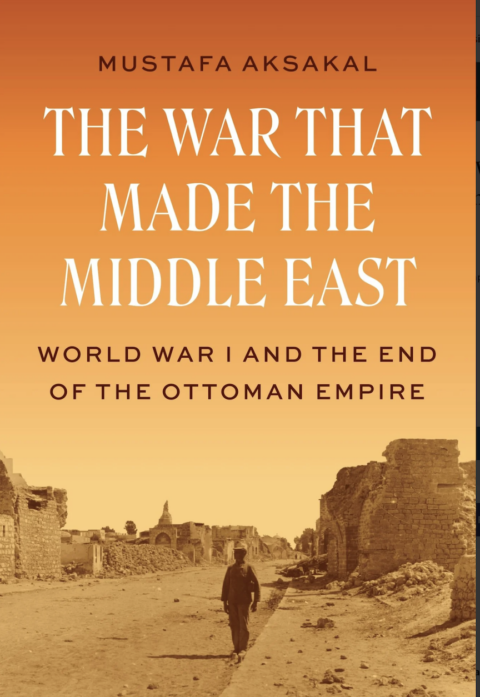 Glancing at the dust jacket of Mustaka Aksakal’s history of the demise of the Ottoman Empire, one might expect a narrative on the region’s key battles during World War I, such as at Gallipoli. (Try Sean McMeekin’s The Ottoman Endgame [Penguin, 2015] for a lively war narrative.) But Aksakal wants us to consider the empire’s collapse, and the ensuing emergence of post-war nation-states, by way of the decisions made by the Ottoman rulers and the catastrophes they triggered. “The war as experienced in the Ottoman Empire remains largely unknown,” avers Aksakal, who teaches Turkish studies at Georgetown University. Over three million human beings died along the Western European front, whose battles are the focus of most books on the war and its origins. Yet the Ottomans’ war campaigns in the Caucasus and elsewhere led to the deaths of 2.5 million Ottoman citizens, including hundreds of thousands who starved to death. The resulting geopolitical shifts in the Middle East (“the phrase was a product of the war itself,” Aksakal said in an interview) suggest that the most enduring effects of the war arose in the wake of the Ottoman collapse.
The Ottoman Empire reached its greatest territorial extent in 1683, with borders stretching to Vienna in the north, to Algiers in the west, northward into the Caucasus, and south to Mecca and Persia. But by the nineteenth century, Aksakal writes, “the Ottoman state found itself under increasing colonial pressure. Foreign powers ruled some of its territories, exercised legal jurisdiction over a considerable segment of the population, dictated the hiring and firing of high-ranking officials, collected directly the profits from products such as salt and tobacco, set import and export tariffs, and could even determine where Ottoman companies could and could not construct railways.” The British, allied with the French and Russians against the Germans and Austrians, warned Istanbul to remain neutral. But the Ottoman Committee of Union and Progress, the organization that staged a revolution in 1908 and reinstated the constitution of 1876 (decreeing the equality of Muslim, Christian and Jewish subjects), regarded the European clash as a means to restore their autonomy and “save our people and our homeland.”
What followed for the Ottomans, due mainly to their own decisions, was military, economic and social disaster, as well as the further diminution of their sphere of influence. At the center of the turmoil was Enver Pasha, the leading Young Turk and Minister of War, who launched his first attacks at the English on the Suez Canal (at German prompting) and at the Russians in the Caucasus. At the former, the 70,000 Arab nomads expected to join forces with the Turks never showed up, and the Turks retreated. In the north, the Turks fared no better. Non-Turkish Ottoman citizens who felt oppressed for years – Armenian Christians, Kurds, and Syrian nationalists – saw alliance with Russia as a chance for self-governance. After Armenians committed a massacre on Turkish territory, the Ottoman government responded with a genocide; between June 1915 and late 1917, nearly 700,000 men, woman and children died after being force-marched into the desert to perish from starvation.
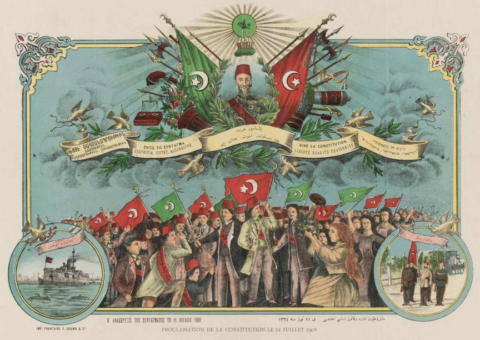 Although unstinting in his critique of the Ottomans, and in describing the details of devastation and death, Aksakal wants us to grasp the increasingly desperate and violent actions of the Young Turks, and to recognize the colonial encroachment and geopolitical forces they contended with. “In particular, I wanted to argue against this idea that it was nationalism or simply the ethnic and religious differences of the Ottoman populations that brought about the end of the Ottoman Empire,” Aksakal said in the aforementioned interview. “I wanted to show that before 1914, there was a complex society of Muslims, Christians and Jews who lived in proximity and interacted with each other, without painting a picture that romanticised the empire or approached the era with nostalgia.”
[Published by Princeton University Press on January 13, 2026, 249 pages, $32.00 hardcover]
⟐ ⟐ ⟐
on Hyperpolitics by Anton Jäger
In his recent New York Times guest essay, Anton Jäger asserts that a weakening Republican Party has become “a bidding hall for private donors,” and that the ebbing influence of political parties in general, throughout the West, has led to “emboldened far rights, poisoned public spheres, fissiparous loyalties and a political future defined more by helplessness than by choice.” Donald Trump, frequently named as the cause of this corrosion, has simply exploited it. In Hyperpolitics,Jäger maintains that these D.C.-based changes are part of a much broader politicization, and he provides a framework for understanding its sources and implications. It’s a lively text that proceeds like an extended essay, packed with contextual cultural references, usually European, such as Michel Houellebecq’s novels and Slavoj Žižek’s philosophical works.
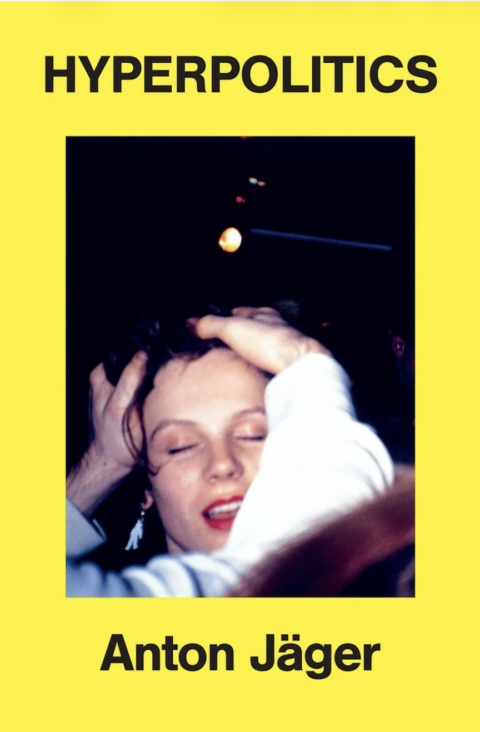 Jäger, a postdoctoral fellow at the University of Leuven, names four discrete political periods, beginning between 1848 and 1914 with mass politics, typified by “a world in which society is both highly socialized and politicized, populated by movements with clearly identifiable social bases and ideologies,” ending between 1973 and 1989. Then came post-politics, “in which citizens retreat from collective life into the private sphere,” spanning the 1990s and early 2000s” when “deliverance from the ideological orthodoxies of the twentieth century provoked a sense of elation.” This short-lived charm is depicted in Wolfgang Tillmans’ photo Love (Hands in Hair (1989) on the book’s front cover. Next, anti-politics arose, “initiated by social groups hit hard by the crisis of 2008.” This is the time of Occupy Wall Street. Now we have hyperpolitcs (the term “denotes a tendency rather than a totalizing style”), “marked by the erosion – or even accelerated disintegration – of social bonds … Hyperpolitics confronts us with a new mode of interaction between public and private. It is dynamic, intense, and polarizing, yet also ideologically diffuse, visibly modeled on the fluidity of the online world.” Jäger sketches representative moments asnd artifacts that point to the emergence or demise of each period (except hyperpolitics, which is current). And so Robert Putnam’s Bowling Alone: The Collapse and Revival of American Community (2000) is an example of a briefly revived “communitarian creed, intended to soften the pitiless liberalism that had triumphed after 1989.”
The hyperpolitical era has seen mass unrest during such protest movements as Occupy Wall Street and Black Lives Matter. But Jäger finds that “the contemporary public sphere spasmodically convulses without ever crystallizing into durable infrastructure.” A kind of bipolar behavior sets in – first the blood-pressure hike from hotly expressing one’s political views (“Abolish ICE” t-shirt), followed by despair at the unlikeliness of reform. The great American monoculture has splintered into “cohorts” that find community (usually online) based on conspiracy theories, solarpunk, femme gaming. Jäger will then pivot to examine the “associative foundations” of Trump’s coalition; in the Rust Belt and Midwest where “stagnation, outmigration, and increasing regional inequality” were experienced, some populist protests occurred – but there is no mass movement, just “acts of defiance carried out in the solitude of the polling booth.”
 In America, the oligarchs tell the politicians what to do, and in Russia it’s just the opposite. But the effects are similar. Aside from the plundering and concentration of riches, both post-politics and hyperpolitics feature “a demobilization and critical weakening of civil society, the hollowing out of parties, [and] the increasing insulation of the state from popular pressure … frenetic activity, relayed by an increasingly digital public sphere.”
The antidote to hyperpolitics is reinstitutionalization via revived political parties – though Jäger avoid prescriptions. In fact, I see Hyperpolitics as a spirited effort simply to describe what he sees and to relate his perspective to the literary and philosophical culture around him. Reflecting on work by Peter Sloterdijk, he writes, “In earlier times, individuals were embedded in dense social networks and participated in a wide array of intermediate associations. Today’s societies are composed of increasingly atomized and isolated individuals. As long as history moves along smoothly and predictably, this need not necessarily be a problem. But when societies enter choppier waters, atomization amplifies their volatility – and the collective incapacity to respond to today’s political and ecological crises.”
[Published by Verso on February 10, 2026, 128 pages, $19.95 paperback]