Translators’ Note
Set in a stark landscape of cliffs and precipices high above the Argentine pampas, Mariana Travacio’s All That Dies in April follows the members of one small family as each makes a solitary journey out of their treacherous mountain home in search of a better life.
◆ ◆ ◆ ◆ ◆
1
My name is Lina Ramos, wife of Relicario Cruz. For a while now I’ve been telling him we need to leave, but he doesn’t want to. He’s attached to this land, he says we were born here and we should die here, too. But we’re the only ones left, I tell him. And he says we can’t abandon our dead, we can’t just go away and leave them behind, without anyone who knows them, Lina. That’s what he says. That we can’t do something like that. So I explain to him that I’d happily stay if there was enough food to eat. But we live in the quebrada, the land is good for nothing. The only things that grow here are pitiful weeds covered in thorns that claw at the wind. Everything else is rock, stone. And it takes forever to get around because it’s so steep; nothing but sharp, sheer cliffs. The other day Iwas feeling unwell so I had to go see Octavia, who knows how to make me feel better. I spent four hours clambering over rocks.When I got there I was on my last legs. I tell Relicario all of this, but he doesn’t listen to me. He says that we can’t abandon this place. That if we leave, the dead will become nameless and confused, because no one will be left to remind them who they were or what they said or what they liked. And you just don’t do that, Lina. We must stay to visit them, bring them a sip of rum and some soup, or whatever they had when they were alive. That’s what he says: if we leave, who’s going to bring them their rum, who’s going to remind them about things; we can’tgo, Lina. So I try to explain that no one wants to abandon anyone, but he should try to think about us a little, too, because there’s no future here. This land provides nothing, Cruz, less and less each day, it hardly even rains here anymore. Sometimes a couple of clouds appear and we stare at them like they might bring us some water but the quebrada rejects them and they go somewhere else to rain. That’s what I tell him. But he’s hardheaded and doesn’t want to take any chances: he wants to stay, period, and then he asks me, where would we live, Lina, we’re getting too old. And I don’t know how to reply, because I’ve spent my whole life among these rocks and what can I say if I don’t know anything about the wider world. Don’t say anything, Lina, I tell myself when I see my entreaties fall on deaf ears.The only thing that makes me feel better is thinking that tomorrow I’ll try again. Then tomorrow comes and I raise my eyes to the empty sky and feel a weariness eating away at me inside. So I gather my courage and insist: let’s go, Relicario. The moment I awaken I see the cloudless sky with no birds, completely empty, nothing new under the sun. The sky always looks the same and it makes me feel so empty, too. I’ve been saying the same thing for fourteen years now, but he doesn’t hear me. Fourteen years, since my brother left with our son, our Tala, who I miss so much. Sometimes I get so tired of repeating myself that I lose my will to go on. But if I don’t keep on insisting, death will come find us all shriveled up next to our dead, and there will be no one left to bring us some rum or soup or anything else. Some days I feel like he might actually hear what I’m saying. Some days I say my prayers to the holy lord, but he doesn’t hear me either. He must have gone deaf, I think. I’m a faithful believer, and Relicario is, too. But lately I’ve had it in for God because he hasn’t answered a single one of my prayers. And sometimes I just get furious. Anger that lasts for days. Whenever it happens I tell Cruz that the good lord must be deaf, or maybe he’s abandoned this place, too; even he must get tired of all this rock. And when I come to him with these ideas, Cruz says I should stop making things up. That God is everywhere. And I tell him that he may be everywhere, but he’s not here because it’s too hard to get to. We’re hemmed in here, Cruz, in this quebrada. You have to look up high, so high, just to see the sky. But he doesn’t like hearing these things. He huffs at me and retreats to his workshop, which makes me so mad that I get sick and have to go see Octavia to get better. It’s a shame she lives so far away. Depending on the wind, it takes four hours to get to where she lives, sometimes five or more. But she’s the only one who knows how to make me better, so I go anyway. At first I move quickly, even though it’s uphill, but then the trail falls away. From there you have to find your own way, clambering over rocks. It takes a really long time and it’s exhausting, but I approach it with determination. Assoon as I arrive Octavia appears, as if she’s been waiting for me. Sometimes she emerges from inside; other times I see her coming from behind the hut, where she grows the herbs she uses for her remedies. And I feel calmer just seeing her. She immediately brings me inside and makes me some kind of concoction before I even tell her anything, and soon I feel better so we start to talk. In the beginning I didn’t talk to her much. I hardly said anything, I just thanked her for her efforts. But these days I tell her a lot. I tell her how tired I am of begging Relicario, how he doesn’t seem to hear me, how he doesn’t give me the slightest hope that we’ll ever leave this place. I’m getting old, Octavia, and I don’t know what to do. Sometimes I think Relicario’s right, we shouldn’t abandon the dead, but my longing to leave has grown so strong that it keeps me awake at night. Night comes and even Christ cannot help me. My eyes stay open, exposed, sleepless. And when it starts to get light and I leave our house to fetch water to brew the maté, exhaustion creeps up my back and leaves me all hunched over like this. I need to sleep, Octavia, so I can stand straight again.
2
I’m leaving, Relicario.
Where do you think you’re going to go all alone, Lina?
Octavia told me which way to go.
What way, Lina, there’s no way out of here.
You have to go straight down until you get to the stream.
What stream, Lina, be serious.
That’s what Octavia told me. To keep going down, all the way to the stream. And to look carefully at which way the water’s flowing and keep going, following the water. That the water goes to the river and the river goes to the sea. Let’s go to the sea, Cruz. Let’s go together.
You’re crazy, Lina. Even if there was a stream it would have dried up years ago.
3
She took our two big canteens and a bundle of clothes and the fistful of seeds Octavia had given her for the journey. These are good seeds, Octavia had told her, they’ll give you strength. Use them when you need them. Stubborn as a mule, my Lina, leaving to go look for that stream. We argued on her last night. I didn’t want her to go and she didn’t want to go alone: she wanted to drag me along withher. She was adamant. Come on, Cruz, let’s go find the sea. Over and over. But I didn’t want any part of this trouble that had grown inside her. You can’t just do something like this, Lina. But she didn’t hear me. Headstrong, she was. And now God knows where she is. It’s been more than a week since she left. I was sure she’d come right back. That’s what I told her as she was walking out the door. Don’t be stubborn, Lina, enough of this madness. What’s the point. You’re just going to come right back. You’ll see, in two or three days you’ll be right back here. Do you really think you’ll be able to get anywhere on your own. You’ve never been anywhere else but here. But it was no use. No matter how hard I tried, she was stuck on this idea of going to the sea. And now I wake up every morningso angry I start to shake. You can’t just abandon your husband, your land, your dead. You can’t abandon them, Lina. What kind of woman does that. We’re too old to go trying our luck out there in the world. But I should have known long ago, before I married her: Lina was a Ramos. And you could never talk a Ramos out of anything. No wonder that brother of hers was the way he was, coming and taking El Tala and leaving us here, with no son and no help.
4
She told me to keep going down, down, down. That’s what I’m doing. But I’ve been going down for three days and there’s no stream. Maybe I should have stayed. Octavia said three days, give or take. Two if I made good time. But I can’t go any faster because the descent is steep and getting steeper, and it has so many twists and turns that I can’t see ahead. I have to take small steps and be careful where I put my feet. Every step scares me. All these jagged rocks. I wonder if this place will eventually become flat. I want to walk on level ground, see some grass, anything that grows from the earth. I’ll keep going down, Octavia, but I don’t see the stream and I don’t have much water left. I’ll keep going as long as there’s daylight. There’s probably not much left. Maybe two hours until the sun sets. I don’t like walking at night. Even though there are so many stars, they don’t give much light, at least not enough to see. The moon has been waning; I can’t proceed without the sun. Now it’s at my back, coming from the quebrada, stretching my body along the path. It looks like the body of a rag doll being jerked along the bleached rocks. Yet my shadow is more agile than these old bones. At this time of day it’s not so hot. If I hurry, who knows, maybe I’ll find the stream before dark. I’ll keep walking until the last ray of light. If it’s really three days, I might see the stream tonight and see which way the water’s flowing and find some grass where I can rest my bones. The rocks are hard,they don’t make it easy to rest. I’ve been sleeping like that the last two nights, unable to find a place where the rocks don’t dig into me. The only good thing about them is they preserve the heat. When night falls and the air cools, the rocks remain warm. Providing a kind of shelter. They keep your legs warm and you lie still while the stars in the sky complete their rotation up above.
5
He was thirteen, El Tala, when Camilo showed up talking about the rainforest. He said there was work, with all the wood. That we had less than nothing here. That we should let him go. That he’d take El Tala too, so he could fulfill his destiny. He really said that: I’ll take him so he can fulfill his destiny. And Lina agreed. She had a weakness for him, her younger brother. She trusted him. Then fourteen years went by and we never heard another word. Not about Camilo, not about our son. Sometimes I think about the forest. Camilo told us there were rivers and plenty of rain to make things grow. He said that was why there were so many trees and so much work, with all the wood. And they must have all kinds of animals we don’t have, because nothing grows here and we hardly have any animals. She’s right about that, Lina is. There’s nothing here. Except these rocky spikes that spring up from the earth and the guinea pigs that race by as if the devil himself were chasing them and the few goats that graze for whatever they can find among these dried-out weeds. But our dead are here. And I was taught you don’t leave your dead behind. None of that mattered to her, to Lina. She let Camilo take our Tala and then she left too. I’m the only one who hasn’t left. But I don’t want to. I know there’s no future here but I also know that in other places the present doesn’t have much going for it either. So stubborn, Lina. She shouldn’t have gone. It’s been two weeks now. I thought she’d be back already. She must have found the stream, the one Octavia told her about. If she hadn’t, she’d be back by now. Or maybe she got lost. Who knows.
◆ ◆ ◆ ◆ ◆
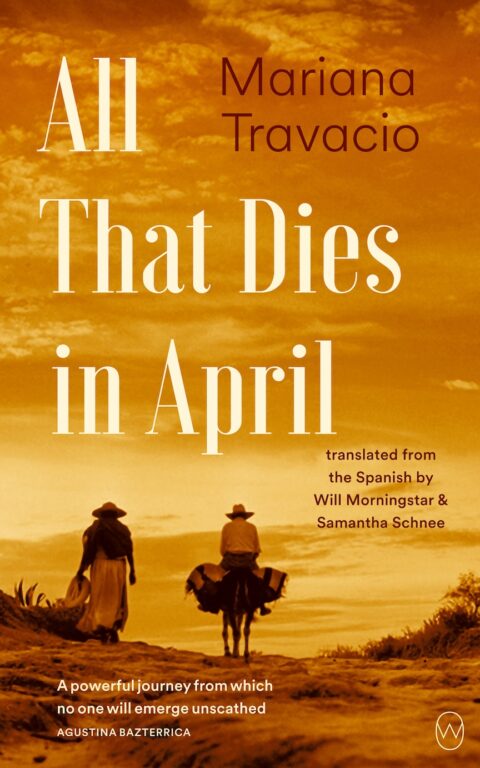 All That Dies in April was published by World Editions on September 9, 2025. You can acquire a print or digital copy from IndiePubs by clicking here or from Bookshop.org by clicking here.