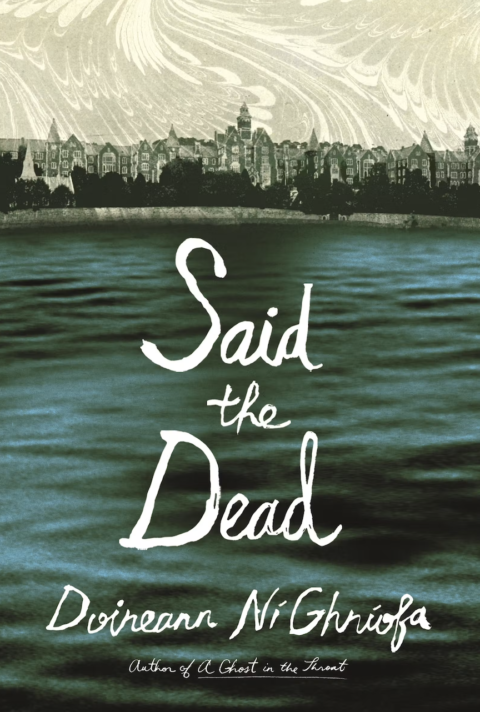
Lines can be porous in Doireann Ní Ghríofa’s works. The Irish poet’s debut book of prose, A Ghost in the Throat, a deeply personal homage to 18th-century Irish poet Eibhlin Dubh Ni Chonaill, displayed an uncannily light touch while it skipped among autobiography, literary history, fiction, and bilingual poetry. Her second prose work, set chiefly in an Irish mental hospital in the last decades of colonial rule, Said the Dead, dabbles in the same genres, except poetry, and adds social history. Where Ghost also traversed centuries and undulations of tone, the new work focuses on a period of about 25 years (ending in 1923) and maintains a deceptive level of tonal control over its many moving parts — chief among them, the voices of dozens of former mental patients of a women’s mental asylum.
Channeling the voices of dozens of real former mental patients, the book’s pages witness no small complement of suffering and strife, but with a certain equanimity. Misbehavior, too, when it does appear, is enjoined by a safe psychic distance. Paradoxically, this line isn’t crossed. Ní Ghríofa enters into a covenant with this past, hoping that by carrying their stories forward she can restore a small measure of what was taken from them in life. The primary tension in a surprisingly frictionless story stems from competing imperatives to liberate these women, not far past living memory, and protecting them.
⟐
Said the Dead emerged as Ní Ghríofa grew curious about the female patients held in the women’s wing of the vast, derelict Our Lady’s Psychiatric Hospital in her city of Cork when it began undergoing redevelopment in the late 2010s. Her own periods of acute depression could have seen her interned behind its walls, she reflected, had she been born in an earlier time. On a whim, she arranged a viewing of a chapel undergoing renovations, its empty stained-glass windows covered in plywood board. In the dim interior, a “finger of light” shines through a dropped knot, so sharp its “beam gripped her chin and turned it,” like a visitation. “The vapours that had risen from warm bodies in the pews would have carried syllables mixed with candle-soot,” she thought, “distilled as condensation on the chapel windows.” The bond was sealed.
 From then the author makes frequent visits to the hospital grounds, an admixture of finished upscale apartments and partly converted and untouched dormitories, chapels, and infirmaries. In a book infused with exquisite prose and striking images, these pages may be the lushest and most alive. One day …
“A blackbird dashed by, and she took his beak for an arrow. It pointed her towards a herd of piebald horses, one of many such herds that roamed the city’s edgelands, between factories and slip roads and estates, where they were named and held beloved by bands of freckled cousins. When she approached, opening her arms, the tallest mare strolled into them, with slow eye-lashes and hopeful, bristled lips, and she whispered to her as she worked brambly knots from her mane.”
⟐
The author soon immerses herself in the hospital’s salvaged records, spending her children’s school days turning pages in the municipal archive (no coats permitted, nor keys or bags or pens), mesmerized by the stories held in the women’s wing casebooks. In their pages she meets young women and old, wayward teens and abandoned wives, mostly from poor families, as well as a few artists and budding writers hard on their luck.
Tacitly Ní Ghríofa enters into a covenant with this past, and the primary tension in her project stems from competing drives to liberate these women, not far past living memory, and to protect them. This shielding goes two ways, however; the ardor with which the researcher-author submerges herself in this past allows her to safely squirrel herself away in the compartments of the casebooks. Each day she returns to untie the ribbons that hold fragile blue pages together and transcribes doctors’ notes documenting symptoms, diagnoses, and the patients’ own stories — until March 2020 blows in, bringing the Covid-19 epidemic and the shutdown of civic life.
Shunted into a daily cycle of homeschooling, housework, and grief in the wake of the unrelenting pandemic and a family death, she falls again into depression and visions of drowning in the river. In the evening, her bones are “so heavy that when she dragged herself upstairs, she had to use her palms against the steps.”
⟐
Perhaps it would be more accurate to say that “the Reader” immerses herself in the archive. In some ways reminiscent of In Search of Lost Time, Ní Ghríofa’s unclassifiable book is slippery in its point of view, as in matters of narration and character. Such are the gossamer seams the author sets in place, creating real yet elusive pressure points along the edges of history, fact, and imagination.
Ní Ghríofa, having begun her research, has dispatched the mysterious Reader to continue digging, or at least share the duties. The Reader is dogged in her desktop research on the history of the institution — established as the Eglinton Hospital in 1852 under the colonial Lord Magistrate and shuttered in 1992 — scouring digitized newspaper and national archives, ordering all the reference and history books that might be relevant. The lure of the river waters fades.
When the archive reopens, the Reader embarks on twin purposes: to research the life of Lucia Strangman, a pioneering female physician who made her career in the hospital’s women’s wing; and to retrieve and hold the lost stories of her patients. The Reader is the protagonist of Said the Dead, but one who positions herself as vessel, often sharing out the leading role to Dr. Strangman and a selection of patients. The Reader’s story, in turn, is told by an unidentified narrator, who offers brief, periodic commentary.
⟐
 As the book progresses, Lucia Strangman’s unfolding biography, fastidiously researched and partly fictionalized by Ní Ghríofa, offers its most coherent and rounded narrative, a steady support to the excerpted patient lives deposited in casebooks. It is with these fragments and scraps, though, that the author creates concise, powerful portraits from which we can infer much about the lives of Irish women around the turn of the twentieth century.
The women met in the casebooks endure poverty, abandonment, continual childbearing, and destitute motherhood. They are turned over to the asylum by magistrates, instability ascribed to causes such as “disappointed love affairs,” “lactational insanity,” or “shock and menopause at the same time.” Girls are exiled from family due to pregnancy. Babies born to indigent women are routinely sent to the workhouse, where they summarily die.
Gleanings from Strangman’s case notes reveal no shortage of personalities. Jane revamps her hospital gown and struts about in a “glamorous turban of many-coloured wools.” Violinist and artist Anna Martha waves a gun at the magistrates who’ll decide her fate. Pregnant Bridget, raped by a man in America, returns to Ireland when she is banished by her brother. When she defies the shame and expectations placed on her, the Reader cheers, but as with so many women of the casebooks, things don’t end well for Bridget. Teenage maidservant Emily Elizabeth is the rare patient who clearly recovers, rallying when she begins writing stories and poems; she is among several women for whom the author assembles a fuller picture through combined further research and imagination.
Years of research were rewarded when Ní Ghríofa turned up hundreds of photos of hospital life, perhaps two dozen of which are reproduced here in full or as fragments, floating and uncaptioned, in a Sebaldian manner. One absorbing image shows four attendants in starched white aprons and caps assembled in the dayroom. The Reader tries to meet their unyielding eyes: were they kind or cruel? “Between seeing and perceiving comes a neural lull, micro-seconds in which a vision carries a lantern along the corridor of the optic nerve, running on bare feet, soles on stone,” she reflects before spotting the half-hidden image of a fifth starched cap atop a fifth stoic face standing at an iron-barred doorway, fists clutching metal.
Said the Dead — a lyrically written, sui generis fusion of research and deep compassion — wants nothing less than to set free the women confined behind those bars.
⟐
Besides her laying out biography, episodes in Dr. Strangman’s life serve as postcards from the world beyond asylum walls. The First World War comes into focus largely through the doctor’s voluntary work with wounded soldiers at another hospital. The failed Easter Uprising of 1916 rattles patients already rattled by the Great War. (We are not privy to Strangman’s or patients’ experience during of the 1918 global flu pandemic, which ravaged such institutions.) Once the Irish war for independence begins in 1919, we witness hunger strikes, political assassinations, battles in the streets of Cork, and the rampages of the vicious mercenaries, the Black and Tans, dispatched by Churchill.
An important history virtually absent is that of the abuse and neglect long endemic to congregate institutions, widely recognized since 19th-century publications such as Nellie Bly’s Ten Days in a Mad House. Two-thirds of Said the Dead passes with no reference to these intractable problems other than a note of an attendant who slapped a patient; finally, after years of casebooks pass, the Reader is greatly disturbed when she finds a patient letter that alleges neglect and abuse. Alarmed, she flees to the restroom with the sudden knowledge that until now she’d seen the asylum strictly from the perspective of the doctors. When she returns to the letter on the desk, though, its over-the-top horror-movie scenes reveal the accusations as patient delusions. In later pages, the Reader finds this patient recovered, no more talk of blood. After this episode, she doesn’t search for other eyes to look through, which would complicate the story she’s been forming for so long. All she can do is keep reading, she tells herself. “She had woken these voices, and to stop reading would silence them.” Point taken, but in a book of virtuosic formal feats, of such beauty and generosity, to elide the keenly relevant history of such suffering and consequence forms a commensurate, overlapping silence.
[Published by Farrar, Straus & Giroux on September 22, 2026, 353 pages, $29.00 hardcover]