In the fall of 2021, near the conclusion of a two-year writer’s residency at the Swedenborg Society in London, Chloe Aridjis was asked to tell a series of stories, not using words as she was accustomed to doing, but images, specifically images projected by a magic lantern. In its simplest incarnation, this antique device, which dates back to the 17th century, is nothing more than a box, a lens, and a light source. A magic lantern show can simulate animation, achieved by quickly swapping out or cycling between slides, but it generally comprises a succession of still images, each projected for 30 seconds or more onto a wall in a completely darkened room. It’s a way of engaging with visual objects that is incongruous with our current age, when everything from photos to videos to news to emails to messages to social media is designed to be consumed quickly, scrolling from one item to the next with little hesitation while your attention is divided between the device in your hand and whatever is going on around you as you walk down the street, or watch something on another bigger screen, or carry on a conversation with your friends, or eat a meal with your family, or sway back and forth on the subway.
 Aridjis, who was born in New York City but grew up in Mexico and the Netherlands, where her father served as the Mexican ambassador, became fascinated with magic lanterns while working on her doctorate at Oxford University in the early aughts. She documented the development of her Swedenborg show in “The Allure of the Analogue,” an essay for the London Review of Books that was later included in her 2024 omnibus, Dialogue with a Somnambulist. Describing the mood that came over her while selecting the more than 100 slides projected during her show, Aridjis wrote that she “surrendered to a state of free association and felt an exhilarating sense of compression and distillation as stories grew out of unlikely juxtapositions.” Magic lanterns are “inherently ghostly,” she wrote, but in her hour-long show, titled Stilled Shadows, the ghosts were unobtrusive, inviting viewers “to make psychological readings of inanimate objects.”
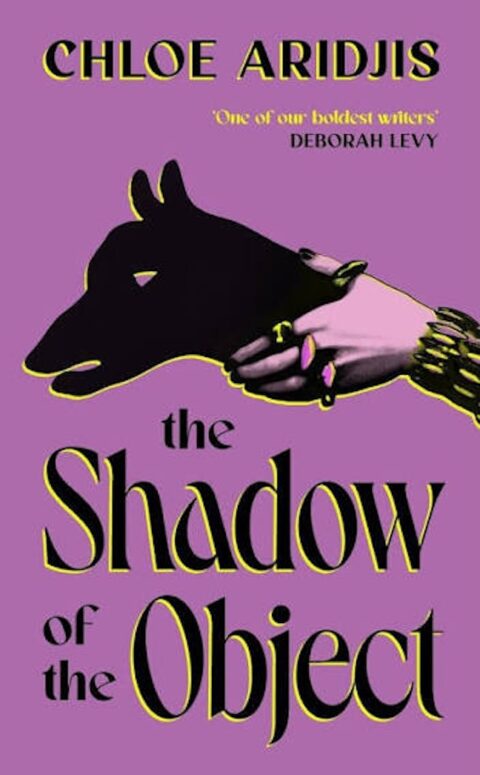
These same juxtapositions and ghosts can be found haunting the pages of Aridjis’s latest novel, The Shadow of the Object, which appeared first in the United Kingdom, and is newly released in the United States on the heels of its inclusion on the Booker Prize longlist. It’s a contemplative novel, one probably better suited to a lazy afternoon when you have time to contemplate individual passages. Narratively, the novel is built out of a series of relatively static scenes — conversations in corridors, slow walks along a canal, a mouse exploring an after-hours library — that occur on either side of two magic lantern shows. The larger story of the novel, its message or messages, can be found in the associations between those scenes, the overlap between their afterimages, the questions they pose about the many meanings of the ideas of permanence, perfection, illumination, enlightenment, and illusion.
Flora, a 40-something Mexican, and Wilhelmina, a septuagenarian German, are strangers who are both visiting Mexico City from London when they end up in the same hospital. Flora, who came to see her mother and stepfather for the first time in three years, has been badly bitten by the family’s 11-year-old Alsatian. Wilhelmina, who is attending a conference, contracts pneumonia, an ailment she’s battled off and on since a childhood bout of tuberculosis. During one of the women’s late-night encounters in the hospital, Wilhelmina explains that she and her late husband once owned one of the largest collections of pre-cinema projection devices and toys in the world. She has traveled to Mexico with her lone remaining magic lantern and puts on a show in her hospital room, enrapturing Flora, who “longed to shed the prosaic world of the ward and everything beyond it, to lose substance and dissolve in a beam of light.” When Wilhelmina dies suddenly, Flora agrees to transport both her ashes and her magic lantern back to London, where she turns them over to Wilhelmina’s son, Max. He and Flora develop a comfortable, cigarette-and-whiskey fueled attraction of their own, and eventually put on a magic lantern show for the employees of the jewelry shop where Flora works.
Prior to that show, Flora notes that her co-workers are intrigued by “the idea of old images thrown in the dark.” It’s an evocative and provocative way to describe not only the event but the way so many of the novel’s key moments and themes are presented, appearing in or growing out of darkness, literal or metaphorical. Wilhelmina is first seen in the distance, “an intriguing silhouette at the end of the [hospital] corridor,” “a figure in the darkness projecting her gaze, nothing but a gaze.” Back in London, the jeweler’s “dimly lit workshop” where Flora polishes and rejuvenates silver rings is likened to “a giant’s cavernous interior, or that of a biblical whale.”
Darkness also derives from the shadows falling on and around these characters’s lives, shadows that stretch across ages and continents. Flora is haunted by the shadow of her father, an electrician who abandoned the family when she was a child, choosing the double life he led in the north of Mexico. Late in the novel, she perceives him in a lightning flash, a “moment of illumination [in which] so many emotions swept over me, rage and adoration and an awful kind of terror.” Even though decades have passed, Wilhelmina’s life is still overshadowed by the drowning death of her husband, an event so traumatic she abandoned Germany for England in order to escape the river into which he “fell or jumped, we’ll never know,” and then months later, sold off her “kingdom,” their shared collection, their obsession, everything except the simple projector that would make its way to Mexico City.
 Aridjis has written about her love of dance clubs, which she habituated in both Mexico City and Berlin, and has seemingly assimilated an unfailing instinct for the pacing of her prose, blending together everything from lengthy chains of clauses to abrupt fragments with the skill of one of the DJs who unfailingly appear in her novels. Here’s Flora on one of her first nights in the hospital: “I listened to sounds distanced from their sources, seconds pooling into minutes, minutes into the purrs of machines, purring in a different language from my machine at work, and now and again these machines would merge with the sound of elevator doors stuttering open and closed, until into this mechanical soundscape entered the voice of a woman, an elderly woman, calling out for a nurse, a doctor, anyone.” Or later on, when she is walking with Max in London: “I sensed a hidden pact between everything, a density forced open for an instant. Winter branches wrote their foreign messages overhead. A blackbird. A wren. Birds who had stayed behind, not answering to any migratory call. Yet the human species appeared to be obeying some sort of winter brief, and for a long stretch it was only the wind that walked ahead of us.”
Aridjis’s attention to language also reveals a gimlet eye for detail and perception. Wilhelmina’s memorial, an event described in the language of the magic lantern (“the faces and voices merged into one vast portrait, everything transforming or dissolving into something else, no scene, no existence, ever self-contained”), includes several indelible images. Wilhelmina’s “eyes were as quick as a taxi meter.” And as a rare female collector, she was “tougher than any man. A chimney stack against the wind.” Like many a multilingual author, Aridjis functions as her own translator at times, opting to use words or phrases in other languages, Spanish or German, to add an extra layer of meaning. Describing the skeleton of a pez diablo, or devil fish, she moves from poet to genre writer in successive sentences: “Caught, carved and laid out to dry into something demonic. Its mother would have once terrorised a Mexican lake, unaware that one of her children would end up as a curio.” And she nudges readers toward deeper consideration of the novel with a seemingly irrelevant introduction to a description of Flora’s jewelry job: “In Spanish to ‘dar vueltas’ to a situation means to turn it over in your mind.”
The novel’s many episodes and allusions fit themselves together again and again, an idea Wilhelmina introduces at the hospital, saying that “we have but a finite number” of emotions that get repeated throughout our lives and down the years, “the same gestures are repeated over the centuries in one vast theatre of the soul.” Later, when Flora starts planning the show for her co-workers, she recalls “images from the past few months, each an unfinished story shedding its own tenuous light, each slightly teasing, a slight stretch of reality, all part of a bid, perhaps, for a new perspective.” That new perspective is what she is ultimately chasing, and what everyone should be chasing according to Wilhelmina, who refers to it as a “swerve,” “that moment when we defy our nature and deviate from the path we find ourselves on, a cleavage between before and after.” The magic lantern shows are pivotal events for Flora, but whether she swerves after either of them is rather uncertain. Near the end of the novel, Flora and Max take a steamer down the Thames, and briefly fantasize about a life together in a new spot. “It would be so very satisfying, wouldn’t it, to observe a work in progress and see it evolve over time.” For that to occur, however, Flora would have to be open to change and not pre-empt it, would have to allow space for evolution, maturation, contemplation. She would have to, much like the reader of this beautiful novel, take time to observe the shadow that a person or a memory or an image or an object has cast down the years.
[Published by Semiotext(e) on October 20, 2026, 216 pages, $17.95 paperback]