The Public Poetry of Americans
There are several types of poetry collections published in English translation, but Boris Dralyuk’s rendition of Alexander Voloshin’s Sidetracked: Exile in Hollywood is an uncommon sort. It is neither the hottest new book of a contemporary world writer, nor is it a retranslated classic of a recognized great. Instead, it is a foray into the archives of the American immigrant past. While Dralyuk, a poet, translator, editor, and professor at the University of Tulsa, doesn’t reveal the full story in his introduction behind his choice to translate this book, he gives us a glimpse into the historical awareness and archival research needed when he writes that he “finally acquired a fragile, hard-to-find copy of his slim collection of poems and prose, Sidetracked …” The value of this translation is, in a sense, two-fold: it is valuable as a new voice in the national archive of the American story, and it also inspires us to imagine how many more similar stories might be unearthed by persistent archivists eager to fill out the portrait of who Americans have been.
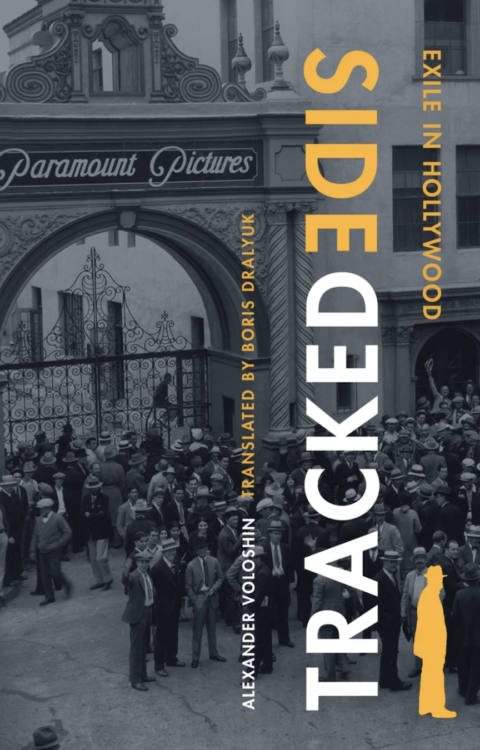 First published in 1953 as part of a longer collection of poetry and prose, Sidetracked: Exile in Hollywood is a novella in verse. The form is rhymed couplets of iambic tetrameter — or, Hudibrastic couplets, referring to the form of Samuel Butler’s Hudibras (1663-1680). This form is frequently the chosen prosody of mock epics, and yet Sidetracked isn’t long enough to be an epic, and its satire doesn’t mock or “cut down to size” anyone needing such a return to reality. Its satire is gentle, and its irony is self-deprecating. While the subtitle emphasizes the centrality of Los Angeles, when read as a travelogue, the book’s geographical arc becomes clear: the narrative takes us from Ukraine to Turkey, New York, and finally Los Angeles.
Satire as a public form
Like any form of humor, satire relies on the existence of a community of readers who share a worldview, literary sensibility, and points of cultural reference. From its satirical tone, this volume reminds the reader immediately of the difference between poetry of the past and today. As I read this book on returning from India where T. S. Eliot is still widely quoted (though essentially shelved here), the idea of poetry’s social function returned to mind. One notion of social function requires the poet to speak through their own voice for a community, and yet this is largely seen as an outmoded way of writing in the US, since the national monoculture has morphed into various special interest communities. In contrast, many of the pleasures of Sidetracked come from how the author situates the White Russian émigré community within the national story.
The book also serves as a refresher course on the collapse of the Russian Empire and a reminder that history is cyclical. Case and point come in the status of Ukraine within the Russian Empire. “Kyiv …” the long poem begins, setting us directly into both history and contemporary times:
I feel obliged to use
all my skill to tell the tale
of the foul destructive gale
that swept over our fair city …
The city was contested by Russian Imperialists, Communists, and then the Germans — read, Europeans. Now, while Russian imperialism and Communism have combined in Putin’s despotic reign, back then the Germans, unwelcome interventionists to most, were preferable, and the narrator writes, “We were hoping, as [the Germans’] guests, / we might finally get some rest …”
Yet, after the German Hetman’s short time in power (mere months), the Reds overwhelmed the South in 1920. If Europe cared, as it said it cared, it was strangely silent: “Where was Europe all the while? There were promises, but no / so-called ‘allies’ ever showed.” Since 2022, these words have had an eerie ring to them. Ukraine, it would seem, has at least for a century been stranded in the no-man’s land of false European promises — though, of course, in the most recent war, the withdrawal of American commitment to a demilitarized Europe has been as salient as the equivocation of European allies.
The life of the émigré begins as Voloshin traces his emigration from Russia. If life at home is routine, then the life of the émigré is both uncertain and full of the excitement of a society tilled and ready for new seeds to sprout. First, in Istanbul, “Some of us even revealed / talents theretofore concealed.” Acting, painting, cooking, being a croupier, cab driving, singing … new identities form while abroad. Then, the American myth — once a lived experience of immigrants from every corner of the globe — begins in New York. Initially, hope persists because “most importantly— / here we’re all treated equally.” The Old World’s social hierarchies, encrusted over centuries, suddenly have no bearing on opportunity. In Harlem, a community forms over food: “An exile’s heart is quick to heal / with the help from a familiar meal …” This reminds me of my mother’s stories of her father, a Russian émigré from Ossetia, who would drive the large family down to Seattle’s Chinatown on Saturday, where he would spend the day at a Russian’s house, eating and talking with fellow émigrés until the evening.
The final Los Angeles chapter begins three-quarters through the book. New identities first formed in Istanbul are now tried out again for size; new identities are again needed:
Russian Los Angeles was rife
with folks from every walk of life —
doctors and actors, engineers
and journalists with stalled careers,
professors and provincial dentists,
even a typesetter’s apprentice.
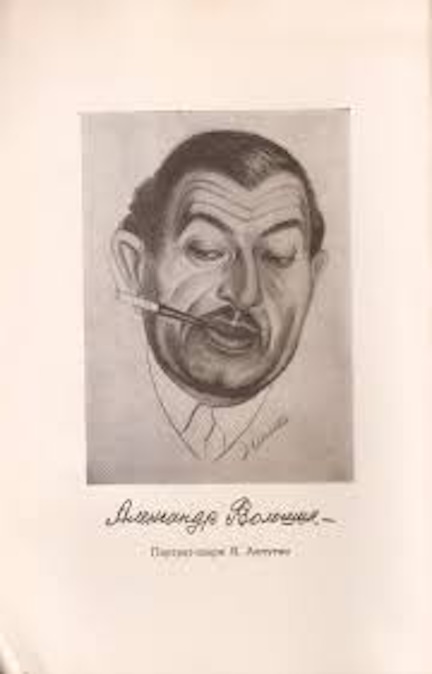
These lines remind me of the types of professions that my grandfather exercised: a gold miner in Alaska, a private in the US Army, a greenhouse caretaker. The story of Voloshin’s experiences as an extra in Hollywood movies, referenced in the book’s subtitle, reveals the poet’s most concerted attempt at self-satire. He stands at the studio gates in the morning:
Friends, I won’t lie: you’ll find me there —
not very often, no, but still …
Why be ashamed? What’s the big deal?
I earn a little “pocket money,”
which keeps my disposition sunny .
 The poem reminds us how Los Angeles has always been a town of displaced persons — an immigrant town — in no smaller measure than New York City. Many of the single largest immigration communities in the United States are found there; it boasts of the single largest Korean population outside of Korea, the single largest Iranian population outside of Iran. Like New York, Los Angeles is a patchwork of immigrant communities. Yet, Voloshin complains of the uninspiring fare of Russian newspapers and publishers available in exile: “But I regret to say our press / leaves quite a lot to be desired …” The intellectual life of the immigrant can be isolating. Hopes may diminish. The latter chapters of the narrative poem focus on regret: “We’re getting old: joy seems to fly / farther away from us each year.” As émigrés age, a sort of false nostalgia brews:
While roses bloomed, we thought of snow
and of our luck; how could we know
that we would someday feel so haunted,
that snow would be all that we wanted …
Encyclopedic chronicles
The Romanian poet Radu Vancu states that poetry can digest anything. In The Rope in Bloom (University of Chicago Press, 2016, tr. Paula and Cyrus Console-Șoican), Vancu sees poetry, paradoxically, as an almost novelistic form. He writes, “[poetry] doesn’t just chew things up; it digests them” and “Nothing is too hard or too complex for its gastric juices.” Poetry is unique because “no other narrative could profitably combine such disparate elements.” It “accepts any number of grafts and comes out the stronger for it.” This may be true when you consider poetry in its entirety. But it is most true for maximalist forms of poetry: the chronicle, the novella in verse. While short of an epic, Sidetracked is a rattlebag of information. Information takes the form of proper nouns. Voloshin contrasts the fates of Russian émigrés in Europe and in the United States. In Europe, they could only obtain Nansen papers, effectively, passports for stateless people, while in the US, they could become citizens: “we are ‘Americans,’ for we / have pledged allegiance — honestly!” Today, when our immigrants are hunted and expelled, when visitors are asked pointless, invasive questions at customs — my Swedish friend, returning in August after a trip in the winter, was asked, “Why did you come in January?” — we see how far our national ideals have fallen. Tracing the genealogy of a family forced to procure false passports, Voloshin shows off some of his best humor as the text lapses into the absurd dimensions of what the émigré’s family is forced to do:
[Émigrés] are all a bit embarrassed
to say Dad’s Greek and Mom’s from Paris,
daughter’s a Pole, son is from Rome,
uncle is Czech, aunt’s from Trabzon —
while Grandma is from Mexico,
Grandpa’s a Hindu, don’t you know …
Though her appearance may well fool you,
mother-in-law is now a Zulu —
no, wait — Chinese? Is it Korean?
Morozov’s Dutch, it’s plain to see, and
old Koryakov’s from Budapest …
Poetry like Voloshin’s, which celebrates the fabric of life from the American past, is a necessary reminder of the good that this country once embodied — and can return to, as we hope it will, in the near future. It was and might well still be a country where ethnic identity does not matter, where the only criteria for citizenship is a pledge to support the democratic idealism that has defined the best moments of our past.
As a translator, Dralyuk deserves praise for his archival work of recovery and representation of an essential American story, but, as the reader can see from the above excerpts, also for achieving the near impossible for an American poet today: reconstructing a prosody that includes rhymed couplets, and for slipping seamlessly into a voice that produces parody, self-deprecation, and honest humility, not as a self-conscious strategy for winning personal likes but as a way of subsuming the self within a greater national ethos and the narrative arc characteristic of the lives of millions.
[Published by Paul Dry Books on April 21, 2026, 99 pages, $17.95 paperback]