Scaffolding a World of Refuge
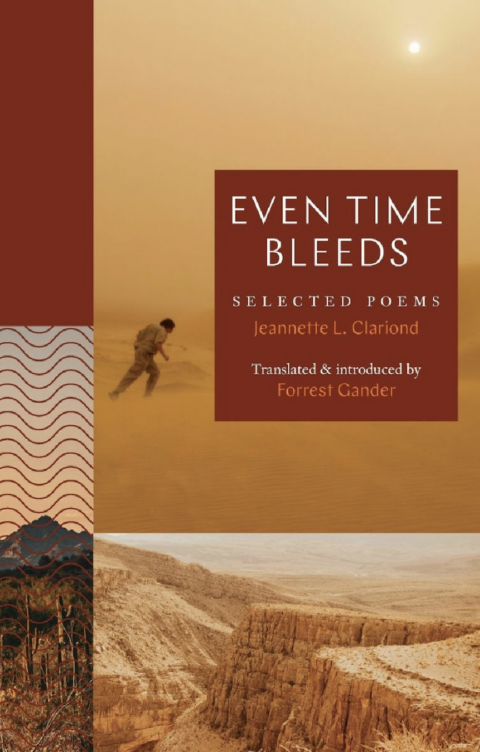
In Even Time Bleeds, the poet and translator Forrest Gander selects and translates poetry from nine books of poetry by the Mexican poet, translator, and publisher Jeannette Clariond. Clariond’s poetry crystallizes an imaginary world built of the elements, where words inhere in things but don’t structure reality. Of the elements, water is primary — with its fluidity, its way of making watercourses, and shores. But also its own elemental violence. Clariond’s world is a fantasy in one sense, but it blunts the violence of reality — historical violence, but also misogynistic violence.
In his introduction, Gander suggests that the reader,.s instead of worrying about knowledge, about what we already do or don’t know about Clariond’s life, career, and poetry, instead of focusing solely on the “psychological acuity” and “linguistic attentiveness” that he sees in the poetry, may instead “feel [our] way” through the poems as much as read them. For me, one word spontaneously appeared while reading the volume. Refuge. And this word asked me to locate two things. First, refuge from what? Second, refuge in what? But also, more than simply articulating the need for refuge, how does Clariond’s poetry manage to construct a world of refuge?
Scaffolding a World
The Buddha’s First Noble Truth is that life is full of suffering, and the age-old adage is that writers write because the world fails them (and because they’re not Buddhist monks and nuns, evidently). Writing is a way to combat disappointment, hurt, and injustice, whether personal or public. The sense that Clariond writes as a response to life’s trauma is evident from this book’s first pages where the rape and murder of three girls is recounted in an extract from Goddesses of Water.[1] The speaker identifies with them to the extent that her body too is “raped, its limbs lopped, / slopped into a swamp.” The poem is a litany of violence, femicidal rage, and horrors. The physical trauma is clear in phrases such as “wake / of lacerated faces,” “bouquets of excruciations,” “dismembered corpses,” “bite marks on their breasts,” “eyes blindfolded”; it amounts to “endless despair.” In response, only one possibility exists: the world is so full of anguish that “Even time bleeds.” This violence is a world to run from.
 At the level of the translation, there are positive reasons to linger. Of course, each language has its sonic centers, words come together in unique phonic ways that are unmappable onto other languages. The sonic consonance of Clariond’s second line, “sido violado,” becomes displaced into “lopped / slopped,” whose meaning comes from the following phrase, “mis restos arrojados.” Likewise, in the following lines, the swamp scene gains English resonance through “muck” and “murk” when the Spanish doesn’t directly promote this image-sonic pairing. Gander is clearly looking for ways to transpose the consonance and assonance of the Spanish poetry. Throughout the volume, some of Gander’s most convincing choices come in finding ways to root in the English physical world through Germanic monosyllables.
Clariond’s Spanish genitive immediately shows its creativity beyond the normative way it marks possession. Joining two nouns by “of” can be a primary means of figurative language when the conjunction is abnormal. (This is the American poet Elizabeth Willis’ trick in Turneresque, for example.) The line “bouquets of excruciations” is case in point. Not knowing the meaning of the latter word, I consulted the Spanish to find “humillaciones,” which, although I don’t know Spanish, would seem to be a cognate with “humiliations.” This is evidently figurative language, and the harsh sounds of the English accentuate the torture these girls went through. So, excruciations. And, as a general commentary, Gander uses the three options to render the Latinate genitive — apostrophe “s,” a compound noun, or the “of” function — creatively, idiomatically, and pleasingly, showing again the value of human agency in a way an algorithm would have a hard time matching.
The sense of the trauma of living and the possible refuge of an imagined world, constructed through language, starts the next poem, a fragment from Ammonites: “Intolerable the world if it could not be thought.” This thinking is, for the author, poetry: “Poetry is exile, to the origin.” Exile is refuge when the present produces harm. This sense of an inverted world, a mirror image, or reflection that mitigates the real world’s violence, continues to the fragment’s last line: “I succeeded in marking your absence my residence.” Whose absence the speaker means seems less important than absence per se, the physical transmuted into memory, imagination, and an inner image. The world of refuge that Clariond constructs is a parallel world, a counterfactual one, imagined (and real for being imagined) but never fully resided in. In “Passage,” this outline of a new world returns: “Reality is something that doesn’t / happen; living is something / else.” The sense of this emergent world beyond the real defines as well “Looking At What’s Looked At,” which ends, “Under the water, my feet step away from the real.” In this general climate of seeking refuge from a hostile world, poetry, or creativity in general, may not be an entire world, but it has a reality that sustains: “But what remains / intact / is the Word” (“Indelible Radiance”).
Very few poems are located in what we might recognize as the world-as-we-know-it. “1004 Mina Street” is located in Chihuahua, the poet’s home-state in Mexico, in 1963 (the only poem included from the volume Chihuahua Notebook), but the poems almost exclusively construct, accentuated through Gander’s selections, this secondary world of refuge, built through poetry and almost mappable (like a crystal, or an occult symbol) through a cross-relation of elements. While reading, I kept noting these connections:
Water, mirror, portal, poetry, light, the word.
__________________________________
Reality, harm, violence, unbearable presence.
 In the world of magic and the imagination, mirrors are a lasting symbol for transport; they suggest a magical portal, at times to the imagined world that the speakers of Clariond’s poems frequently try to access, while sometimes that access is blocked. The speaker in “Scar” imagines their mother, who is “inside” the imaginary space of memory. Her trauma is evoked through the image of a “mirror weeping human tears.” The very next poem in the collection, “Sky of Shadows,” uses the mirror, again. The speaker addresses Samara, a Hebrew guardian spirit, who has left her only “this mirror reflecting leaves.” The use of the mirror continues throughout the book. For example, a section of the Ammonites gives us, “The mirror observes me not knowing who it observes.” Here, the idea seems to be that the mirror reflects exteriors without knowing interiors — the psychic worlds that bodies contain. From an untitled excerpt from All before Night, “my words go to pieces / in the mirror.” From “Heavy Swell,” a poem from The Tears of Things, near the end of the book, “In the mirror, rain falls over gray waves.” Here, we have the confluence of the mirror as a magical portal, and the imagery of water: a double water image, rain over waves. While the poems don’t use the word “surreal,” the imagery and use of elemental vocabulary recall the French surrealist Jean Follain (1903-1971), and the title recalls, at least to my mind, Salvador Dali’s “The Persistence of Memory” with its melting clocks. Recall, as well, that the background to that painting is a sea. Still, Clariond’s images are more magical and spectral than surreal. They avoid the label often applied to postcolonial, postmodern work of this sort, magical realism, because they are not tied in an obvious way to history, as Gabriel Garcia Marquez’s novels, or early Salman Rushdie.
The poetry strips back the extra, the social, the trauma of living with people, to try to get to a physical, spiritual core that connects us across chronological time and to the physical world. “Nakedness is safe haven,” one section of Ammonites ends, and in this phrase, there is a conjunction of refuge and, again, water: the stripping of our social layer, clothes, produces refuge in elemental life. It is interesting that this elemental poetry doesn’t map immediately as nature, or eco-, poetry, but that is due to its slightly surreal, or irreal, frame, either accessed through a mirror or a portal. It is a dream world, an imagined world, whereas eco-poetry has a clear rooting in the historical world of society. Gander’s preface asks us to trace the emotional line through the poems; emotional intelligence is not, however, the ends, but the means to the imagined spectral-spiritual world where wholeness is possible.
To return for one last moment to the translation itself, the fact that the Princeton Lockert Library of Poetry in Translation uses dual-language editions needs to be pointed out, not for what the original language’s presence allows in the worst-case scenario, namely, the amateur reader’s search for any degree of difference, construed as “error” (the disrespect of the translator is legend), but for what it might do in the best-case scenario, that is, to allow the reader the opportunity to see into the work of translation as art. Let’s return to Clariond’s use of the genitive as a signature device to unaccustomed metaphors, through two nouns mirroring each other. The title of the poem “Looking At What’s Looked At” suggests, once again, a mirror, and the poem provides, to my count, eleven genitives in ten stanzas:
glow of golden leaves
silence of fragrant agave
fresh blood of desire
mirror of the mirror
trajectory of the stars
vastness of the sky
tendernesses of water
passing of this season
emergence of the pear tree’s snowy buds
rains of love
the palm of my hand
The repetition of the syntax provides rhythm, constraint, and expectation. The variety of images is evident as well, from the prosaic “the palm of my hand” to the poetic “tendernesses of water.” For each instance, Gander has three options, and he uses the “of” linker in all but one case, “the pear tree’s snowy buds,” where he uses the apostrophe, perhaps because the phrase is a double possessive construction. Yet, there is no absolute law for him. Two poems later in “Scar,” he uses “temple horses,” a lovely English phrase, for “daballos del templo.” One poem later, “Sky of Shadows” (yet another genitive), he uses in the first line the apostrophe, “the Lord’s hand,” for “la mano de Dios.” This variety shows human ingenuity behind a basic decision to retain the Latinate genitive across the book as a whole.
Conclusion
This is Clariond’s seventh book of translated poetry, but it is different in being a selected volume. This honor is conferred on poets with long careers (who have written a lot), but it also presents a singular challenge. Selection. The translator, as editor, has done considerable work not only by choosing individual poems but by not choosing others, and this task exists quite beyond his logic of translating poems that haven’t been yet translated. One still has to arrange the whole, and the translator’s intuition has constructed a whole that provides through-lines and a “narrative” for the volume. Perhaps the most obvious addition attributable to the translator’s work as editor is the inclusion of the sentence poems from Ammonites, Clariond’s last translated poetry volume (World Poetry, 2022), as refrains, or section breaks, among the poems from other books. These were some of my favorites due to the way the sentence unit creates an almost philosophical quality, somehow redolent of L=A=N=G=U=A=G=E experiments. Yet, while a selected volume does celebrate the author with something like a lifetime achievement award, it leaves questions for a new reader, such as myself, to wonder about, such as how the images of water and mirrors read in each book. That will be my bookmark for further reading.
A Marxist would say that we must remain in history to make sure we pass beyond the exploitation inherent in capitalism. A Buddhist would teach pacificism, meditation, and acts of charity in reaction to the world’s trauma. Clariond’s poetry is a continual search for refuge through words, poetry, and the imagination. It both seeks a refuge, and in its quest, provides refuge, a buffer against, a safe haven. Reading her poetry, I recall the basic magic of language: words, as both the subjects and objects of creativity, let us inhabit worlds one step away from this world — worlds that exist only in our imaginations, but worlds that save us from this world and from the worst parts of ourselves.
[1] Reviewed by Ken Walker, “The Tectonics of Patriarchy,” Review of Goddesses of Water by Jeannette Clariond, translated by Samantha Schnee, The Oxonian Review, 15 May 2023, https://oxonianreview.com/articles/the-tectonics-of-patriarchy.
[Published by Princeton University Press on January 13, 2026, 168 pages, $19.95 paperback]