Charlotte Salomon (1917-1943) was a German-Jewish artist. She grew up in a family with a complex web of maternal-line suicides, including her mother, aunt, and grandmother. She escaped Berlin for the south of France after Kristallnacht in 1939. Between 1940 and 1942, she compulsively created her work, “Leben? Oder Theater?,” “Life or Theater,” which was hidden during the war. In September, 1943, she was hunted down by the Nazis in Villefranche, deported to the prison camp at Drancy, and from there to Auschwitz where she was murdered upon arrival in October, 1943. At the time of her death, she was five-months pregnant.
♦ ♦ ♦ ♦ ♦
Invisible
Nice, 2025
You are always thrown back on your own resources. There is nothing else.
— Etty Hillesum, Diaries
A Russian couple: tall-made up-platinum-blond-straight-haired wife, and tall-overweight-former-athlete-type husband pushing a sleeping infant in a baby carriage, walked into the hotel dining room behind me. I stood waiting for the maître d’ and the husband pushed past me with the stroller, and asked to be seated. The maître d‘ said, yes, of course, are there four of you, counting me (and the sleeping infant in the stroller). I shook my head and said, in French, no, no, I’m alone, and the maître d’ said, to the man, of course, just you and your wife and baby, like earlier, at lunch. The wife said to her husband, in Russian, that girl was here first, and he responded, what girl, then turned and saw me and said, it doesn’t matter, we have a baby, we should go first. I remembered an email the art historian and scholar Griselda Pollock had sent to me in response to my note telling her about my trip to walk in Charlotte Salomon’s footsteps and asking for advice. If Charlotte Salomon calls you to travel, Pollock said, and see the places where she lived and worked, you may be moved, or, you may find that time has erased her footprint and forgotten her part … there is little there … as she passed through … as an invisible figure. I decided to try, for a moment, to stop being invisible and said to the wife, in Russian, don’t worry, I’m not starving, go ahead. They both looked at me, as if I had materialized paranormally, unexpectedly. The Maitre D said, follow me, and the man pushed on with the baby, but the wife hung back, embarrassed, you go, she said. Don’t be ridiculous, I replied, go with your husband and child.
Charlotte, would they have noticed
you? Would you have
noticed me? What am I
doing? It’s as if I’m trying
to outline in ink what you traced in pencil.
The next morning, the hotel called me a taxi. I was to go, on this, my last day on the Cote D’Azur, to the places where Charlotte had painted her monumental work of art, the site of the Villa owned by Ottilie Moore where Charlotte took refuge, and, eventually, where she was hunted down and pulled screaming and pregnant into a car that took her to a central location from which she was deported to Drancy and eventually to her death in Auschwitz; and, the hotel where she lived and painted alone in a room, following her own advice to pursue utter solitude in order to create. As I walked out of the lobby with my knapsack and my yellow shoes, there was the Russian woman from the night before, holding her infant. She was wearing a white jacket and skirt and high pink heels. The baby was asleep again. We smiled at each other, as if … what? … some secret between us? Some secret of women who notice, who hesitate before crossing thresholds? Who follow their men slowly, not without first putting up some resistance? Have a good day, have a nice day, we said to each other, in Russian.
I waited by the hotel entrance, and soon the three of them, with stroller and suitcases, were behind me. A cab pulled up and the driver, a woman, got out, hurried past me, and went to speak to the bellhop who was helping the Russians with their bags. I heard the confusion, the mixture of French and Russian and English. I knew it was my cab, but bided my time. I let them chatter until I heard the driver mispronounce my name. That’s me, I said, and again, it was as if I had appeared out of thin air. Was she always there? you might have thought, had you borne witness. I waved at the Russians and smiled, and drove off in the cab.
They stood with their suitcases and their stroller and their baby
and faded from view, becoming smaller and smaller as we drove.
Are you going to take pictures of the view, the driver asked
when I told her where I was going. No, I said, I’m a writer, a poet.
I’m here to do research. Do you have many books, she asked.
Not yet, I said, maybe one day, and in the rearview mirror, the blue of the sea.
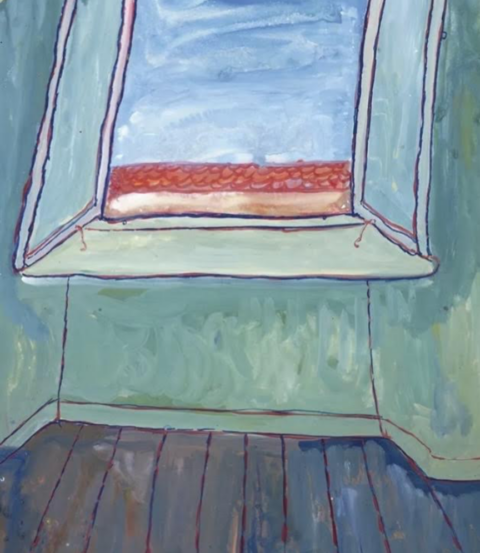
The Empty Window, painted by Charlotte Salomon in the smithy of France, 1940-42.
♦ ♦ ♦ ♦ ♦
Window I
(with lines from Darcy Buerkle and Walter Benjamin)
A window’s not a window to the soul.
Nothing is a window to the soul. The field
of color often doubles as the whole
deadly presence, floods the senses, yields
reflection: light refracting without
end. All is pared down to the woman
and the window. What is she thinking about?
The unnameable sources of common
despair. The air, thick with glass. She can’t see
what is before her, beyond her. Her shadow
darkens the pane. How can she become free?
The page, as such, approximates a window.
The means by which a woman dies or thinks
of dying. Or lives. The horizon, a retreating line of pink.
/ / / / /
Window II
Nice, 2025. In memory of Marianne (née Benda) Grunwald, Charlotte Salomon’s grandmother who leaped to her death from a window in her villa, Nice, 1940, as Charlotte tried to stop her.
— after James Turrell’s Space That Sees, 1992, Israel Museum
Sky that sees and sounds
like seas – gulls, bells, wind.
I walked unnoticed, up
the hill. The moon above
the orange trees was shy,
exposing curved line
of ivory, outline
of an outline, finger-
nail of a shadow, shadow
of my own body. Like swimming
underground in a narrow
pool, and above me, in the stone
ceiling, a hole. If I were
in a painting, if you were
to turn that painting upside-
down, I’d fall from water
into sky. What would you see?
A blur of blue, the long
wingspan of white sea-
gulls, the air vibrating
with the memory of bells,
rustle of leaf, orange
orb below, fruit
growing skyward.
If she were in a painting,
an old woman
by an open window,
and you turned the painting
on its side, slowly, very
slowly, she’d fall,
through blue air,
past the glowing
oranges decorating trees,
through green leaves, but
please, turn the painting
upright again, let her stay
a woman at a window,
seeing, waiting,
breathing, watching
as sky lets evening in.
Turn me around too,
let me be that dark
mass moving through water,
as silent as the hill outside
her house outside which I stood
like the sky, while inside
whoever lives there now
closed the shutters.
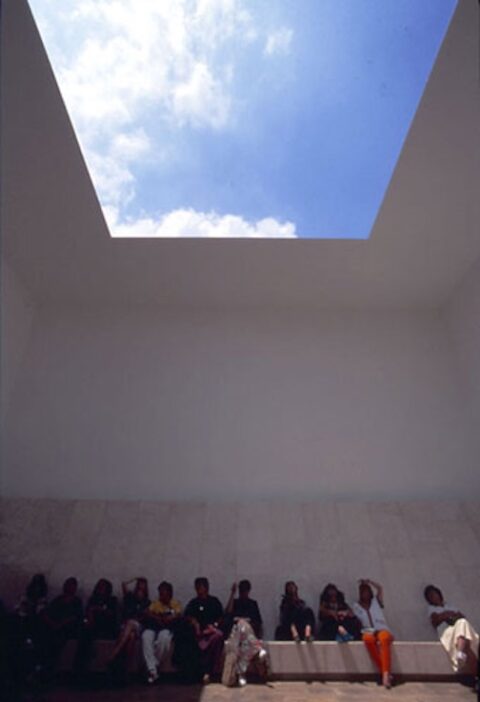
“Space That Sees,” James Turrell, 1992, Series: Skyspaces, Genre: Installation, Israel Museum, Jerusalem, Israel