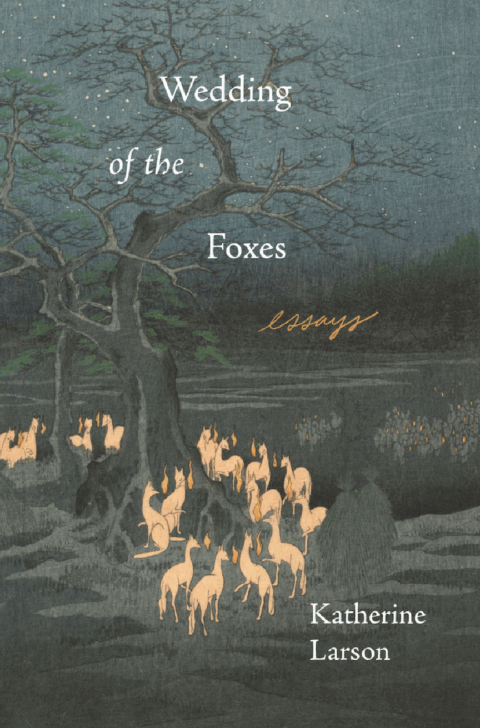
Katherine Larson’s Wedding of the Foxes, a collection of essays in a variety of forms, puts me in mind of a mobile: its many parts in exquisite balance, rotating slowly in a breeze that only its own delicacy makes perceptible. An exercise in literary equipoise, the book is both a sob for the destruction of the planet and a ringing hurrah for its persistence.
Fittingly, the first essay is titled “Threshold” and, like many of the other pieces here, braids topics that reveal their connection via juxtaposition. One of these is, again fittingly, a birth: that of her daughter, after such severe morning sickness (technically “hyperemesis gravidarum”) had incapacitated her. The other subject is the natural marvel known as the leafy seadragon, a relative of the seahorse. Larson telegraphs her essayist’s working method in their description: “They can be many things at once; it’s not a question of what species they are (there is only one), but rather, how many permutations of the same self they are capable of inhabiting.”
 So, too, the author, who sometimes inhabits the third-person self, sometimes the one who calls herself I. Larson’s project is, in part, to demonstrate that the self is as multivalent as the biological world, of which she is a scientist. Throughout she also deploys a Japanese viewpoint by way of its porcelains (she has what sounds like a formidable collection of teapots) and its storytelling, particularly that of its unjustly unappreciated women writers. To them — Tawada Yōko, Ōta Yōko, Ōba Minako, Taeko Kōno — she writes personal letters full of fellow feeling across the years and oftentimes across the line separating life from death. These writers are very much present for Larson.
Permutation is a key theme in both the flora and fauna she observes and the writing forms she utilizes to investigate their meanings — the segmented or braided essay, the letter. She keenly observes appearances of “hybrid forms” in the plant and animal kingdoms; it is no accident that these are what she then employs to express her wonder, and dismay, at the myriad ways the world breaks and then is remade, over and over again.
All these species of fracturing are in one book stitched together in a literary analog of the art of kintsugi, which she beautifully describes in the segmented essay of the same name. Larson notes that the Japanese style of “golden joinery,” in which broken pottery is repaired using lacquer mixed with precious metal dust (its brokenness emphasized and beautified, to eschew the notion that perfect restoration is ever possible in this cracked life), flourished during the Sengoku period. Also known as the “Warring States period,” the 15th and 16th centuries were marked by civil war and social upheaval. The time may be likened to our own, with its political strife, extinction crises, and climate change. The pandemic was a jolt amid this slow-boiling catastrophe — a sharp blow that brought death to our doorsteps rather than “out there” somewhere. Larson’s depiction of her community’s drawing together (even though it had to remain apart for reasons of contagion) is a moving example of social kintsugi in action.
Wedding of the Foxes is, above all, a book of impossible hope. Larson has a deep reverence for the past, which is as much as to say, for the world.
Her affection for thrift shops reveals a deep truth: “Life is fleeting. The object remains.” These places, chaotic and ugly as they may be, become emblems for the intricate connections that bind us all, despite species or era. We are all shape-shifters, she seems to say, not all dark or all light, in her discussion of the Japanese imaginary beings known as tsukomogami, drawing an implicit parallel between our destructiveness and the possibilities of regeneration. After 99 years, according to the folklore, inanimate objects can gain a spiritual dimension, so that time alone may cause a tool or a pot to transform into a strange creature. (In the west, the Surrealist movement was a similar regenerative idea, she posits, because it imagines other realities, other points of view.)
 In all her guises — mother, biologist, poet, reader, Japanologist — Larson looks for commonality, itself a form of repair. “We are the natural world. We are the world’s body. There is no separation.”
The premise of the kind of restoration she proposes — that the grief in each one of us can be stitched back into a new whole by the kintsugi of noticing, pausing, appreciating — is accomplished only for the individual. It will not change anything “real.” But what is real? Is it what is inside us, or outside? This, I believe, is the one breach that can never be made whole.
Fine writing acts as a wide scope on the problem, at least. Larson’s letter to Godzilla, “My Monster, Your Monster, Our Monster,” offers perhaps the sharpest focus on this elemental problem in the whole book. Full of lively images, and plenty of heart, the essay enacts the native love for the weird, the outrageous, the creative, that if rekindled in each of us may prove our only saving grace.
At one point in Wedding of the Foxes, Katherine Larson offers the most concisely truthful appraisal of the purpose of literature I may have ever read. “It’s about being lost. And found. And lost again.” It embodies, like life, a paradox. Round and round it goes, never truly finished. Never fully broken, and never fully put back together again. But when joined with visible gold, a book of essays does the best it can: it tries.
[Published by Milkweed Editions on July 15, 2025, 208 pages, $20.00US paperback]
To read “Soap: Art of Failure,” an essay by Katherine Larson published On The Seawall (January 2025), click here.
To read Ron Slate’s review of Katherine Larson’s poems in Radial Symmetry (2011), click here.