Horror as a genre has never been more popular, fueled by a year-round appetite for movies and streaming series that frighten, frazzle, and utterly unnerve audiences. But novelists are pulling their weight as well with the ranks of ink-and-blood-stained wretches swelled by hordes of authors fortifying their literary fiction with horror tropes. This flavor of novel is not new, having been written by folks like Mary Shelley, Shirley Jackson, and Stephen King, but it was British authors Daisy Johnson and Sophie Mackintosh who drew me in several years ago. Since then, the titles that have thrilled me the most have tended to be written by women from non-English-speaking countries whose work has been translated into English, authors such as Mexico’s Fernanda Melchor and Ave Barrera, Argentine’s Samatha Schweblin, Mariana Enríquez, and Agustina Bazterrica, Ecuador’s Natalia García Freire, and Sweden’s Johanne Lykke Holm. But another author who fits the bill, though she writes in English, is Helen Oyeyemi, a Brit who was born in Nigeria and has lived in the Czech Republic for more than a dozen years. Oyeyemi’s novels often take their horror cues from fairy tales, though not the sanitized versions used as bedtime stories for US kids, but rather the darker Germanic versions originally crafted as much to frighten as to entertain.
I don’t know if Czech author Zuzana Říhová ever talked shop with Oyeyemi in some pivnice or kavarna, but they’d probably have a fascinating conversation as Říhová’s probing and deeply unsettling 2021 debut novel incorporates the depravity of the Brothers Grimm’s Little Red Riding Hood. Playing Wolf, as Říhová’s novel is titled in the new English-language translation by Alex Zucker, is a rural horror story exploring what happens when a middle-aged couple trades their glass ceramic cooktop in Prague’s ultra-hip Holešovice neighborhood for a gas stove that must be lit by matches in the one-pub village of Podlesí. Bohumil Novotný and his wife Bohumila have made the move to try and salvage their marriage, damaged — at least most recently — by Bohumila’s infidelity, but what starts as an attempt at healing via nature and small-town values ends up closer to a Bohemian Chainsaw Massacre, albeit without the chainsaws.
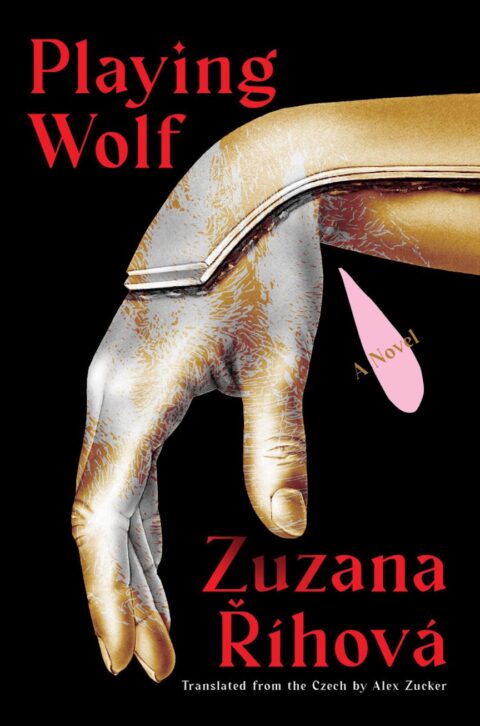 The novel’s original Czech title is Cestou špendlíků nebo jehel, which translates roughly to “on the path of pins or needles.” From a marketing perspective, I can see why such a title might have been unpalatable, but from a narrative standpoint, I find it more revealing than Playing Wolf, simply because this story is all about the consequences of choosing between two imperfect options — the decision to come to Podlesí in the first place versus remaining in Prague where everything fell apart. Staying married versus getting divorced. And by the time the novel opens, which is several weeks after the Novotnýs and their son have settled in a cottage so deep in a ravine on the outskirts of town that “the cottage was the ravine,” the Novotný’s choice has become whether to stay and tough it out or cut their losses and return to the city while they still can.
Bohumil is utterly miserable, confessing that “without drinking I would have walked off into the dark forest ages ago.” Bohumila has essentially given up on reconciling, “no longer [wanting] anything from [Bohumil].” He vacillates between self-pity and an abstract desire for everyone around him to suffer; she takes a job at the pub as a way to get out of the house, despite nursing a festering wound on her hand as a result of Bohumil “practically [crippling]” her. And though they’re loathe to admit it, Bohumil and Bohumila both flirt with the desire to run away from their son. The boy, who is never named, was born 12 year ago, but “mentally he’s six, maybe seven.” Bohumil’s misgivings are internal, observing that the child “has the IQ of a pumpkin”; he views himself as the victim, “the dad of a handicapped boy. Never again just a dad.” Bohumila actually did walk out on the child back when they still lived in Prague, abandoning the family entirely for several days.
Říhová keeps readers off-balance in several ways, starting with continually shifting the narrative perspective among Bohumil, Bohumila, various locals, and an omniscient observer. Even “the night” takes over at one point to fantasize about harming Bohumil as he walks home: “I’m about to delve into your suffering […] feeding on your fear. […] I’ll hold you so close you’ll be gasping for breath, all the better for me to drink in your perpetual but sweet regret.” That “all the better for me” phrasing from Zucker sets off alarm bells for anyone who knows their Little Red Riding Hood, violent versions of which start to appear in the novel, feeding off of increasingly uneasy references to the presence of a wolf — lycanthropic or canine is unclear — that is responsible for “those sounds in the night, that howling that isn’t human.”
The narrative itself is slightly asynchronous, occasionally jumping backward to elaborate on a scene that has already taken place, as if everyone is slightly out of sorts and having trouble staying anchored in the present. This disorientation is amplified by the fact that life in the country can become so repetitive it’s difficult to differentiate one day from the next, a sentiment indelibly expressed by Bohumil: “His small world had become even smaller here. What was the point of it all? He had gained the unique ability to observe his world but lost the ability to live in it. The impossibility of change weighed down on him with full force, the awareness that his life decisions had been exhausted. This is it now, this is my life. He kept treading over the same ground, days and gestures looping back around like the grimy rubber handrail that always lags a little behind on the Metro escalators.“
 Even the actual climate of Podlesí is threatening, vacillating between stifling heat waves that imperil the local livestock and drenching rains that flood the parched landscape while doing little to alleviate an ongoing drought. This atmospheric inhospitableness would be particularly difficult for transplants from Prague, as the Czech capital’s citizenry have an almost reverent love of the countryside and will take any opportunity to escape the city, either to visit cottages called chaty or simply to hike, pick mushrooms, or be in the fresh air. (A Prague friend I spoke to during the early lockdown phase of the pandemic was adamant that her children would never wear masks outside because the benefits of fresh air were so much more important than even the potential of inhaling a deadly virus.) There are numerous places called Podlesí in the Czech Republic, but one that is too intriguing not to mention is the Hotel Podlesí about 100 miles east of Prague, a kind of hybrid resort that includes a Fairytale land where one of the many themed chaty you can rent is the Červená Karkulka cottage, or Little Red Riding Hood cottage. (In that same neighborhood, just 30 miles south, is Peklo Čertovina, or Devil’s Hell, a theme park that is exactly what it sounds like and I could easily imagine a trip to this region planting the seeds of the novel in Říhová‘s mind.)
Ultimately the greatest menace for the Novotnýs is the Podlesí locals themselves, despite their outward efforts at appearing hospitable. While the threat eventually turns tangible, it is initially present obliquely via Zucker’s word choice, as when Bohumila is being ogled in the pub: “They track her with a hunter’s gaze, but a hunter with the grazing roe comfortably in his sights.” Or in Říhová’s imagery: “Let the little baby bird from the city settle in, make herself at home. Add one twig to another, spit and droppings and glue it together, caulk it together, you’ve got your nest. Tidy up, bake up some food. And then we’ll come for you.“ Among the handful of colorful characters around the village is Sláva, an old man whose stomach is riddled with an unspecified pain. Like Bohumil, Sláva feels alone: “How does a man come to an understanding with his fate, enveloped in such unpleasant and disconcerting loneliness, he wondered secretly.” But unlike Bohumil, he moves through the world intent on inflicting this misery on those around him for as long as he can, and to that end he wheedles his way into the Novotný’s life, including an early episode where he leads their son deep into the woods and revels in the child’s mute terror.
From the outset, Zucker’s skilled translation highlights differences between Bohumil and the local men, differences that feed their animosity. The novel’s opening scene finds a dairy farmer named Pepa plunging his arm (and a rope) deep into a cow’s vagina, which the squeamish Bohumil “chastely” avoids looking at, to help the animal calve. Pepa’s internal monologue labels Bohumil a “city slicker” and mocks him for “walkin in here like he’s steppin out on the town. Starin at that calf like he’s never seen veal in his life.” Říhová likely wrote this passage in colloquial Czech, for which there is no one-to-one translation, leading to Zucker’s evocative decision to truncate the verbs. At another point, Zucker reveals how the locals are presumably mocking Bohumil’s Prague accent, by having them respond to his mention of someone named “Michael” by saying “What Michal is that?”
Zucker also deftly captures the playfulness of Říhová’s text, as when Bohumil discovers a typo on a website he is consulting, which Zucker translates as “you’re almost doen” before Bohumil screams “Proofreader!” on the next line. Also amusing is Zucker’s light-hearted rendering of the fake French accent that Bohumila uses while reading to her son, resulting in the line: “Ze docteur tahps on ze boo-boo, zen writes a prescreepsion.” He even recreates end rhyme on a passage from a children’s song. These types of subtle decisions derive from instinct and experience as much as fluency, and they are part of what makes Zucker such a premier translator. Thankfully for Anglophones he is also a tireless one who has played an outsized part in English-speakers’s ability to enjoy the breadth of contemporary Czech fiction.
The novel gets extremely upsetting at the end, leaning into the horror that has only been hinted at, but Říhová handles it all thoughtfully, particularly Bohumila’s emotions, which had me hoping for a future novel that sees her settle more fully into exploring a single character’s mind and motivations. Playing Wolf’s haunting coda is incredibly cinematic, which makes sense given the marketplace’s ravenous appetite I mentioned at the start, Halloween having begat the month-long Spooky Season that now helps drive success even in the springtime, as with the colossal and deserved success of Ryan Coogler’s Sinners, which was released in March. This type of art may never win over that stodgy subset of the public who have so long dismissed genre fiction as somehow lesser art than “serious” literary fiction, but for the openminded rest of us, bare your big fangs and dig in, you’ll be both delighted and disturbed by what you find.
[Published by Catapult on September 30, 2025, 288 pages, $27.00US/$35.00CAN hardcover]