Frank Bidart’s afterword to The Collected Poems of Robert Lowell almost winces, as early on as its title, with defensiveness: “On ‘Confessional’ Poetry” — that word, confessional, bracketed by quotation marks and suspicion alike. And with good reason. Despite years of disavowals, Lowell was never able to unburden himself of that thorny crown as confessional poet par excellence appended to him, much against his will, by M.L. Rosenthal’s review of Life Studies in 1959. Bidart’s task in the afterword, then, is one of correction, clarification, and — perhaps — of liberation. Lowell, he says, “always insisted that his so-called confessional poems were in significant ways invented.” That is, their utterances emanated from a poet, not a penitent caught or compelled to tell on himself. These are poems, not transcripts from an interrogation or inquisition. So rather than the sense of legal, criminal, and moral culpability undergirding that word, Bidart would have readers place Life Studies, and Lowell’s oeuvre in general, within a different tradition of confession, one that is at once theological and, ultimately, literary — that of Augustine’s Confessions, “the most earnest, serious recital of events of one’s life crucial in the making of the soul.”
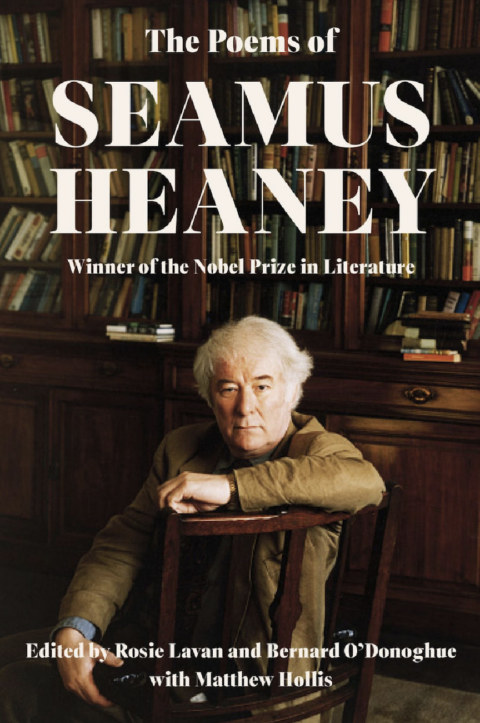 Although confessional poetry was largely an American phenomenon, Seamus Heaney found himself, much like Lowell, pressured by a need to articulate, or qualify, his relationship to it. Surely the timing of his emergence as a poet played a significant part in this. When his first collection, Death of a Naturalist, appeared in 1966, Life Studies was not yet a decade old. Ariel by Sylvia Plath, the wife of Heaney’s friend and mentor Ted Hughes, appeared in 1965, only a year earlier. Not to mention that Lowell and Heaney became friends during the years Lowell lived in the United Kingdom for most of the 70s. Heaney, for his part, consistently denied too close an alliance with the confessional mode in his own writing. In his Paris Review interview of 1997, when asked about Robert Lowell, Heaney tells Henri Cole that although the “literary critic in me says Life Studies is the real goods,” it’s the later fourteen-liners of Notebook, History, For Lizzie and Harriet, and The Dolphin that “were Lowell’s strongest influence on my work.” And now, thanks to the 500-some pages of notes in The Poems of Seamus Heaney, one can see just how early in his career the poet began to cultivate the climate of opinion into which his books would be received. For instance, in the notes for Door into the Dark, Heaney’s second collection, the editors paraphrase an article written by Heaney for the PBS Bulletin from 1969: “the ‘recollected emotion’ of [Death of a Naturalist] was now to be ‘contained rather than confessed’ in the second book.” This stance — gentle deflection rather than outright denial — is the one he would continue to strike throughout the years. Later, in their notes to Station Island, Heaney’s most religiously-inflected collection, the editors include Heaney’s insistence, first documented in Stepping Stones, that the book was not confessional as much as it was “an examination of conscience.”
But despite the protestations and demurrals, it’s not hard to understand why Heaney had to entertain such questions. From the first, his poems dug down into memory to find their source. Or, more precisely, the excavation of memory — both personal and cultural, and the continuity he sought in it — is his subject. The harmonies that Lowell exploited magisterially in Life Studies, of the poet sounding off as an Emersonian representative man and, simultaneously, listening in as a man represented, are the same ones to which Heaney is attuned: “I rhyme,” he writes, in the final lines of Death of a Naturalist, “To see myself, to set the darkness echoing.” The texture of the poems would be the textures of his world, not merely remembered but touched, like the “heavy lip of cream” transfigured into “coagulated sunlight” from “Churning Day.” Experience is the densest and surest material he can handle, he decides early on — even if the extremity of the kinds of experience he’s drawn to risks callousing the poems. “Still, living displaces false sentiments,” he quips coolly in “The Early Purges,” as the speaker reflects on the need to drown puppies on a farm where “pests have to be kept down.” Like Lowell, his eye is already fixed on, and enticed by, violence; and like Lowell, his instinct is to domesticate it. The locked shaving razor of “Waking in the Blue” becomes, in Heaney’s hands, “the squat pen … snug as a gun.” Already, he comes into contact with a sense of menace dormant in the poetic endeavor, and so close to home.
This seeming “need for roots” (in the Englished words of Simone Weil) is what Anne Stevenson understood about him when she wrote, in 1990, that “Mr. Heaney is essentially a domestic poet, most moving when writing of homely matters.” Homely matters, however, were not for Heaney simple matters. The Troubles in Northern Ireland, which started practically in parallel to Heaney’s start as a writer, made it impossible for him to keep the violence confined solely to his studio. In Wintering Out (1972), guns no longer inhabit the poems as metaphor, but as landscape: “a bomb had left a crater of fresh clay / in the roadside, and over in the trees // machine-gun posts defined a real stockade.” A spiritual cratering impresses itself into this landscape as well, in the wake of those off-page explosions:
Is there a life before death? That’s chalked up
on a wall downtown. Competence with pain,
coherent miseries, a bite and sup,
we hug our little destiny again.
(from “For David Hammond and Michael Longley”)
The ordering of experience here is traumatically flipped: life able to be lived only after death, with none of the consolations of the Christian resurrection to redeem this formula, only “competence with pain,” a sheepish accommodation to apparently intractable conditions. But if, indeed, the question before him was if there is a life before death — a question he poses again in “Whatever You Say Say Nothing” from North (1975) — then who else could the poet count as his contemporaries but the shades?
***
“For years I’ve been writing poems where I meet ghosts/shades, and among those are some of the ones I cherish and value the most,” Heaney writes in a 2006 letter to Jane Miller, before adding, “But then I’ve always had a weakness for the elegiac.” One wonders if this “weakness,” as he calls it, was in truth a necessity for his survival as a poet. Heaney, by way of Auden, muses in his foreword to Preoccupations that “breaking bread with the dead” was “essential to the life of poetry,” a kind of sustenance found in communion with the forebears. But aside from mere artistic renewal, perhaps even more vitally the elegy provided Heaney an opportunity to practice his chosen trade responsibly. As the pre-eminent poet of Ireland for most of his life (“the most important Irish poet since Yeats,” as Robert Lowell wrote of him, fashioning for Heaney a different kind of inescapable thorny crown), he felt the weight of that role acutely, often chagrined but always thoughtful about its implicit responsibilities. In The Redress of Poetry, he credits Robert Pinsky’s essay, “Responsibilities of the Poet,” with helping him to articulate his sense of what that responsibility is — “to feel a need to answer, a promise to respond.” The elegy offered Heaney his only means of answering back to the dead. It becomes the way he could make good on his promise to respond:
I missed his funeral,
Those quiet walkers
And sideways talkers
Shoaling out of his lane
To the respectable
Purring of the hearse …
They move in equal pace
With the habitual
Slow consolation
Of a dawdling engine,
The line lifted, hand
Over fist, cold sunshine
On the water, the land
Banked under fog: that morning
I was taken in his boat,
The screw purling, turning
Indolent fathoms white,
I tasted freedom with him.
To get out early, haul
Steadily off the bottom,
Dispraise the catch, and smile
As you find a rhythm
Working you, slow mile by mile,
Into your proper haunt
Somewhere, well out, beyond …
Dawn-sniffing revenant,
Plodder-through midnight rain,
Question me again.
(from “Casualty”)
As quiet and reverent as this writing appears on its face, it seems to me nothing short of heroic. This is Heaney at his best, his most exacting, as he renders his “feelings into words,” which is, as he suggests in an essay by the same name, the standard by which he judges a successful poem. Experience isn’t wrestled into form as much as the form, much to its own surprise, accommodates itself to the jagged reality of the poet’s grief. I prefer this reification of the poet’s inwardness, as in these lines, to, say, the more deliberately public, hieratic addresses of North that W. S. Di Piero criticizes as performances that “[bully] the reader into admiration.” I don’t mean that I want inwardness alone — that’s solipsism. Rather, I want a poetry where the inner and outer worlds negotiate a shape that reflects both. In the excerpt above, as happens so frequently in Heaney, the poem finds its start in the outer world, with the procession of the missed funeral, its “equal pace” and the “habitual / Slow consolation / Of a dawdling engine,” the first ten lines rolling gently at first, keeping to a (mostly) regular trimeter, the enjambments breaking naturally at the end of discrete units of syntax. This easy, almost soothing ritual is soon interrupted — “The line lifted,” referring all at once to the line of mourners, a fishing line, and the poetic line — as the poem dives into more stilted (and interior) consolations: the poet’s memory. The reader is deluged with a breathless rush of images, sounds, and phrases plowed together by commas, before, in the final tercet, the meter smooths again, and the poem ends in rhyme, seeking closure and anticipating a response: “Question me again.” As though a soul, listening, overheard itself, and waited for the entrance of another voice. This tedious labor is the true task of elegy: trawling into language to discover the rhythm that will work this ghost, Louis O’Neill (a friend of the Heaney family who was killed by a bomb), into his “proper haunt.” Which is to say: elegy, for Heaney, doesn’t seek to exorcise his ghosts, to make them disappear. It aims to make them addressable, answerable.
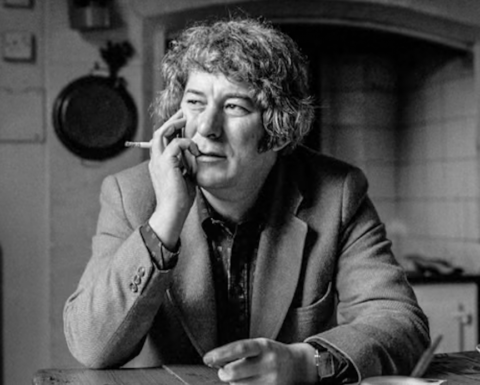 That Heaney arrived naturally to the elegy, that poetic mode which bids the poet to “speak yet again” (Shakespeare) to the dead as well as to past experience, seems like an inevitability as one reads through the 700 pages of poems in this formidable book. He is a poet of second looks. His patron saint might well be St. Thomas the Apostle, though Heaney is not disbelieving as much as eager to press his first thoughts against new experience, not contrarian as much as cautious to not allow his conclusions to atrophy into doctrine. I started this review thinking about the apparent defensiveness with which both he and Robert Lowell met the critical tendency to categorize their poems into the latest, and catchiest, literary label. Part of Heaney’s frequent disclaiming, one imagines, is PR; or rather, his resentment for the PR he constantly had to engage in and entertain. In a letter to Michael Longley from 2010, he groans at the thought of “hotting up other would-be biographers, which is something I dread, especially now that I have turned into a kind of product already.” (Looking down on us now from the heights of Parnassus, he must be rejoicing that he died in 2013, before the apotheosis of social media.) But this aversion to being labeled is also part and parcel of his poetic gift. For Heaney, circumspection is introspection:
I love hushed air. I trust contrariness.
Years and years go past and I do not move
For I see that when one man casts, the other gathers
And then vice versa, without changing sides.
(from “Casting and Gathering”)
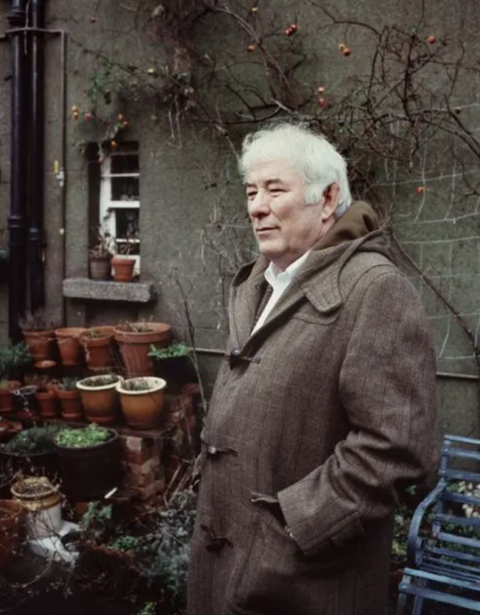 Not jumping to conclusions, not rushing to pick a side, taking a second look, allowing for that vice versa — this is the attitude that kept him alive, in a very real way: he saw first-hand how the pressure to choose a side could petrify the soul of a country, then turn deadly. In contrast he claimed for his poems, and himself, the right to look again, think again, speak again, choose again. To grasp this aspect of his temperament, noble in its own right, helps to account for the weaknesses of the later poems, which begin their decline around Seeing Things (1991), where Heaney starts revisiting and recycling his old hits: I’m talking about “Glanmore Revisited” from Seeing Things reprising, unevenly, the “Glanmore Sonnets”; or “The Tollund Man in Springtime” from District and Circle (2006), summoning back “The Tollund Man.” Most crucially, however, Heaney’s principled ambivalence kept him connected to his sense of responsibility. His own response to the pressure he felt to choose a side in the politics of Northern Ireland is instructive. Poets, he wrote, “will only be worth listening to if they are saying something about and to themselves. The truest poetry may be the most feigning, but there are contexts, and Northern Ireland is one of them, where to feign a passion is as reprehensible as to feign its absence.” In other words, the artist must maintain his independence of vision and keep the eye “clear / as the bleb of an icicle” (“North”). Only then can he act in good conscience on “the desire to witness exactly” (to use a fine phrase from Heaney’s essay “The Government of the Tongue”).
***
“To witness exactly”: I began this review also thinking about Augustine, which is where all of this started. About a decade ago, before I had read Heaney with any seriousness, I was reading Garry Wills’ short biography, Saint Augustine: A Life, in which Wills attempts to correct, clarify, and liberate Augustine from the unfair misconceptions (“an ex-debauchee obsessed with sex”) that have followed him for centuries. Many of these misconceptions, in Wills’ view, are the result of inexact translation: “Confessiones,” he writes, “transliterated rather than translated into English Confessions, misses the complexity of a word in which Augustine intuited an entire theology.” For Wills, the word that more accurately and capaciously embodies the project of Augustine’s most famous work is “testimony” — the same word chosen by the author of the Gospel of John to attest to the truth of his experience: “This is the disciple who is testifying to these things and has written them, and we know that his testimony is true.” That Wills’ alternative title for the Confessions has hung around with me ever since then has seemed a quaint oddity. Aside from my own need to salvage the meaning of “confessional” (not a pressing one), or to reconsider Augustine (more pressing, but still not urgent), Wills’ proposed revision — resonant, provocative — nonetheless floated inertly as a glimmer in the offing of my memory. That is, until I started working on this review and read through Robert Pinsky’s essay I mentioned earlier, “The Responsibilities of the Poet,” and heard the echoes of not only Carolyn Forché and Seamus Heaney, but also (unbelievably) Augustine, by way of Garry Wills. Witness as poets practice it, says Pinsky, “may or may not involve advocacy, and the line between the two is rarely sharp, but the strange truth about witness is that though it may include both advocacy and judgment, it includes more than them, as well. If political or moral advocacy were all we had to answer for, that would be almost easy. Witness goes further, I think, because it involves the challenge of not flinching from the evidence. It proceeds from judgment to testimony.”
When I first read this and noticed the rhyme between all my reading, I, like most readers, perhaps even you, thought I might explain it away as coincidence. More so, I had no idea how I’d connect these synchronicities into plausible sentences. And who would believe it anyway? (“Chi crederebbe giù nel mondo errante?”) Could I really have been preparing to write this, all those years ago, when I knew hardly anything about Seamus Heaney other than the Nobel and, maybe, “Oysters”? Aren’t I, the more I try to make sense of this, traveling deeper into incoherence? These were the arguments I had with myself, at any rate. Still: I have read what I have read. What else can I do, but testify to what I have seen?
In the end, what I’ve seen is the solidity Heaney gives to his own experience, even if at first he casts it a questioning glance, or opts to return to it later. This is more than confidence. It’s an act of witness that allows him to proclaim the world more clearly than most—so much so, that he sometimes gets ahead of it:
Strange how things in the offing, once they’re sensed,
Convert to things foreknown;
And how what’s come upon in manifest
Only in light of what has been gone through.
Seventh heaven may be
The whole truth of a sixth sense come to pass.
At any rate, when light breaks over me
The way it did on the road beyond Coleraine
Where wind got saltier, the sky more hurried
And silver lame shivered on the Bann
Out in the mid-channel between the painted poles,
That day I’ll be in step with what escaped me.
(“Squarings, xlviii”)
Like Augustine, Heaney’s life’s work — this book, his testimony — looks, poem by poem, through his avid eyes at the crucial moments that compose his soul. As I can attest, it anticipates us.
[Published by Farrar, Strauss, and Giroux on November 18, 2025, 1296 pages, $60.00 hardcover]