When Hester Kaplan was just about thirteen and her parents were away for the evening, she entered her father’s study, off limits to her even when he was there. Sitting at the desk where Justin Kaplan had composed his magnificent biography Mr. Clemens and Mark Twain (1966), winner of the Pulitzer Prize and the National Book Award, she turned her father’s typewriter on and off (it made “a satisfying clunk”), played with his paper clips and rubber bands, sniffed his glue dispenser, and spun around in his chair. And then, just as in a Henry James novel, calamity struck —Hester‘s hand brushed against a stack of colored index cards on the desk (the building blocks of her father’s next great work?) and sent them flying across the room; she, watching helplessly as they descended, helter skelter, on the floor. If trespassing into her father’s inner sanctum had been a terrible breach of trust, messing up his notes was the ultimate sin, a crime worthy of harsh punishment: “There would be no way to repair what I’d broken, no way to escape my rotten, destructive nature.”
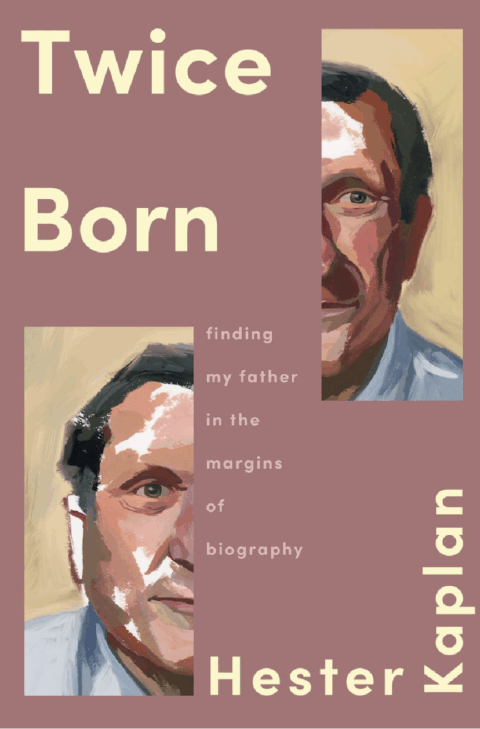 To her surprise, that punishment never came. As she recalls in Born Twice, the next day her father didn’t so much as chide her. “Maybe you even made it better,” he said, referring to his work-in-progress. But Hester knew she hadn’t: biography, her father’s line of work, means bringing predictability and logic to someone else’s life, finding a purpose in each moment. Hester’s index card flinging had interrupted that attempted order, causing a scene so traumatic that, decades later, she still remembered every detail of it.
To his daughter Hester, now 66, and the author of two novels and three collections of short stories, Justin Kaplan remains a puzzle. She and her two sisters grew up on leafy Francis Street in Cambridge, in a book-filled old Victorian house, steeped in cultural privilege. Their mother, Anne Bernays, herself a well-regarded novelist, was the daughter of a double nephew of Sigmund Freud (that is, Anne’s father was related to Freud both through his father and his mother). In Cambridge, their neighbors included the economist John Kenneth Galbraith and culinary celebrity Julia Child. Among the guests at Justin’s famous dinner parties were Kurt Vonnegut, who spent a night sleeping on their living room sofa, and John Updike, who tried to help Hester with her math homework.
But the dominant tone of Hester’s Born Twice reflects not excitement but melancholy. As Hester observes, in a sentence that stayed with me for days, her father’s “leavings” — his precipitous departures into his study where his index cards were waiting — felt like “a thousand abandonments.” The people who really mattered to Justin weren’t his children but the shadowy subjects of his biographical works, Mark Twain and later Walt Whitman. (Justin’s 1980 biography of Whitman also won the National Book Award). When Justin did spend time with her, Hester knew that often he’d rather be somewhere else, in his study or on one of his long, solitary walks with his dog along the Charles River, from where he invariably returned reeking of smoke, steadfastly denying that he had touched a cigarette. The rare occasions when Justin did stick around — joining Hester, for example, at her lemonade stand outside the house rather than moseying on to the annual end-of-the-semester party at the Galbraiths — remained engraved on her mind. They also strengthened her resolve to do things differently with her own children: “Later, when my own kids knocked on my door when I was writing, I always let them in. I soothed and listened and took my hands off the keyboard. I would not be like my father.”
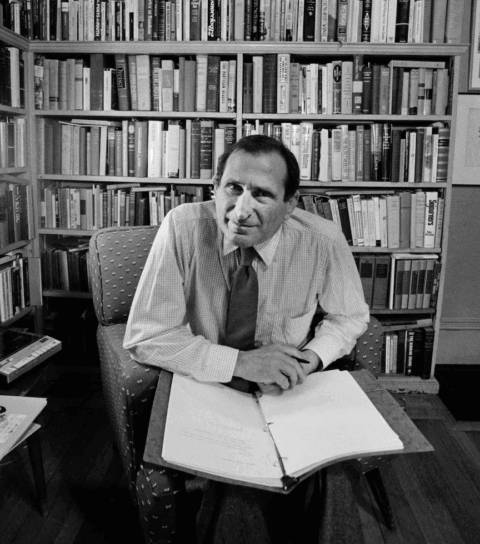 Biography made Justin Kaplan before he began making biographies. The son of an immigrant shirt manufacturer who had learned English from reading James Fenimore Cooper’s The Last of the Mohicans, a Harvard grad school drop-out ill at ease in the company of better pedigreed academics, Justin drifted through a series of desultory jobs in publishing. Things changed when his then-boss Max Schuster, of Simon & Schuster, accepted his proposal for a new biography of Mark Twain, a man who, Justin had written, “like no other major American writer … flung himself into his time.” Max Schuster’s enthusiastic response, cabled from Vienna, where he was vacationing, marked the moment of Justin’s second birth (hence the title of his daughter’s book), the beginning of a career uncompromisingly devoted to explaining the careers of others. In Hester’s telling, it is no coincidence that the 34-year old Justin chose to open Mr. Clemens and Mark Twain with a similar second birth — the moment when Twain, then only a few years younger than his biographer, departed San Francisco for New York, “the scrambling center of American life.”
The flamboyant, convivial Mark Twain and the socially awkward Justin Kaplan, underneath their overt differences, had many other things in common. They were both irresistibly funny as well as thin-skinned and vulnerable, perennial outsiders longing for inclusion though inevitably skeptical when it seemed within reach. Invited to join Boston’s illustrious Tavern Club, the pinnacle of social distinction in blue-blood Boston, Justin endured one meeting and then asked to be excused. Both men were orphans, condemned to emotional immaturity (Twain lived “in a nursery which was as large as the world,” wrote Justin), but, in the absence of parental oversight, also equipped with the freedom to reinvent themselves the way they wanted. One of the most poignant passages in Justin’s biography portrays Twain parading up and down Fifth Avenue wearing his trademark white suit, making a show of an innocence he realized he had already lost: “I wear white clothes both winter and summer, because I prefer to be clean in the matter of raiment — clean in a dirty world.”
Twain and his family were constant presences in the Kaplan household, long after Justin’s book was finished. Once, at a party, Hester’s mother was introduced as “Mrs. Mark Twain.” And they continue to wield their influence over Hester today. From the shadows of the past beckons Twain’s daughter Susy, who wrote her father’s biography when she was only 13 (the same age as Hester when she scattered Justin’s index cards), a document her father, years after Suzy’s premature death, still considered a “king’s message” to him. And by that he meant that it was urgent, important, more precious than anything anyone had ever written about him. Twice Born is, in a way, Hester Kaplan’s own “king‘s message” to her father, with the crucial difference that she began writing it only after Justin’s death.
 As if further confirmation of that death were still needed, Hester starts her biography not at Justin’s cradle but his grave — more precisely, with his cremation in March, 2014. Her rendering of that event is both unsettling and darkly humorous. It includes an inspection of Justin‘s dead body that leaves little undescribed: Hester lingers on his dimpled face, his still smooth skin, his unusually shaped nose. Comic relief comes in the guise of the obsequious funeral director, a character straight out of a sitcom, giddy with excitement over the famous man (he has read some of his books in preparation) he will be consigning to the flames today.
Stepping outside the crematorium, Hester is relieved not to see any smoke drifting into the crystalline blue sky. But she still imagines her incinerated father departing “as air,” as Walt Whitman said he was at the end of his poem “Song of Myself”: floating above Mount Auburn Street, travelling over Harvard Square and Harvard Yard, returning to his beloved Francis Street. “I stop somewhere waiting for you,” Whitman shouted to his readers, and that’s precisely what Justin, or Hester’s reimagined version of him, is doing, too, at the end of this deeply moving book, in his own, quiet way. Back from the dead, ensconced once again behind his desk, Justin is waiting for Hester: “Would you like me to read what you’ve written?”
Blurring the lines between life and death, fiction and reality, Twice Born is, ultimately, neither Justin Kaplan‘s biography nor Hester Kaplan’s autobiography but both things creatively meshed: the book-shaped equivalent of Hester’s jumbled-up pile of index cards. Eschewing the tried and true rules of the biographer’s trade, impeccable chronology, narrative objectivity, scrupulous adherence to the facts, Twice Born splendidly delivers what Hester at the beginning of her quest said she was looking for — something that would, at long last, “unburden” both her father and herself.