In her essay “Life Among Others,” collected in Radiant Lyre: Essays on Lyric Poetry (Graywolf, 2007), Linda Gregerson writes:
“The lyric poem is a form of social speaking. This simple, self-evident feature has often been obscured or overshadowed by the lyric’s prized affinity for inwardness. But the very trait we prize — the public face of privacy — is paradoxical, reminding us that the social and the solitary, the plural and the personal, are interdependent and mutually sustaining realms.”
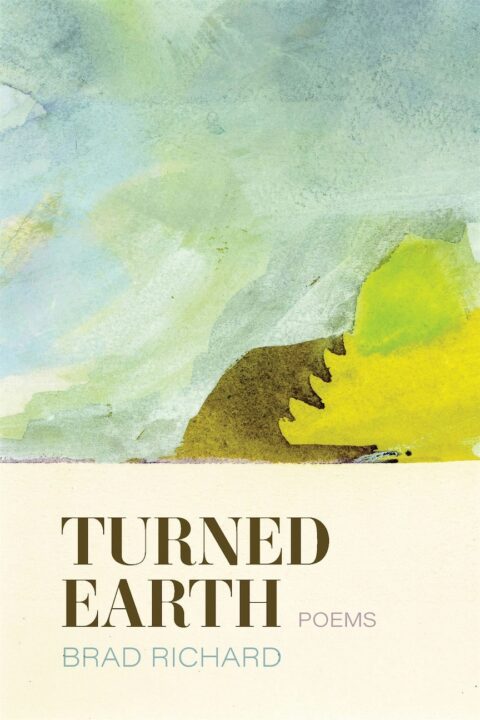
Connected with this insight, in my view, is the fact that the distinction often made in poetry classes between lyric and narrative — with a lyric poem having songlike qualities and focusing on one suspended moment, and a narrative poem conveying the arc of a story — doesn’t hold when looking closely at specific poems. New collections by Brad Richard and Rosanna Warren are cases in point.
The poems in Brad Richard’s fifth collection, Turned Earth, are both narrative and lyric in feel. They blend the past and present, the flow of time with the suspension of time, and the poet’s inner life with the lives of others — his mother, his father, his husband, his students. The first poem in the collection, “Then Again,” starts with a wide frame of reference — the state of the world — and then enters the poet’s childhood:
While the world ends, burns, drowns, starves, I remember
summers at the house my mother rented in the country
outside Tuscaloosa, a two-story log cabin built by a judge
for his wife, two sons, and two daughters: two wings,
with connecting bedrooms upstairs in each, divided
by a high-ceilinged room with a fieldstone fireplace
where we spent nights reading — Tolkien for me,
Sayers or Christie for Mom. Sometimes out of the hush
came a staccato click-click-click-click-click-click-click:
wood-boring beetles, working their way through the walls …
 “Then Again” implicitly recognizes our need for memory and story — note the grounding details of the setting, down to the very walls of the summer cabin. The poet’s recollection is informed by his awareness that his mother was “tending her own grief/for her mother.” While she grieved, “shut in her bedroom,” he “wandered the surrounding woods, pines/swaying in the hot breeze, creaking and rustling.” The portrayal of the inner realities of both mother and son illustrates Gregerson’s point about “the social and the solitary” being intersecting realms.
A lush music accompanies the narrative lyricism in Turned Earth, especially in the poems of love and desire that rejoice in the physical world of New Orleans, its flora, its weather. “The Rain” is dedicated to Brad Richard’s husband Tim:
I need you to remember the rain —
lie down with me, love, and remember
all the rain we’ve known, while we know;
how it talked to itself through afternoons
like a boy with his imaginary playmate,
rain lost to itself in its coming, as we listened;
how it burst down morning lawns,
ending bright-beaded on castor bean leaves
and in your hair when you came in with the dog;
how the hurricane pelted through the porch screen
as we sat naked there in the after-dark, heat
heavy with wet, our slick skin one with night;
how sudden a fall — imagine you and me
loosened from the sky, oblate,
pancake-shaped, small wobbling
spheres cast down and finding
in falling one another, falling in air
as in one another, how, one body
spirited homeward, heavier
in falling further, we divide
to meet in earth again.
 The poem’s 21 lines sweep the reader along in a single sentence, an invitation to the beloved to remember and celebrate their ongoing intimate life. The lyric “inwardness” is also an outwardness: the poem is clearly as much about the “you” and the “we” as the “I.”
Throughout, repeated words and phrases such as “the rain/rain/all the rain,” “known/know,” and “fall/in falling” ring changes on the sensory immediacy of the weather and the passionate closeness of the relationship. The lovers find themselves and lose themselves in each other and in listening to the sound of the rain, precisely rendered in the plosives of “bright-beaded on castor bean leaves.” The erotic blends with the couple’s domesticity; this is no one-night stand, but a portrait of a shared life.
The solitary I versus an I accompanied by a you: even in “My Desires,” a lyric poem about gardening, the speaker looks outward in the first stanza as he directly (and humorously) addresses an invasive plant he must deal with:
Ok, sure, I loved you,
parrot lily, princess lily, fancy-ass invasive
stretching your spindly stems
above the sword ferns each spring,
your blooms bristling all summer
until, spent, you went dormant,
tubers swelling all winter,
dreaming the garden yours.
The penultimate poem in the collection, “The Crossing,” which depicts the poet at age ten with his father, in a bayou—a wild landscape, in opposition to a garden that can be trimmed and shaped and tended — is dedicated to Jim Richard. The boy and his father, in their pirogue,
… lull in the shade
of a river oak, six feet from a branch sagging
from the weight of snakes piled asleep on it;
some part of one of them rolls, another, slow,
unknowable knot — then one strand of the mystery
stirs and wriggles free, ribbons down
into shadowed water, then ripples across …
The snakes are a figure for transformation, and the poem is a crossing through time as well as through a bayou; time is held in lyric suspension, but is also flowing, as we come to the adult’s realization of passage through it, and loss:
… That’s it; I’m here; I’m doing this
until it can’t be done, until there is no other
side, no farther to go, and no father,
every loved, every feared thing stolen
(as this boat will be in a month or so),
until I am equal to what the snake knows,
slipping down from the tree, stepping down
into bilge, head up to steady myself, pushing off.
 In its exploration of what it means to be his father’s son, “The Crossing” counterbalances the crown of sonnets called “Matrilineation: Homage to Nell Parker (1944-2015) in part 2 of the book, dedicated to the poet’s mother, who also wrote poems. Both “The Crossing” and “Matrilineation” embody what is strongest and most moving inTurned Earth: a deep awareness of what connects us and what separates us, how our inner and outer worlds speak to each other.
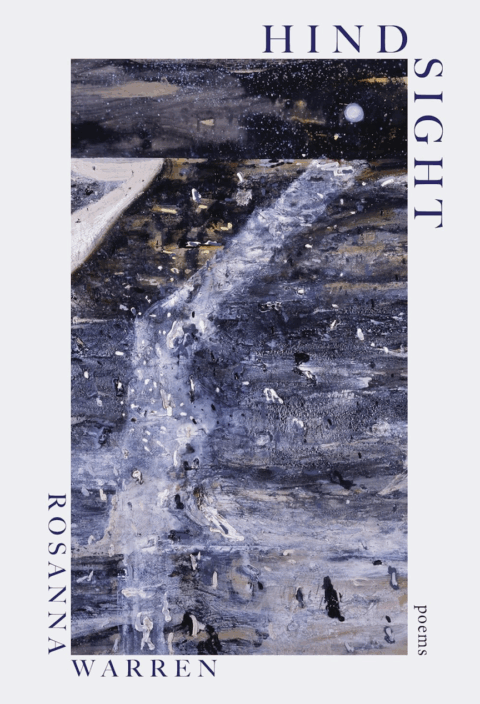
Rosanna Warren’s seventh poetry collection, Hindsight, recreates both the recent and more distant past. She has an inventive sense of the possibilities of both lyric and narrative form as “mutually sustaining realms” (to borrow Gregerson’s words again). The speaker of her poems is often accompanied by another, a “you,” creating a dual sensibility, strikingly personal but also reaching outward from the self.
In “Burning the Bed,” for example, a couple is shown initiating a concrete action: getting rid of an unwanted bed. The poem begins,
Carefully you balanced the old mattress
against the box spring to create a teepee on that frozen December patch
behind the house, carefully
you stacked cardboard in the hollow and touched the match
to corners till flames crawled along the edges
in a rosy smudge before shooting
twenty-five feet into darkening air …
Thus far we have a straightforward account of the facts, the beginning of a story. But then the atmosphere of the poem begins to change. We learn that reflections from the fire have gilded each “looming, shadowed tree,” and have gilded the faces of the couple as they stand watching with “shovel and broom.” The vision expands to include other lovers in other eras:
… So much
love going up in smoke. It stung
our eyes, our lungs. Pagodas, terraces, domes, boudoirs
flared, shivered, and crumpled
as the light caved in, privacies curled to ash-wisp, towers
toppled, where once we’d warmed each limb …
It’s as if, in the flames and smoke surrounding the bed, entire histories burgeon and die out. The poem concludes with three lines that return us to the couple, merged with the reality that everything, for all of us, eventually goes dark:
… And now at dusk, our faces reddened in the heat
so artfully lit, we needed all that past, I thought,
to face the night.
A different take on the past illuminates “Liliane’s Scarf,” in which the poet considers the life story of an older woman she knows. But first she poses a question, one that many women may have wondered about subliminally for years: “So what’s that about, gold chains printed on silk scarves?”
Next, we see Liliane herself, “dying, shriveled, alone in her high-ceilinged salon.” This is a “social” poem, rather than a lyric focused solely on the I. We are told that “Liliane sent me/her Chanel scarf” and the poem goes on to examine aspects of Liliane’s history, by way of an association with those printed chains:
…To what was she chained?
To angoisse — which is not quite anguish. To
the dream of a lost château. To the yellow star
pinned to her coat as she walked to school, Jewish,
Parisian, and bound to be hunted down
like her aunts and uncles, cousins, and grandmother, torn
from their apartments, shoved into trucks …
 Warren’s narrative finesse can be seen in the poem’s conclusion, which returns us to the person writing the poem, while at the same time speaking for a swath of women who don’t have the knack for accessorizing: “I don’t know how/to knot this silk stylishly around my neck.”
Although there’s much to say about the past and the present in Warren’s haunting use of ancient texts in this collection, as in “They set about wasting the land,” I want to look at two more poems fully anchored in our current time: “Number Theory” and “Snow.”
As with Brad Richard’s “The Rain,” “Number Theory” is a portrait of a you and an I living together. A snake, over four feet long, tries to enter their kitchen. Blocked by the screen door, it noses along the foundation where it finds a crack big enough for its “impossible length and girth” to squeeze through.
The snake’s intrusive otherness reinforces our sense of the couple’s closeness, despite the difference between the partners: she is a poet-scholar, and he is a mathematician who studies “the gaps between prime numbers. Until infinity.” The poet comes to terms with her fear of the snake by merging her observation of the snake’s patterned markings with her partner’s inquiry of number theory:
It’s pattern you seek. The opening through which
your thought will glide suddenly into a lit space
and be at home. In a shaky house, where wasps gnaw the walls.
The house of numbers is shaky; the balance between any two people will necessarily be shaky at times; and understanding and careful observation create a space for the poet’s thought and for her partner’s discoveries.
Warren’s poem “Snow” opens with a heart exam: “Your heart is photogenic, but it’s shy,” the nurse asserts, as she slides her “jellied wand” over the poet’s left breast. The narrative moves back to a recent time during which the poet had to pack up her apartment, a chore she equates with “practicing/for death.” The medical visit and the remembered packing set the poem in motion, and then, we get a heart-stopping lyric moment when an old passport comes to light:
…my younger self
stares at me: full-cheeked, with anxious eyes,
she wonders at the crepe paper crinkle above my upper lip,
my cheekbones carved by shadow, my wisping hair.
And I stare back: there’s nothing I can tell her,
no warning advice she’d hear …
At the poem’s conclusion, dizzying imagery dissolves present and past, as if all time were held in suspension:
… The doctor’s screen
shivers in the blizzard static of an ancient black-
and-white TV where snow, once started, falls and falls.
Lyric and narrative, social and solitary, moving fluidly through different periods of a life: both Richard and Warren write poetry that fully reckons with the mysterious separateness and encompassing closeness that are fundamental to how and what we feel, delivering the paradoxical “public face of privacy.”
[Turned Earth, published by Louisiana State University Press on February 7, 2025, 90 pages $20.95 paperback]
[Hindsight, published by W.W. Norton & Company on September 23, 2025, 96 pages $26.99 hardcover]