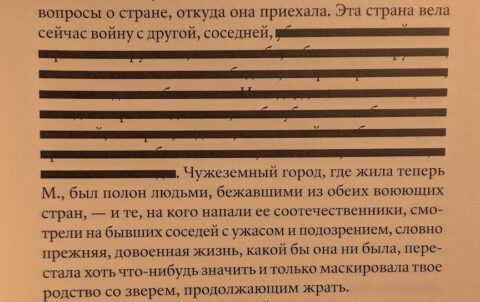
It feels like a different century, but it was only five years ago, in 2021, that Maria Stepanova’s In Memory of Memory became available to anglophones thanks to translator Sasha Dugdale and publishers Fitzcarraldo in the UK and New Directions in the US. A sweeping analysis of USSR’s legacy from the point of view of one Jewish family, that novel took decades to write — as behooves a deep, contemplative work driven by a desire for closure.
“After the Soviet Union disappeared, everything began rising up to the surface, objects regained little by little their primary function, and our accumulated and preserved past became once again what it was to begin with: a museum of cultured life at the beginning of the twentieth century,” Stepanova writes in that book. And towards the end, “… it is only possible to love the past if you know it is definitely never going to return.”
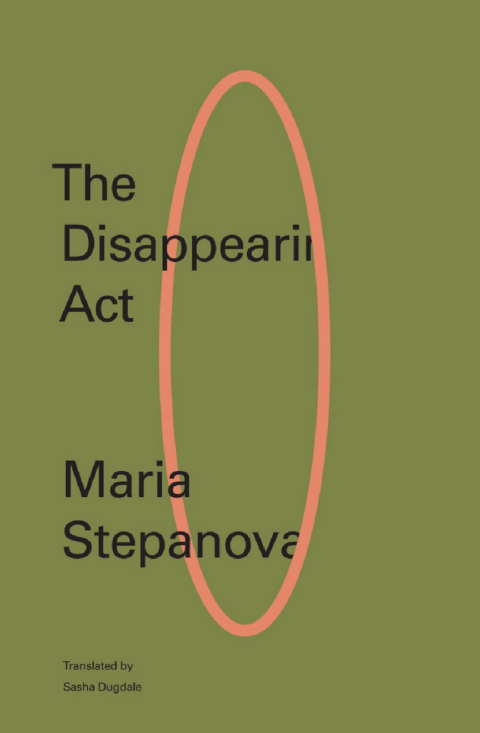 What hopes we had. But since February 2022, when Russia launched its full-scale attack of Ukraine, the past has caught up with us. Like the old USSR before it, the new Russia has shown an unslaking appetite for murder by the hundreds of thousands. “This country,” Stepanova writes in her new novel The Disappearing Act, “was currently waging war against a neighboring country, killing the inhabitants with missiles, with fire from the skies, with bare hands, and yet it still couldn’t conquer it, nor accept that its opponent was not going to offer itself up on a plate.” Stepanova doesn’t name the country (though elsewhere she names its primary language, Russian) but no one is fooled, least of all Russian censors. In what is now a common Russian publishing practice, typesetters blacked out two sentences in the original edition following “a neighboring country,” leaving the tips of “b”s and the tails of “p”s visible on the page, so that visually the text suggests bombed-out ground.
The Disappearing Act, also translated by Dugdale, follows novelist M who, like Stepanova, has left Russia during this war, and is now living in an artists’ residence in Europe, grappling with her new understanding of her home country and herself as a part of it. Dugdale’s translation is a loving one, beautifully rendering Stepanova’s melodic and rhythmic prose into precise English.
The central metaphor that M devises for Russia is that of a “devouring beast.” In the sentences below, note the variety of pronouns Stepanova uses in reference to M:
“M … found it hard to explain that the very nature of the beast made it tricky to hunt down or to fight … It was all around me, and to such an extent that it’s taken me years to realize that I was living inside it, that I was perhaps even born inside it. Do you remember the story … about the old man and the wooden boy, sitting inside a sea monster with only a stump of tallow candle? They could have caused the monster some discomfort by, say, jumping up and down in its belly or by making a fire. But in our case the disproportionate size of the beast means you can do it no real harm, let alone kill it. The only hope is that one day it will begin to choke and puke, and, without knowing how it happened, you suddenly find yourself on the outside, seeing quite distinctly that the room you spent so long in was in fact its stomach.”
The image of a wooden boy and an old man lighting a candle inside a beast comes from Carlo Collodi’s The Adventures of Pinocchio (1883), as mediated, I’m guessing, by the Walt Disney animated film Pinocchio (1940). But for me, and I imagine for Stepanova’s other contemporaries who grew up in the USSR, this metaphor calls back to another children’s story: The Dragon, a visionary play by Evgeniy Shvarts completed in 1944.
Initially censored by the regime, this work for children received a new life during the Khruschev thaw in the 1960s and became so popular that in 1988 director Mark Zakharov filmed it as a movie, To Kill a Dragon. Shvarts wrote his dragon as an all-too-clear metaphor for a totalitarian ruler — originally, this was supposed to be an anti-fascist production. A young, idealistic man called Lancelot kills a dragon that has been tyrannizing a country only to find that the dragon’s ways of controlling power have seeped into people’s hearts. The people immediately appoint a new “dragon” in the old dragon’s place, and Lancelot’s work to free them isn’t finished until he can convince them to kill the dragon inside themselves. The 1988 film version is even darker, suggesting that Lancelot takes on the work of killing the dragon in people’s hearts as his next quest, turning him into, well, a dragon.
So what happens to the immortal dragon when he grows bored of consuming the homegrown meat? And when every representative of his country has been absorbed into the dragon’s body and is part dragon?
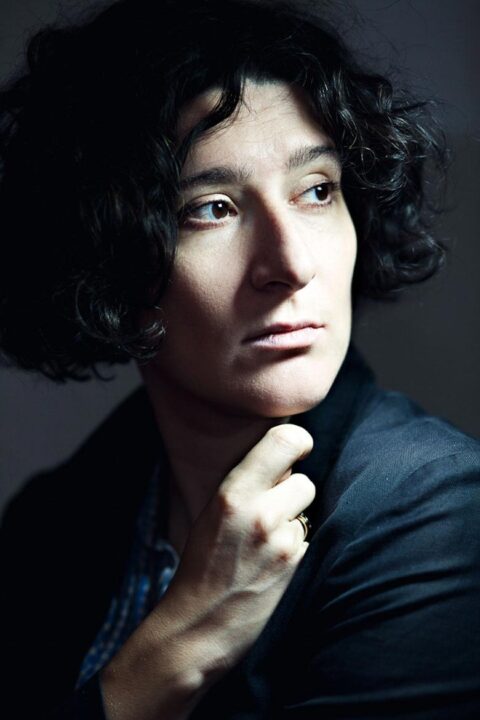 In an interview given shortly after the Russian-language publication of The Disappearing Act in a podcast by independent Russian news media “Novaya gazeta,” Stepanova suggests that “the beast” is an expression of the capability for violence that all individuals carry with them. The beast cannot be contained within geographical and political borders; it has overwhelmed people’s bodies and minds.
I should be clear that in this interview, Stepanova refrains from holding every citizen of Russia accountable for starting the war and perpetrating violence against Ukraine — the argument for “collective guilt” all too common on social media. She rejects this facile assignment of blame. On the page, however, she has allowed herself to create a character, M, driven by her overwhelming sense of guilt and anxiety that she’s also a beast.
In addition to the beast anxiety and guilt, M also suffers from grief over the loss of her home, and perhaps from more generalized PTSD symptoms that leave her feeling powerless, as though already dead. As she travels by train from her residency to a festival in a different European country, her thoughts spiral: “She was used to thinking of herself as a work in progress, a slightly more mature grammar schoolgirl, waiting for graduation or a successful match, but today it seemed obvious that the inevitable conclusion was a cleaver and a package of meat.”
Even minor inconveniences of travel leave M in a state of helplessness. She buys and gives away her food to two homeless men who ask her for it, one after another. She develops tunnel vision: “If she had learned anything from the past year it was the certainty that one could only move forward.” She takes her own anxiety as a sign of fate. For example, the act of leaving her suitcase at a station café while she goes to the bathroom seems of momentous importance: “leaving [the suitcase] by the table … would be tempting fate, and she might bring even more misfortune on herself.”
When her connecting train is canceled and she neither finds the power to complete her journey to the literary festival nor sees the possibility of going back to her residency, she allows her future to be directed by portents and accidental encounters. It is to Stepanova’s credit that the narrative not only loses no momentum at this point but its pacing actually speeds up. M chances upon a traveling circus in need of a magician’s assistant and offers her services for a trick for which she has to lie motionless inside of a sarcophagus, a part of an illusion where a woman gets cut in half. Her trial performance is deemed acceptable and the circus owner offers to take her on until he sniffs out (he’s a blind man, and he literally sniffs the air to make this observation) that M is a Jew.
“And M, who for the last months had only ever referred to herself as Russian, a Russian novelist, a speaker of Russian, replied almost with astonishment, that yes, she was — yes.”
This observation connects the book in intriguing ways to In Memory of Memory, where Jewishness and Jewish experience seem so central to the narrator’s identity, even as she is absorbed by the russified Soviet culture. For novelist M, the reminder of her Jewishness comes as a strange, perhaps grounding, relief from her feeling of Russianness (“the beast”), while at the same time it further destabilizes her narrative. The next day, when she returns to the circus intending to travel with it, she finds that the circus has disappeared.
Or maybe it didn’t. Stepanova veils the ending in a series of illusions, giving an impression that she’s exorcising novelist M from her system in a multitude of ways. The conclusion reminded me of another book I’ve been reading to my children, Is a Worry Worrying You? by Ferida Wolff and Harriet May Savitz, illustrated by Marie Le Tourneau (2005). After explaining how anxiety works and how it affects children and adults alike, the narrator asks a rhetorical question before making a series of suggestions: “So, how can you get rid of a worry once it starts worrying you? You can … imagine it away. Put it in a suitcase and send it packing. Seal it in an envelope and mail it away.” It doesn’t matter what happens to M. The author’s main concern is that she’s gone — or at least no longer worth worrying about.
My encounter with M’s way of thinking has helped me to externalize some of my own concerns and preoccupations. I admire Stepanova’s straightforward way of confronting her worries on the page. I’m also glad to see Stepanova working through the guilt and beast anxiety, clearing a path, perhaps, for future work and for more characters who could meet the beast on different ground, without being quite so overwhelmed by it, on their own terms.
The novel’s title in the original Russian is more abstract, suggesting in different contexts either “a trick” or “a focal point.” With The Disappearing Act, Stepanova’s talents have grown to include a magical quality, and it leaves me longing for more of her tricks.
[Published by New Directions on February 17, 2026, 119 pages, $15.95 paperback]
Russian state censorship …