During my childhood in Northern Colorado, it wasn’t fear so much as fascination that informed my own kind of cruelty to the diminutive critters that Boria Sax calls “creepy crawlies.” In the summers especially, the neighborhood kids and I would swarm the strange, forgotten corners of our cul-de-sac, bothering worms and beetles and – on lucky days – butterflies.
We were, in retrospect, a menace, especially to the bees whose attraction to the butterfly bush (Buddleja davidii) between my neighbor’s house and mine made them particularly vulnerable to our adventuring. At least once we caught an unfortunate bee in a water bottle and, at the instruction of one of the older boys, put her in the freezer where, dazed at first and then dormant, she appeared to die. We did this, as I remember it, for the strange thrill of delivering the stunned bee back out into the heat of our summer hideaways, where we would observe her drunken revival and eventual return to the bushes. Now I am struck, of course, by the casual cruelty of our curiosity — though I am also intrigued to remember our intense fascination with such small and alien life.
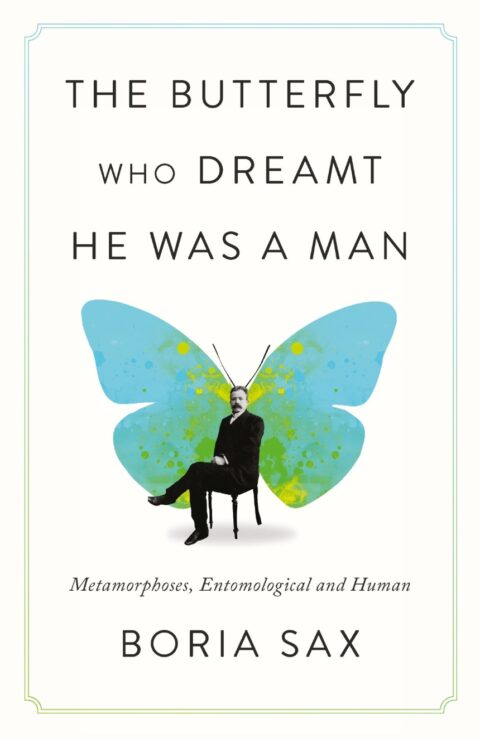 This same fascination underlies Boria Sax’s book, The Butterfly Who Dreamt He Was a Man: Metamorphoses, Entomological and Human, which begins with a scene from his own childhood. In these opening pages, Sax is eight years old and sitting alone by a river in rural New York when he is startled by the sudden company of a dragonfly landing, perhaps improbably, on his nose. Sax’s memory of this moment is emblematic of his decades-long interest in the philosophical and cultural questions that both inform and are informed by human relationships with the nonhuman. The insect, as he remembers it, is both mythic – “Suddenly,” Sax writes, “the dragonfly became a dragon” – and a pragmatic reminder that there are more ways of experiencing the world than humans tend to consider. “That,” he owns, “was more than half a century ago, though as dragonflies experience time, it might be a few thousand years.”
Sax associates this episode with zooanthropologist Roberto Marchesini’s notion of an “animal epiphany,” or a personal encounter with a nonhuman animal in which “identification with another creature distances us from our status as men or women, inspiring reflection on what it means to be ‘human.’” Sax, for his part, is no stranger to commenting on these kinds of encounters. Since his first book, The Frog King, was published in 1990, he has authored nearly a dozen books attending to the appearance of a wide range of animals in art and written sources. In The Butterfly Who Dreamt He Was a Man, however, Sax acknowledges that animal epiphanies and the insights they inspire are associated, by most people, with encounters – be they real or imagined – between humans and other mammals, or, at times, between humans and birds. “To write about epiphanies in relation to insects,” he tells us, “is a greater challenge, for the diminutive creatures have perceptual worlds that are far more different from ours.”
Though insects and other creepy crawlies may be difficult, in some ways, to empathize with, Sax believes that their lives render them especially suitable for comparison with human concepts and institutions. He highlights insect metamorphoses, especially, as a “model for human transformations.” After all, if it is true that if “except for a relatively brief period of infancy, the lives of mammals in the wild seem continuous,” then it stands to reason that insects, with their many, striking, metamorphoses, might offer a unique mirror for our own varied and varying lives.
“People,” Sax writes, “have associated the ant with industry, the cicada with ecstasy, the bee with holiness, the fly with filth and the mantis with esoteric knowledge … Mammals other than human beings may mirror our emotions, but insects show us the patterns by which we, both as individuals and members of society, may try to structure our lives.”
With glancing reference to a wide range of evidence, including folktales, Egyptian hieroglyphics, illuminated manuscripts, Renaissance paintings, poetry, the notebooks of early European naturalists, and anecdotes about insect husbandry (and more!), Sax’s book offers a kind of sweeping insight into the many significances that encounters with insects have carried in disparate cultures and across centuries.
While the scope of Sax’s study may seem unwieldy at first (it is certainly worth noting that the European naturalists and artists whose work he attends to are addressed in significantly more detail than any of the other examples he employs), Sax anchors his work in the “four basic ontologies” identified by the anthropologist Philippe Descola. By returning regularly to the admittedly broad ontological categories of naturalism, totemism, animism, and analogism, the book links its attention to insects with essential questions about being more broadly, and especially the relationship between subjectivity and the objective world.
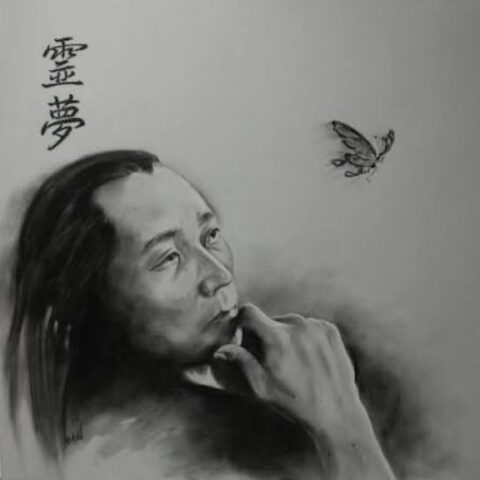 Sax begins and ends The Butterfly Who Dreamt He Was a Man with an anecdote from Chinese Daoist scriptures. The sage Zhuang Zhou (c. 369–286 BCE, also romanized as Chuang Tzu) dreams himself a butterfly, “fluttering over a field.” He awakes from his dream suddenly unsure if he is really a man who had dreamt himself a butterfly, or a butterfly all along, dreaming himself a man.
This and other slippages between human and insect existence invite questions about what it might mean to be a bug or, for that matter, a man. In this sense, Sax’s reflections can be complex, though the author takes pains to make his argument approachable. While he is not an entomologist, Sax is a sensitive and insightful successor to the artists and scientists whose work he features. Readers who are interested in learning a little about a lot – and always with an eye out for interesting insects – will enjoy this book’s lively intellectualism and slight eccentricities.
Vulnerable to the dual threats of climate crisis and simple human dislike, the beetles and bees of my childhood are rapidly disappearing. Although they are essential to ecosystems as food sources and pollinators and decomposers and more, warnings about declining insect populations remain relatively unheeded. While Sax admits that his book is not likely to solve the problem of the “insect apocalypse,” he makes a compelling argument not only for the intrinsic value of his creepy crawlies but for the remarkable intimacies, unexpected as they may be, between insect and human life.
In insects, and in humans, metamorphosis presupposes continuity as well as change. The Boria Sax who authored this book both is and is not that young boy by the river, just as I am – and am not – the girl that I used to be. As Sax points out, “the identity of the caterpillar remains in the butterfly, the child in the man and the wave in the current of a stream.”
My summers are different these days, busier and more burdened. There is so little time, it seems, for anything, and even less for curiosity or wonder. The insects that I see most often are easy to dismiss as a nuisance, the spider in the corner of my bedroom, the flies that plague the farmers’ market. This year though, I have had Sax and his dragonfly to remind me that it is worth slowing down and really looking around. It would seem that the world is as wonderful and weird as it was when I was young. I just needed to be reminded to notice.
[Published by Reaktion Books on August 26, 2026, 280 pages, $25.00 hardcover]