Did I hear roaring in the Midwest? I mean when Liza Hudock — Coast Guard veteran, grieving caregiver, young mother and poet — sent the manuscript of Reveille to Flood Editions. Readers for the Chicago press must have cheered. After all, it’s rare to open a PDF and find wise, pitch-perfect verse from an unknown poet.
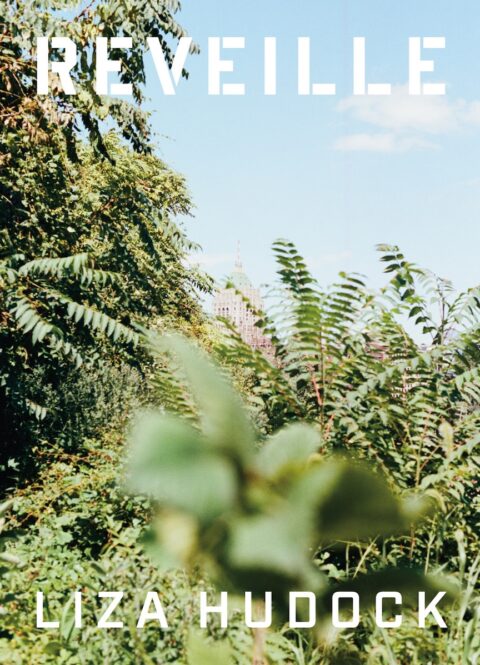 Likewise, in Detroit, where Hudock received word of her manuscript’s acceptance. To place a debut collection with Flood would be cause for celebration for any young writer. Over the past quarter century, this press has rescued book-length poems by Roy Fisher and Ronald Johnson, bringing them back into print; has showcased the Persian translations of Basil Bunting; and has sustained a score of celebrated contemporary poets, including Daisy Fried, John Tipton, Jay Wright, Elizabeth Arnold, and Fanny Howe. Hudock belongs in such company.
Whether crafting prose poems or lyrics, Hudock never loses her grip on the American vernacular, conjuring music from the pulse of everyday speech and letting observed details blossom into understated metaphors. Here’s how she does it on page one of her collection with a lyric titled “Boy in a Red Waistcoat”:
There is a portrait of
a sullen French boy
nailed to my innermost
chambers.
Pearly egg of childhood
and the ruptured curtain
all behind him now,
he protects my stick
of smoke, despite his own
accreting anguish and my
red walls,
right there, bursting
with unsolicited
advice. I want to warn
him about disappointed
innocence.
How it can harden
you into an artifact
or it can be your
nub of clay.
 With that concluding “nub of clay,” Hudock spins a simple particular into a multivalent emblem, vaulting her 20-line poem toward heaven, and reminding one of how often this mundane stuff recurs in both life and literature: from the clay molded into humankind at the Creation, to the mortal clay one surrenders at death.
Throughout Reveille, Hudock’s language is as spare as Shaker woodwork — and just as evocative of the spirit. Her subjects also are plain — a prayer card used as a bookmark, a fur coat soiled by nesting mice, an invasive pumpkin dangling from a neighbor’s tree — but through her deep engagement with the quotidian, Hudock achieves visionary effects. In “Largemouth Bass,” for example, her description of a landed fish goes beyond icthyological precision as she conjures a first-person voice for the creature. Her bass is both a fish out of water and a vivid persona through which the poet speaks of her own suffering. Here is how the poem ends:
Look in:
this my cool,
diaphanous muscle, this
my paper-lantern throat.
Look me
in the eye:
this mouth is the shape
of my forgiveness,
I offer it completely.
Pinch me
by the bottom lip
and dangle
the full weight of me
at arm’s length. Such
largeness of forgiveness!
I suffer my humiliation for it.
Hudock keeps a firm hold on her narratives, even amid family tragedy — her mother’s final illness, her sister’s fatal overdose. The poems are informed by loss, but Hudock never exploits events for pathos. She takes readers to the sickroom, for example, and gives us a prose poem called “Hope.”
On the ground beside my mother’s bed, I lie. A human tripwire to keep her
from running away or falling down in the middle of the night. I feel a foot at
3 a.m., nudging me to get out of the way. She says, I’m going out to the crab
apple tree to stand among the apples and see what I can see. It isn’t the season
for standing in apples, but still, she holds my arm with a sureness I must call
hope, or the mixture of certainty and hope which once staggered ships across
the globe, one candle to each, illuminating the vast nakedness between them,
and this way proved the world was round.
Hudock knows how to establish distance, and slaps us with concrete details. She fixes upon the past — just as she once gazed into the eyes of her relatives — and there she finds ways of telling that resonate more deeply than a simple act of witness by a survivor. The authority of these remarkable poems is wrapped up in their matter-of-fact tone — neither dismissive, nor casual about grief, but made taut by Hudock’s effort to find meaning, to place her losses among the vast machinery of days and habits, to demonstrate that she doesn’t just belong to her sorrows, but that she also belongs to us.
[Published by Flood Editions on August 25, 2025, 96 pages, $18.95 paperback]