Sufien, the protagonist of Hannah Lillith Assadi’s gorgeous novel Paradiso 17, would never be as happy again as he was in a refugee camp in Syria. During the 1948 war, when Sufien was only five years old, his family was driven out of their home in Safad, Palestine, leaving behind their house with the blue door (a recurring motif in the novel). With so many others they kept walking, huddling at night in tents lashed by the desert wind. “Their lives laid bare beneath the stars,“ they slept on mats and drank water and ate food provided by the UN. But at least no one was alone: “They wept, yes, but they also sang and they danced and they played the oud and babies were born, and there were even weddings held in the twilight.” For the rest of his peripatetic life, in Italy, where Sufien went to study, and then in the United States, where he went to make money and had a family of his own, he would remember those nights in the camp: the sounds drifting through the desert air, the “screaming, the crying, the laughter, the chatter of children.“ Camp wasn’t paradise, to be sure, but paradise is nothing without the people in it, as Sufien’s mother likes to say, and here they at least had the people.
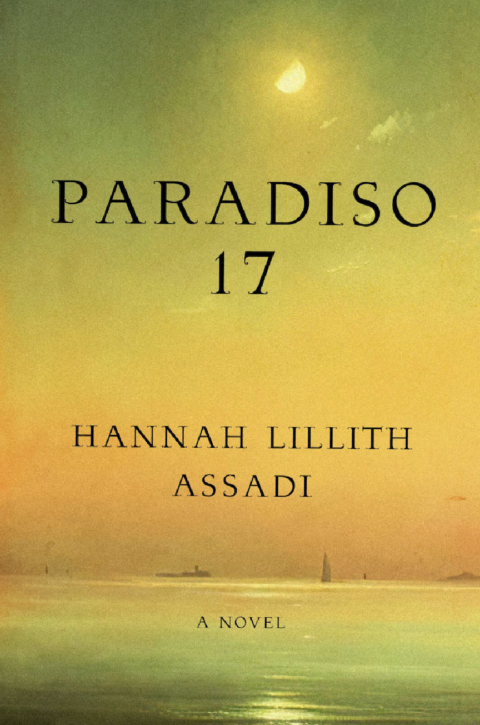 In Canto 17 of Dante’s Paradiso, from which Assadi’s novel takes its title, Dante learned a similar lesson. Traveling through the various spheres of heaven, he meets his ancestor Cacciaguida, who warns him that he will be hit by the “arrows of exile” and will have to give up everything dear to him. Dante’s one consolation: in his banishment, he will also make new friends. Fittingly, a few lines from Paradiso 17 serve as the epigraph of Assadi‘s novel. But there are important differences between the medieval poet and the modern Palestinian migrant. Because he was forced out when a mere child, Sufien has few actual memories of Safad. Home, to him, during his decades of displacement, is a series of substitutes, forever diminishing in authenticity.
Those substitutes include the market in Florence, where Sufien works after dropping out of college, taking in the smells of leather and carpets, of basil, rosemary, and sage, the meats and fish sold by the butchers and fishmongers. Later there is the constant soundtrack of New York: the banter of the students on the campus of Columbia University, the men shouting in Central Park, where Sufien, briefly homeless, sleeps on a bench, the traffic Sufien hears when driving his cab: “There was beauty here in this city, there was life.” Once he steps into a church and listens to someone play Rachmaninov. Sufien feels an angel has come for him. “A man had made this music?” With Sarah, the Jewish woman Sufien meets in a bar and marries, he moves to Arizona, his final version of home. In the desert, he can see the stars again, billions of them, “enough … for every one of us.” Yet when his mother, Uma Sufien, foul-mouthed, cantankerous, and quick-tempered, visits him, she is not impressed. “This place no, nothing,” a paltry copy of the real thing. And the heat? “Worse than the hells of Iblis” (a nod to Shaitan, the King of Hell).
Sufien is a far from perfect human being. He drinks, behaves badly toward his girlfriend Eden, and later cheats, for no good reason, on his wife with a prostitute he picks up at a 7-Eleven. Sufien is a kind of head-in-the-sand person, shrinking from conflict: when his father, Abdul Jalil, had begged him to return home, he escaped to the United States instead (and waited five years to read his father’s final letter). And he is immature: faced with a cancer diagnosis, he tries to ignore it. But his flaws are also part of Sufien’s beauty as a character — despite his frequent failures, Sufien somehow, until his final illness, always “survived himself.” A poet without ever writing a line of poetry, he feels everything intensely. At any moment in this exuberantly written novel, Sufien is fully himself, his senses wide open to the world, and Assadi lets us participate in his experiences, lavishing her descriptive talents even on simple activities. Thus, when Sufien cleans out his Grove Street apartment, we are right there with him as he sweeps the floors, bleaches the bathroom, and scours the stove — and then promptly forgets the cash he was going to use to take Sarah out to dinner.
 This isn’t just narrative muscle-flexing. It is important that we experience Sufien as the vibrantly alive, irreplaceable individual he is. War makes targets out of people, rubble of their homes, craters of their landscapes. It doesn’t persuade; it pummels. People’s lives become smudgy traces in the grim logbook of loss. But whatever war seeks to extinguish only goes into hiding and resurfaces later: violent displacement might remove the person from a place, but it can never remove the place from the person. Indeed, wherever Sufien goes, Palestine lives on inside him, in his bones, if not in his consciousness. And wherever he settles, he still feels the pull of his birth family, “a force like gravity.”
Of course, during his decades in exile, Sufien forges, as Dante did, too, new friendships, notably with the wealthy Bernardo, who gets him out of multiple scrapes. And there are also, and always, Sufien’s cats, generations of them. Feral creatures of the desert, they seem to follow him: Sharmuta in Florence, Hemingway in New York, the two Caesars in Arizona. The most memorable, and short-lived, of these is Marco Polo, the New York street cat with the ghostly eyes that shows up, on the brink of death, on Sufien’s fire escape, needing to be, in her last moments, with someone as “lonesome as her.”
One of the saddest, and most touching, moments in Paradiso 17 comes when, facing his own end, Sufien suddenly wails, “Does my family know where I am?,” sounding like someone who has just woken up in a hospital without knowing how he got there. And by family he means the folks back home, his dead mother and father, his brothers and sisters. In extreme situations, one longs for the people whose love one can simply take for granted. By then, Palestine, to Sufien, is no more than a handful of images shimmering behind his closed eyelids: a courtyard, an olive tree, the fog on the hill, and, invariably, that blue door. It is through that blue door indeed that Sufien vanishes at the end of the novel — in his daughter Layla’s dream.
Hannah Lillith Assadi’s previous novels include Sonora (2017) and The Stars Are Not Yet Bells (2022). Of these two, Sonora, a coming-of-age story about Ahlam, the daughter of a Palestinian refugee and his Israeli wife, previews some of the elements of her new novel. But Paradiso 17 is easily her most accomplished, most richly imagined work, a voice raised in protest against the warmongers who boast about “delivering death and destruction” to their enemies, as if those things were packages dropped on people’s doorsteps. And while Assadi’s literary intervention might seem futile — those who should read this book won’t — it is a necessary and beautiful one.
[Published by Alfred A. Knopf on March 17, 2026, 299 pages, $29.00US/$39/00CAN, hardcover]