Born in Tokyo in 1960, Yoko Tawada has lived in Germany since the early 1980s. Oddities course through the pages of her books: ghosts swarm the health food stores of hipster Berlin demanding sugary snacks; in a future Japan, children have become so frail that the elderly must care for them; a man who is also a dog courts a schoolteacher who has declared that she will marry the first person to lick her bottom. But despite these emotional and social cataclysms, Tawada’s novels are resolutely cheery. As the critic and translator Natasha Wimmer once put it, “her dystopia is Day-Glo bright.” Yet this sanguine tone — which presents loss not necessarily as gain but decidedly as the start of something new — isn’t the most unusual thing about Tawada’s work. Tawada writes in both German and Japanese, switching between languages from book to book as she sees fit.
Most discussions of Tawada begin with this fact of her writing life, which is taken to be extraordinary. Whether they think of her as a marvel or odd-ball, readers invariably conclude that she is exceptional. And why not? It’s one thing to start life in one language and finish by writing in another (like, for example, Vladimir Nabokov, or Samuel Beckett, or the French writer Inès Cagati, whose first language was Italian). It’s quite another to create regularly in both. Tawada, however, would reject this thinking. The thrust of the pieces in her first essay collection, Exophany: Voyages Outside the Mother Tongue, translated from the Japanese by Lisa Hofmann-Kuroda, is that her choice is simply an extreme version of an ordinary state of affairs.
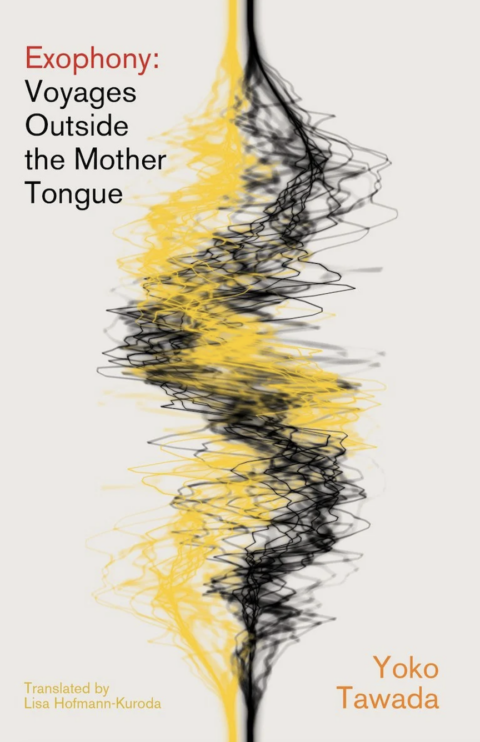 Exophonic, a term Tawada takes from the scholar Robert Stockhammer, refers to “the general experience of existing outside of one’s mother tongue.” Exophonic literature is similar but not identical to related terms like “immigrant literature” or “creole literature.” The latter terms, for example, don’t describe the experience of Swiss writers, at least those in the German speaking parts of the country. They mostly write in standard German even though they carry out their daily lives in Swiss German, a language so different from standard German that it cannot be called a dialect or pidgin. Exophony allows us to name and therefore consider the implications of such experiences.
But as Tawada argues, exophony is not as unusual as it might first seem. She urges all of us who live primarily in one language — whether we are writers or not, whether we take our monolingualism as a source of defiance or embarrassment — to recognize that our seeming linguistic purity or separateness is in fact only an inability to see the differences that inhere between and within languages. As her book was first addressed to Japanese readers, she points out that Japanese is a useful example of such self-difference. It uses three different writing systems, Hiragana, Katakana, and Kanji; the first two syllabaries used to spell out, respectively, words native to Japanese and those imported from elsewhere, also known as “loanwords”; the last a logograph whose often elaborate characters, as translator Hoffmann-Kuroda helpfully notes in her afterword, incorporate both semantic and phonetic components. Kanji is often taken to be the “real” or “pure” version of Japanese, yet as Tawada observes, it is itself a translation developed on the basis of Chinese characters.
Here and throughout the essays, Tawada delights in the absence of authenticity. Newly arrived in Germany, she realized that, as a “native” Japanese speaker, her difficulty in distinguishing the phonemes “r” and “l” made it hard for her to distinguish Brücke (bridges) from Lücke (gaps). As in her fiction, where inability so often becomes ability, this “failure” proved fortuitous: it allowed her to clearly see how every bridge needs a gap. It wouldn’t surprise me if Tawada loves the much-derided images on Euro notes, which are of bridges that don’t exist in reality — those bridges join nothing to nothing; they are pure signifiers, nothing but gaps.
It follows that Tawada rejects the idea of “the mother tongue” as a person’s “true” language. She hates it when people ask her what language she dreams in, rightly seeing it as a “gotcha” attempt to prove that she must in her heart of hearts prefer one of her languages to the other. She similarly rejects the idea of “correct” vs “incorrect” translations, pointing out that it is the easiest thing in the world, but also the least satisfying, to find things that are “wrong” in a translation. Such errors will always exist. She urges us instead to consider the interpretive possibilities manifested by such mistranslations. The worst thing you could say to Tawada is that “her German is so good” or that she must be worried about “losing” her Japanese. In Tawada’s hands, exophony offers a framework for replacing linguistic moralism with linguistic possibility.
If this sounds abstract, that’s because it is. The best moments in the collection are those when Tawada sharpens her thinking on the basis of surprising observations and interpretations. She notes the presumably unintentional multilingualism in some lines from the German Jewish poet Paul Celan, who wrote his most famous poetry while living in exile in Paris, remarking that the German word Neige (dwindling) looks the same as the French word neige (snow). Even better, she close reads Heinrich von Kleist’s syntax in a fascinating discussion of Mori Ōgai, a doctor and writer who began translating European literature when the Japanese army sent him to Germany in the 1880s as part of a modernization process. Ōgai’s obsession with the burgeoning field of hygiene seems to have shaped his translations. His versions of Kleist, the first in Japanese and some of the first in any language, pruned Kleist’s famously thorny sentences, ironing out the unruliness of their many dependent clauses. This “failure” allows Tawada to see Kleist differently. His dependent clauses, for example, “don’t just give the reader more information — instead they seem to have a life of their own, sprouting up one after another.”
Just as often, unfortunately, Tawada replaces literary close reading with socio-political bromides, her language aping the breezy carelessness of an op-ed (“For several years now, far-right political parties in Europe have been garnering votes on anti-immigration platforms”) or the self-indulgent platitudes of a would-be aphorism (“All borders exist in order to be crossed” or “To learn a foreign language is to create a new self, to discover a self that is unknown to you”).
Since these essays don’t claim to be comprehensive — they feel like occasional pieces, although I don’t know if they were first published that way — it’s easy enough to overlook these hasty moments. There’s plenty to like here. Her challenge to hegemonic ideas of language; her insistence that even in apparently homogenous societies other non-standard or minor or foreign languages always exist inside the dominant one, and not just through loan words; her hymn to the pleasure of being immersed in a language you don’t speak, a state she likens to becoming “a giant ear” — in such moments, Tawada makes us thrill to the idea of exophony. But she fails to tackle its full implications. Most damningly, she has almost nothing to say about linguistic coercion. She admits that exophony is a right, not an obligation, adding that it is “especially heinous to force people who have had to flee their own country to abandon their mother tonge and speak a different one,” before concluding “People have no right to proselytize about the joys of exophony if they have never been forced to speak in a language not their own.”
 Surprisingly, this truth seems to surprise Tawada. At a conference in Seoul, a Korean participant remarks that they have never considered Japanese literature as foreign because their generation had to read all so-called foreign writers in Japanese. Tawada reels from the force of this dark epiphany. But why had she never thought about this before? If one were to write a true history of exophony, surely one would find that instances of linguistic joy to have been matched, perhaps exceeded, by instances of coercion, violence, and domination. Writers from formerly or still colonized places have had much to say about the ambivalence of finding solace and shame in taking on the colonizer’s language.
Every time Tawada references such complexities, she swerves to safer ground: the conference in Seoul becomes an occasion to work through her ambivalence about the predominance of English in Japanese. How can she both reject the idea of linguistic purity but think there are too many loanwords? Her conclusion — that she can’t just reject those intruders but must instead push them “to their fullest, most radical potential” — might have solved a problem for her (although it’s hard to know what that would mean in practice), but it ignores the question that continues to affect so many people today: can exophony ever be uncoupled from violence? How do the inevitable inequalities experienced by even those who choose, let alone those who are forced, to speak another language shape that experience? Where does power fit into Tawada’s thinking?
This failure resonates more strongly today than when Tawada wrote the book, which was published in Japan in 2003. Its international settings — invariably conferences, residencies, or writing workshops in cities around the world — represent the neoliberalism and globalization of the 1990s and early 2000s. The essays feel dated when read in our own illiberal, increasingly authoritarian circumstances, when immigrant communities are under literal attack around the world and difference is seen to be so threatening that it is met with state-sponsored violence.
Tawada’s American publisher, the small but mighty New Directions, has admirably committed to bringing her work into English. But I have to wonder why they’ve published this book now. What will English-language readers make, for example, of the book’s second part, comprised of riffs on the connotations of various German words and idioms and their connections to Japanese? That material is always interesting, even pleasing, but probably less so if you don’t speak either language. Tawada’s Day-Glo depictions remain a useful beacon in our dark times. But without acknowledging that even lurid hues carry the shadows of darker tones within them, that resolute brightness can seem like oppressive chirpiness.
[Published by New Directions on June 3, 2025, 192 pages, $16.95 paperback]
⟐ ⟐ ⟐
To read Ron Slate’s review of Tawada’s Paul Celan and the Trans-Tibetan Angel, (2018), click here
To read Ron Slate’s review of Tawada’s The Emissary (2018), click here
To read Ron Slate’s review of Tawada’s Memoirs of a Polar Bear (2017), click here