
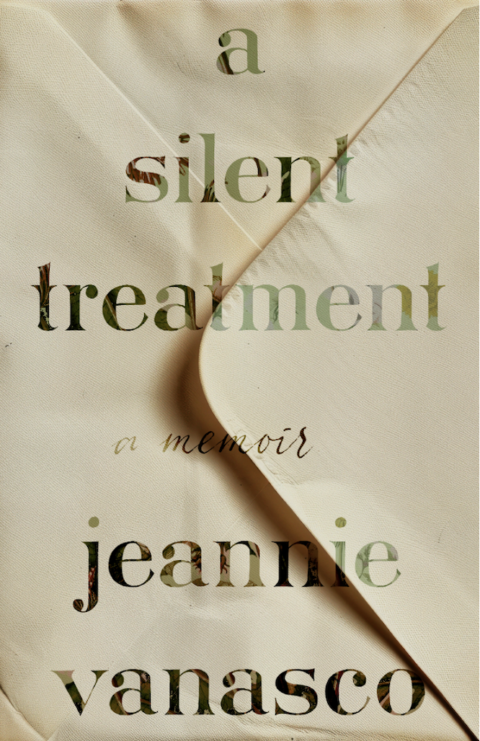
Sometimes, it’s not the what that captures my attention as a reader so much as the how. So it is with Jeannie Vanasco’s memoir, A Silent Treatment. The book chronicles a period of prolonged silence inflicted on the author by her mother, Barbara, who has a habit of severing communication at any perceived slight. The episodes last from two weeks to six months, reducing the mother-daughter connection to “two-letter replies, such as ok and no,” and then only about logistics that simply can’t be avoided. Many books have explored silence in relationships, usually as a product of absence. Elizabeth McCracken’s wrenching story of her stillborn son in An Exact Replica of My Imagination comes to mind, as does Elizabeth Alexander’s The Light of the World, in which the author becomes unexpectedly widowed. But what makes Vanasco’s account so achingly different is that while Barbara is verbally absent she is still so physically present, living as she does in the basement apartment beneath the home Vanasco shares with her husband, Chris.
 Vanasco is not allowed to interact with Barbara, nor is she allowed to forget it: “My mom’s silences — a few days here, almost six months there, over the five years since she moved in with Chris and me — amount to a year and a half, at least. A year ago I told her: When you don’t talk to me, it’s all I can think about. I feel sick constantly. Next time I do it, she said, yell at me. Tell me to go to hell. I can’t do that, I said. Sure you can. I’m not telling you to go to hell. Why not? Because. I don’t know. Just don’t do it again. But she did it again. Then she did it again, again. And, now (I think), again.”
The narrative opens just as Barbara is beginning to withdraw, and what follows is necessarily one-sided — Vanasco is, after all, being asked to put words where there literally aren’t any. And yet the author’s prose succeeds in animating the emptiness through a series of deft artistic choices that immerse the reader in her lived experience.
Her first task is that of making Barbara’s silence, this particular absence, tangible, and Vanasco does that by writing in the present tense. Speaking to Chris, Vanasco says, “Writing from within a silence is truer than reconstructing it. Perspective isn’t true because we never have perspective. The moment that we’re experiencing is the truest thing. You should write that down, he says. That’s why I get so frustrated, I continue, when people think memoir is strictly about the past. We tell stories about the past to make sense of why we feel or think the way we do. But we don’t really know anything.” Memoir writers often opt for the past tense because it allows them to utilize the dual perspective, whereby they consider their past from the perspective of the present. But Vanasco is in pursuit of the day-to-day uncertainties and minute-by-minute questioning that accompany withheld affection. In this way, A Silent Treatment forms an artifact of the author’s real-time torment.
 Fragmentation is another important element in Vanasco’s book, reflecting the kind of disjointed yet strangely telling thoughts that arise when the mind becomes distracted by a problem it can’t solve. One chapter opens with the narrator sitting in her car: “A friend calls, asks what I’m doing. I’m in the car, I tell her. Oh I’ll let you go. No, no. I’m parked behind the house. Your house? When you’re in a turn-only lane is the turn signal necessary? Or is it redundant, like a double negative? Are you okay? I feel embarrassed when I’m the only one using my turn signal.” This small scene reveals the extent to which self-consciousness overcompensates during the silences — but then just as quickly the chapter careens from a contemplation of the letters on the car’s gearshift to unsolicited writing advice to weeds in the garden. Vanasco’s associative style reflects the burden of conflict without resolution, showing how a creative mind desperate for relief searches for answers in every corner. “What are you doing?” Vanasco asks her husband at one point early on in the book. “Closing the drapes” he says. “But she might think that means something, I say.” If only these speculative bursts of meaning could alleviate the author’s distress; instead they are more symptom than cure.
Vanasco also plays with the idea of character by giving the couple’s Google Home Mini a voice on the page. Conversations with the AI assistant start out innocuously —”Hey Google. What are some things I can do to relax?”— but over time Vanasco seems to be asking AI to speak on Barbara’s behalf: “Hey Google. How does it feel to give someone the silent treatment? On the website relationshipsnsw.org.au, they say: The person who is silent might not actually feel like they want to punish their partner. They may internally be emotionally overwhelmed, where they know they are retreating and can’t get themselves back.” Or later, “Hey Google. Why might a parent use the silent treatment? On the website timesofindia.indiatimes.com, they say: Apart from that, parents can also be emotionally immature at times. Because they sometimes want to avoid conflicts or avoid answering uncomfortable questions, they might use silent treatment as a way out too.” Whether these responses truly reflect Barbara’s motivation is anyone’s guess, but at least they replicate the call-and-response of missing conversation. But even that interaction falls short: “Hey Google. Please talk to me. I’d love to talk to you. How’s your day going? My mom isn’t speaking to me. Thanks for sharing.”
This emphasis on technique isn’t meant to gloss over the very real pain at the heart of A Silent Treatment — both that of a mother reduced for any number of reasons to silence, and a daughter left to endure it. Rather, it’s meant to show how Vanasco’s artistry turned the nothingness of silence into something undeniably concrete, the finesse of her portrayal ensuring that we all partake of its stifled potency.
[Published by Tin House on September 9, 2025, 304 pages, $26.99 hardcover]