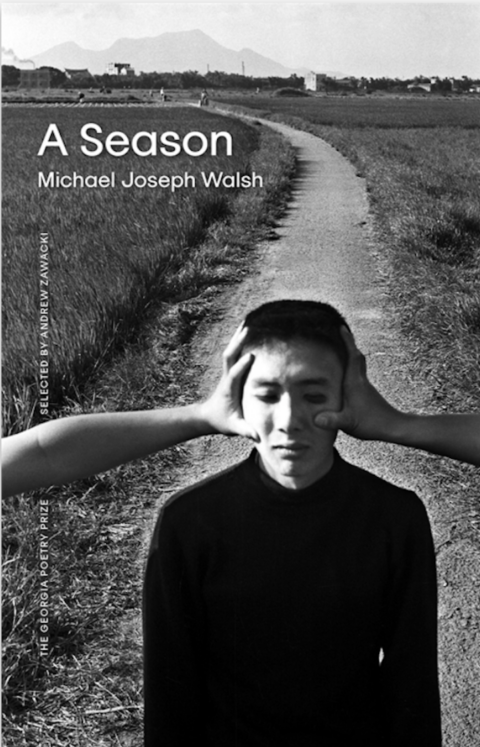
 In A Season, recipient of the Georgia Poetry Prize for 2026, Michael Joseph Walsh offers an integral evolution from his excellent debut, Innocence[i]. Both books arise from fine and perceptive awareness of consciousness observing and reflecting upon itself, expanding into meta-awareness of the processes by which poetic meditation can create mirrors of the psyche’s states and movements. A Season departs from its forerunner in being comprised entirely of longer sequences. The first, “Tocatta and Fugue for the Foreigner,” proceeds by alternating two kinds of poems with distinct processes of composition. One is “made mainly of quotations and fragments” from diverse texts; the other, italicized and in prose, is “made mainly of fragments from a personal diary” with less frequent quotation. These inventive processes allow organic interplay between present and past selves — and particularly the poetic aspects of those selves — as well as between the individual poet and the predecessors whose writing has moved through, moves yet within, this psyche of the poet. Such themes converse with the other meditation, “A Season,” which deepens consideration of the psyche as both contained and containing. Walsh presents a truly complete work that incorporates aspects of its various creative processes as essential to their completion.
“A Season” moves through evolving self-reflexive experiences of inner alterity. It captures the mutability and mobility of perceiving and perceived self-states through flexible adherence to the second person address. This approach allows the necessary fluidity for both the dialogical nature of the processes of consciousness rendered in the work and the changing of speaker positions between inner perspectives. It is so seamlessly made that a feeling of narrative and logic guides the reading experience. However, within this structure, the poems’ connective tissue, made of repetitions such as “And then” and “As accordingly,” creates surreal juxtapositions between logical language and emergent imagery:
As accordingly when I was eyes, and sun, slamming
(Whether I meant to or not).
As accordingly when I re-emerged,
Gasping on the surface by a nearly perfect hill.
And then on went time, on down the days,
In the bare and bleached crust of the earth
The ominous cool of the dream.
And that was it though I hardly trusted it
The tension between emergent image and constructed language reflects the observed self’s experience of trying to orient within strange new life. Emergence, whether as a child or a new aspect or version of oneself, is clumsy, more perceiving and experiencing than understanding, and yet full of new light. Here we see the brilliance of Walsh’s surrealist logos: The lines can apply to the psyche’s experience of either specific situations or entire life stages — and from both experiencing and observing standpoints.
The uncertainty that results from perceiving the gap between inner experience and external world only grows more acute when given conscious attention:
There it is, we imagine it
In whatever space between trinkets.
Then disguised again the nested infinities —
One’s body one’s thoughts —
In an exquisite opening, however, the meditation sees in such gaps the potential — and pathos — of creativity:
A musical thinking, a face
To help remember, a face
Sourced equally at the speed of thought.
The connection between the seasons as a natural metaphor for these cyclic-feeling psychic unfoldings relates, in interior life, to “[t]he intimate knots of the dream / [a]t speech’s edge our weirdly / [l]ive gods in parallel voice” as well as the genesis of “something” that:
Flowers in honest erasure of itself
And makes space for the new snow —
As meaning does
Without, perhaps, loving it
Gets behind a page
And blanks
The personification of meaning reflects the intuitive connections with and changeable dynamics between aspects of oneself experienced in self-reflection — all both dream-like and requiring conscious thought to be made, to some degree, into poetic reflections. This opens to inclusive understandings that integrate the recursive movements between dream and consciousness, inspiration and creation, macrocosm and interiority — reading and translating:
To have read over and over what
One tendril then another makes real —
In truth, all life
In the blue morning’s sheen the mouth
No simple ghost.
Having arrived itself from the future.
Having opened that gap to the wind.
The intertwined themes of ghosts and seasons evoke the paradox of living a double consciousness between the experienced presence of life to the living and the echoes of that living present in what we read or interpret.
“Tocatta and Fugue for the Foreigner” also reflects a consciousness aware of itself as contained by eventuality, yet also container of the world that contains it, container of the dream that contains it, container of the textual mirrors of others’ consciousness — as container of the stranger themselves. As the title alludes, the interplay between two styles structures the sequence. One sequence presents self-composition through the writing, reading, and self-editing processes. The poems inhabit an intermediary space between the “ghosts” of “A Season” — with their associations to textuality and reading, on the one hand, and the emergent aspects of the psyche, on the other — and dayworld consciousness. The uncertainty involved again pulls them toward the surreal, the narrative elements reading more like echoes of daily conventions still heard as echoes in the depths, reflecting the strangeness of Newtonian life when imagined without the assumptions of routine and familiarity.
 The connections between texts and physical bodies are experienced here by the retrospective first person: “I relaxed my body until my legs were two columns of text on a page, until I was so at peace I could hardly bear the weight of it.“ However, here a witnessing resonance between the self-stages gives a compassionate feeling tone to the portraits of ungrounded confusion: “In those days I worried that I might think myself out of myself, and these thoughts dropped their shadows into both my life and my work. I thought of them like fish: I attended to them, to their smells. ‘Life is self-providing,’ I thought, “it’s painful to be alive.’” In the process their passages follow a progression of self-reflexive movements manifested in and through writing: “As both author and persona I slept soundly, having been a main player even in the depths of my sickness … The earth crumbled beneath me, then, and I laughed a laugh I could feel with my hands.” The leaps between literary and psychoanalytic meta-cognition, on the one hand, and the surreal intuitions of internal connection on the other, foster a unique, non-dual expression of emergence and pathos, self-analysis and self-acceptance.
However, this opening unveils an awakening as to the deeper psychological realities of the audience lifted up by these pieces: “I had only one reader, an ideal one, and over time it got easier calling his bluff.” This realization subtly dislodges reified notions of the self: “’A self needs an audience,’ I thought. ‘A self is a season.” This uncertainty, underlying the processes we call self-reflection and poetic composition, opens to experiences of its fluidity’s freedoms hidden beneath apparent identity: “My memories at this point were dreams, or nearly dreams, each a pretty doppelgänger of the other, and all crouched adorably as if about to pounce … It was like looking at myself from behind.” Here again, apprehension of pathos and the hidden potentials opened by its realization emerge concurrently, the new self a revealing perspective on its own past modes of perception.
One deep image of the psyche offers a flexible lens through which to read the entire sequence: “Eventually it was so clear even I could see it: the sliding door dividing the room in half symbolized my destiny.” As the poems unfold in fine movements of self-apprehension, imagistic corollary, and rhetorical pantomime, what inhabits the two sides of the room shifts with the psychological developments that take place. In each season of the self, dream, audience, creative work, operating self-concept, and intuitions attributed to the other take up different, temporary places on each side of the sliding door — as the concept of the door itself — or as the idea of the room itself. Awareness of such fluctuations quietly begins to return from introspection to connection with others: “I was song, pantomime, song, slow fire. And whenever I closed my eyes I saw scores of old friends whom for years I’d not thought of but whom, it turned out, I still loved.”
The increment of a season is likewise flexible, including periods of life that, in the terms of the book’s mirroring, might correspond with the length of a poem, a sequence, the book itself, or the world of readings from broader movements of literatures that conversed into its genesis within the author’s psyche. Creative work with texts of a community of readings forms the book’s third sequence of poems. The form and process of selecting from and collaging readings into new poems in a new sequence foregrounds the interconnectedness of reading and writing, while organically evoking the way the “foreigner” theme functions to highlight a deep uncertainty beneath our daily conventions around personal identity and expression:
Yesterday goes forth from this moment. As a test of our astonishment, a cock crows.
In this body there are head hairs, body hairs, nails, skin, teeth.
Rejection on the one hand, inaccessibility on the other.
The foreigner calls forth a new idea of happiness: smear of light at horizon’s commissure, a pantomime of stone lacking flesh.
And how better in the end with leastening words to replace itself.
The psychotic ghost that haunts poetry is the hidden inclusive world.
Another “ghost” in this final line recalls the fear and the connectedness of realizing that we are contained within the psyche that we first conceive ourselves as containing. As this line both arises from and contains the poem it concludes, likewise the revelatory aspect of the collage poems is the way they read like meditations we usually assume come from where we conventionally call within, though they were made from a collection of voices from what we habitually call outside.
The complexity shows a different face when we meet similar movements in the first person:
In order to make up from whole cloth an identity, I stand up from my worktable. A spring wind rises.
That all-inclusive wind where words foment: that must indeed be called a beyond.
Often in this sequence, each line reads like a movement of psyche — and each movement to the next line feels like the leap of a new departure, part blending, part opening a space between two kinds of truth, uncannily related because they flow between microcosm and macromcosm. In the process the reader’s own experience of the sequence recreates a microcosmic dramatization of the lifelong experience of thoughtful and meditative reading: Others’ works take on one new life in being read and considered and a second one in joining a conversation among the other works who have previously taken up residence in the same psyche.
In doing so, this sequence presents a way of speaking to — and from — the foreignness presented by each of our own inner diversities, consciously or otherwise. At times such awareness can foster integral connections between world, body, consciousness, and alterity both within moments of being and creation:
Taking up a flower and smiling, without speech.
We call it the moon in terms of properties.
And this body, too, a moment of mountains, rivers, embedded in the flesh of its speaker.
Iridescent skin, refined nostrils.
To pierce the skull of the world and just to sit, as the clash of planes gives rise to a body linked to that “other scene.”
This moment of flowers, arrival of flowers.
This primordial, pleasing, death-bearing hand, all white and pupil along invisible blanks.
Importantly, the potential for the ego to experience itself as subordinating the outside world is witnessed as another psychic content within the same awareness:
Let us lighten that otherness by constantly coming back to it.
The mass of suffering wounds him, but in flashes.
When lying down, he discerns, “I am lying down.”
The eyeball thunders, crushing the vast sky.
Yet, through the experience of itself as a force of nature, that eye finds mirrors in its creations:
The entire body is a mouth: I call it a red furnace.
Such words are less the sign of a thing than of my distrust for them: fleshless skeletons smeared with blood, connected with tendons.From live metaphor to dead metaphor, with the blood of the finger or the tongue: the inner work of the prosthesis resonates differently in our individual bodies.
In containing them, an opening reemerges to the connective aspects of psyche — and poetry. Passages containing — or contained by — such perspectives offer a dual experience, part seeing all of creation as interconnected as if from outside, part flowing through it, creating:
The wind begins to rock the grass. The valley sounds are the long broad tongue.
Whatever you dream up entangles an absence, a still life.
A strange light shines on that obscurity that was in you: the operation of the lungs, the digestive system.
We thus stand firmly, facing each other, with bits and pieces of red heart, an iron tree.
Life must be the bird and life must be the fish.
The involution of the strange in the psyche, or the shape of the mountains below it.
Together, the two alternating sequences’ modes create a mutable, multidimensional space where the individual poet overlaps identities with poetic forebears, past selves, and various self-states within a more encompassing, meta-poetic perspective that collects them together and fosters their plural, inter-contextualizing co-existence. Within a world whose seasons and foreign beings we experience, we each experience our lives as seasons populated by foreigners within. These poems offer a textual reflection of these processes across time, different persons’ creations, even different layers and evolutions of the individual — so many aspects of what we call a self, it often feels selfless. This is a poetry that makes a home of our smallness and continual connectedness, a work to which those who live in poetry will often return.
[Published by the University of Georgia Press on May 1, 2026, 96 pages, $19.95 paperback]
[I] Michael Collins writes on Innocence for Heavy Feather Review here: “the I who meets the eye / in the evaporating pool”: Michael Collins Reads Michael Joseph Walsh’s Poetry Collection Innocence – Heavy Feather Review