Why do writers write? Ask a hundred of them and you’ll likely get a hundred different answers, as demonstrated by Lithub on a smaller scale in 2021 when they rounded up responses to that query given by thirty-three different writers over the years. No one explicitly said they wrote to be remembered, though Gertrude Stein came close by jesting that she wrote “for praise,” and yet that desire to leave something behind — either in the words themselves or the influence those words might have on the people who read them — is intrinsic to many of the writers’s answers and really to the very nature of being a writer, a vocation that requires at least some belief that you have ideas worth preserving in a way that allows them to be encountered by others. True, there have been plenty of authors who wanted some of their writing to be destroyed after their deaths, but even those, like Kafka, who were famously adamant about this desire, weren’t interested in retroactively eradicating earlier work.
 Occasionally, however, you do come across a writer who left nothing behind. A Paris Review piece in 2020 with the rather suspect title “The Great Writer Who Never Wrote,” talks about Stephen Tennant, a “fairy-tale character magically granted every conceivable blessing” who toiled over the same novel his entire life but never published anything except the foreword to an essay collection. A more interesting iteration of the reclusive Tennant is Roberto Bazlen, an Italian writer born in Trieste in 1902 who was said to have moved “beyond the book” because “writing didn’t interest him.” Bazlen published nothing prior to his death in 1965, though he left behind letters, fragments of a novel, and some short nonfiction pieces, all of which were collected and brought out posthumously as Scritti (1984), or Notes Without A Text (2019) in Roberto Calasso’s English-language translation. Despite the existence of this volume, Bazlen remains chiefly known today for the same reasons he was known during his lifetime, namely how he lived. He hobnobbed with literary titans like Italo Svevo and Eugenio Montale. He touted authors and titles he loved to friends and publishing houses. He offered advice and inspiration to those in his circle, often giving them destabilizing suggestions on how they should conduct their affairs, including their sex lives. Basically, as he put it in one letter, he had “a world of fun and then some.” If Bazlen were alive today, it’s easy to imagine him being tagged with the ignominious label of influencer.
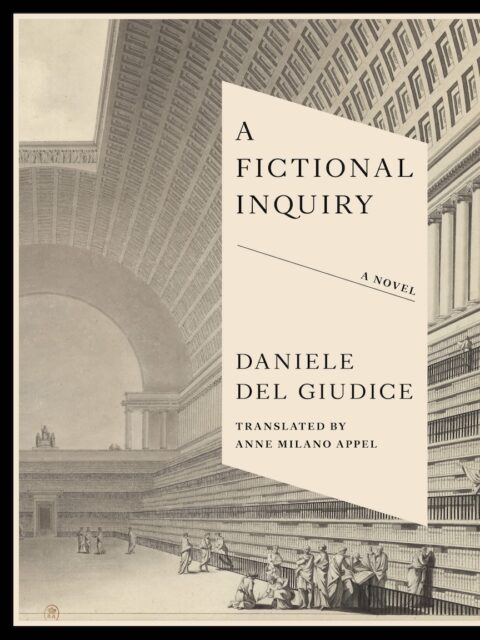
Daniele Del Giudice, an Italian writer who did write with regularity during his lifetime, uses the example of Bazlen, “a writer who didn’t write,” as the provocation for Lo stadio di Wimbledon, his 1983 debut novel that explores the nature of perception while critiquing both writers and the writing life. Anglophones at last have an opportunity to engage with this intriguing and intellectually stimulating novel for the first time thanks to Anne Milano Appel’s new English-language translation, titled A Fictional Inquiry. Given how long ago it was originally published, Del Giudice’s novel may be regarded as a precursor to those works, like Rachel Cusk’s Outline trilogy, in which the narrator’s personal encounters and conversations matter more than any of their activities over the course of the book.
The unnamed narrator of A Fictional Inquiry doesn’t do much. In Trieste, he briefly tries his hand at windsurfing one afternoon and watches as some people tour a French battleship docked in the harbor. In London, in the latter third of the novel, he watches a house burn near his lodgings and has a nice soak in a tub. Mainly he spends his time tracking down and talking to people whose lives intersected with Bazlen’s, personalities who are never identified except for two women who were subjects of poems by Montale. The first is Gerti Frankl Tolazzi, an Austrian Jew from Graz who lived most of her life in Trieste and who is the subject of Montale’s “Carnevale di Gerti” (Gerti’s Carnival). The second is Ljuba Blumenthal, a Ukrainian-born Jew whose departure from Italy for London prior to World War II is memorialized in Montale’s “A Liuba che parte” (“To Ljuba, who is leaving”). Ljuba was Bazlen’s lover for many years, including at the end of his life, and it is when speaking with her that the narrator most clearly states his purpose: “What I am interested in is a point at which knowing how to be and knowing how to write perhaps intersect. Everyone who writes imagines it in a certain way. With [Bazlen], however, there was an omission at that point, a refusal, a silence. I would like to understand why.”
There is, of course, no definitive answer to such an abstract question, and while the narrator comes to a conclusion of sorts about Bazlen, he largely listens to various opinions on the man. One former friend says that Bazlen “struggled” and “was trying to make something out of life” only to end up “disillusioned.” He was hampered, perhaps, by an obsession with originality, a point (perhaps unintentionally) emphasized by Appel’s decision to retain Del Giudice’s Italian — one of the very few times she does so — by writing that Bazlen “used to say that the only value is primavoltità, the first time.” The clearest, or at least surest, impression of Bazlen comes from Gerti, who tells the narrator that her late friend “lived through others” and had the “power to orchestrate” their lives, adding that it is only in those lives that any trace of him can still be found: “All that remains of him are the friends who loved him, and in whom he still exists.”
That group of friends might also include the narrator, who is often read as a stand-in for Del Giudice, according to Appel. The author lived most of his life in Venice, which is a short train ride from Trieste, and the narrator takes the train in and out of Trieste each day he visits, allowing for the possibility that he is commuting from home. And the narrator talks about the sea being in the wrong place in Trieste, which faces Venice from across the expanse of the northernmost Adriatic: “It’s a clear day, hardly cold; only the presence of the sea is strange, maybe because I can only picture this city from the south, and I’m disoriented by the position of the sun relative to the water and the type of light and color.” While it is never spelled out, there is unquestionably some sort of tie between the narrator and Bazlen, a seemingly painful one based on several hints throughout the text. When Gerti emphasizes that she “was part of all this. Others were on the outside, spectators, instead,” the narrator is perturbed: “I purse my lips and don’t answer.” When she takes out old photos, he makes himself stare crosseyed and blur his vision if she says Bazlen is in one of the photos. And later in London, he is even more direct when speaking with Ljuba: “Listen, I can’t look at the photographs. That’s how it is, I’m sorry.”
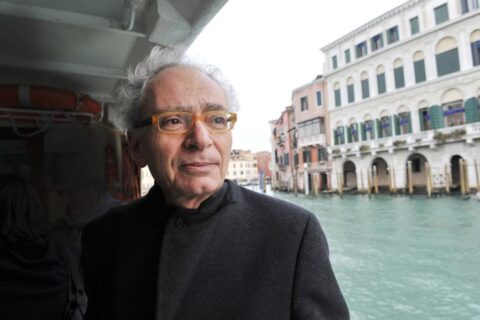 [left — Daniele Del Guidice] This unexplained personal investment is forthrightly acknowledged in a two-page passage near the midpoint of the novel when the narrator briefly switches from singular to plural, using we and us to include himself in the subset of those who were friends with, influenced by, and ultimately disappointed in Bazlen. This passage addresses both aspects of the narrator’s interest in that intersection between “knowing how to be and knowing how to write.” He opens by talking about writing, stating that even though Bazlen left Trieste, he couldn’t leave his friends, “his characters,” because he didn’t write about their lives: “You know, you can free yourself of characters only by telling their story, and maybe not even then. With us he’d done something different, and as we grew older we were able to recognize ourselves: not described on a page, as would have been normal, but set in motion by him.” And he concludes by discussing Bazlen’s being, how he conducted himself throughout his life: “Perhaps he too had changed, over time. He left us as you would leave behind something old and insufferable. I think it was the restlessness of someone who is constantly renewing himself by remorselessly shedding; the past seemed like a dried out, empty skin to him, intolerable.”
While this passage is the closest the narrator comes to expressing any true understanding of Bazlen, he continues to question his own perceptiveness and how close he wants to allow himself to his subject. At his most candid, he laments his “obsession over what others might be seeing where I see nothing as I walk and look around.” This theme arises in the novel’s opening scene, when the narrator must walk into Trieste after his train breaks down, leading him to remark that “train signals are visible only from a distance; up close they grow dim, from below they seem to be turned off.” He later talks about how mariners navigate by constantly measuring distances, remaining aware of how far away something is. One of Bazlen’s friends is known only as “the sextant lady” because she owns one of the ancient navigation devices. And on the flight to London, the narrator reflects on the Mercator projection, an egregiously distorted way of looking at the world, though he is seemingly unaware of these flaws, referring only to his belief that the map was “devised with precise calculation, and with near perfect mathematics.”
Because the story remains in Trieste for so long, Del Giudice’s original title, Lo stadio di Wimbledon, or Wimbledon stadium, acts as a kind of navigational beacon, drawing the reader’s mind toward the narrative horizon. Upon arriving in London to visit with Ljuba, the narrator gets off the Tube at the Wimbledon stop, but doesn’t actually enter the stadium until the novel’s penultimate scene. It’s a moment bursting with symbolism. He is at a loss for how to assess his progress — “No ideas come to me, only phrases” — and he yearns for something besides his writing: “for the first time I’m sorry, right now, not to be able to photograph a sweeping panorama, or a detail that matters only to me.” It feels like a test he has posed for himself or that Del Giudice has posed for his stand-in, a trial that will be repeated even more tangibly immediately after he leaves the stadium to say goodbye to Ljuba, who gives him a sweater once owned by Bazlen. In both instances, the narrator is set up in opposition to the specter of what Bazlen represents; and in the choices he makes, Del Giudice renders his final judgment, his belief that being a writer requires commitment to one thing only: writing.
[Published by New Vessel Press on October 28, 2025, 146 pages, $17.95 paperback]