Written in German but first published in Sweden under an English pseudonym, Ulrich Alexander Boschwitz’s first novel, Berlin Shuffle (1937), has finally arrived in the US in a lively translation by Philip Boehm. The international and multilingual elements of that publishing history — a function of its author’s attempt to escape the Nazis — don’t appear in the novel. But Berlin Shuffle nevertheless features plenty of movement. Ceaselessly on the go, its characters circulate, almost always on foot, almost always without finding what they’re looking for, through the working-class neighborhoods of the capital at the height of the Great Depression, a time when unemployment soared to 30%.
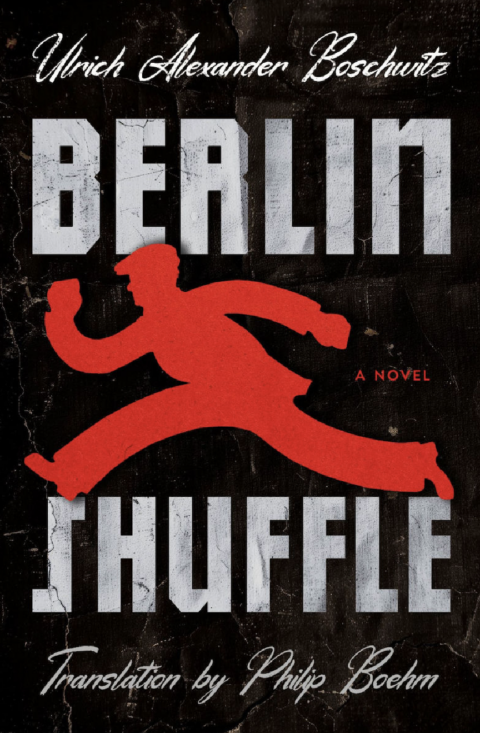 Hard times are good for criminals. Makes sense, then, that the novel features a Ringverein, one of the mafia-like criminal gangs prominent in the Weimar period. These associations had folksy names and disguised themselves as harmless clubs. Boschwitz invents the 1929 Liederkranz, a singing club that masks a ruthless cartel of pimps. (They burst into song any time an outsider chances on their meetings.) The men gather monthly in the back room of the Jolly Huntsman, a tavern and dancehall where most of the novel’s characters end up.
The Ringvereine were so named because their members wore distinctive rings, but the word’s literal meaning, “ring union,” best explains the organization’s function in the novel. Structured like a ring, Berlin Shuffle tracks the comings and goings of chance acquaintances connected by larger forces, most significantly the economic catastrophe of late Weimar Germany. Boschwitz’s characters are linked by their suffering at the hands of a precarious and mostly uncaring society.
The cast includes Fundholz, a former upstanding citizen and now professional beggar whose fall came so long ago that he can no longer quite remember how it happened. Out of a remnant of kindness, he has become the companion — more accurately, the guardian — of a man named Tönnchen, as fat as Fundholz is thin. Tönnchen, who endearingly refers to himself in the third person — “Tönnchen is hungry!” — and who is stuck at a child-like level of mental and emotional development, lives only to eat. Fundholz and Tönnchen fall in with Grissmann, an unemployed bus driver become petty thief and blackmailer. Grissmann is determined to steal away Elsi, the girlfriend of Fundholz’s fellow mendicant, the blind WWI veteran Sonnenberg, who ekes out a living selling matches outside subway stations.
At first glance, these characters barely deserve the name, reduced to a primary attribute: Sonnenberg angry, Elsi frightened, Tönnchen starving, Fundholz caring only for the brief oblivion of a glass of schnapps. And yet over time they prove to be more than caricatures. Boschwitz sketches their histories economically: the humiliating end to Fundholz’s marriage, the childhood trauma that arrested Tönnchen’s development, the bad luck that led Grissmann to lose his job, the abuse Elsi suffered walking the streets as one of Berlin’s legions of sex workers, and, vividly, the anger Sonnenberg feels after having been disabled in a war no one wants to be reminded of.
These portrayals make Berlin Shuffle a guide to human suffering, a seemingly endless life in which, as Fundholz muses, “Every minute of joy winds up costing hours!” The book’s tone is grim but leavened with flashes of humor, examples of the famous Berliner Schnauze, coarse wit. Readers will occasionally laugh out loud, as when Tönnchen, faced with a fascist’s paranoid conspiracy theories (the Masons murdered Schiller; the Jews betrayed General Ludendorff) thinks, sorrowfully: “It was about Ludendorff, Schiller, and Goethe. All things Tönnchen had never eaten.”
 Boschwitz adeptly juggles pathos and punches, verbal or otherwise. But he has a harder time relating the forces of history to the fates of the individuals who live it. The novel’s struggle to integrate these elements, played out in its unstable point of view, is at once its most interesting and least successful quality. Reflections on psychology, technology, or economics regularly pop up in the narrative. These are prompted by characters’ experiences, but uncertainly connected to their thoughts. Sometimes the text uses conventional free indirect discourse — that narrative technique that voices a character’s subjective or personal reflections in third person. A section comparing the generosity of the poor to the stinginess of the rich, for example, clearly comes from Fundholz’s perspective:
“To be sure, the couple who had just given him compote and bread was hardly poor. Certainly not by Fundholz’s standards. But he was well acquainted with the difference between being rich and having limited means. It was a strange world all right.”
The reference to the character’s experience (“he was well acquainted with”), the qualification of an earlier thought (“to be sure”), and the homely conclusion, befitting the unwillingness to probe too deeply into things that readers have come to associate with him — these elements tie the reflections firmly to their origin in a character.
At other times, the point of view is less certain. Take the example of Frau Fliebusch, a formerly middle-class woman lost to grief and unable to understand that her husband died in the war. In one scene, she eats a hot meal for the first time in a while. The narration seems to be focalized through her perspective: “She had been hungry, very hungry in fact!” Exclamations, like questions, are classic clues to free indirect discourse. But as the passage continues, the perceptions seem less like the deluded woman’s:
“Hunger is the best cook, people say, But not only is it the best cook, hunger is also a splendid tranquilizer. People who haven’t eaten for weeks are generally prepared to yield and admit the error of their ways. Opinions and ideas become pale specters if they can’t be fed. A lack of nourishment rules out any display of strength.”
Nothing in our experience of Frau Fliebusch inclines us to think these reflections come from her. In fact, the substance of the passage spells out what was only implied by Fundholz’s throwing up of the hands (“It was a strange world all right”): hungry, oppressed people don’t have the energy for convictions.
In still other cases, the separation between character and narration is absolute. The scene describing how the bus driver Grissmann loses his job segues into a page-long disquisition on economic inequality stemming from technological innovation. As someone who can’t explain why his fare box was light by 20 Marks, let alone explain the macroeconomy, Grissmannn can’t be the source of these thoughts.
Are these little state-of-the-nation addresses meant ironically? That might explain a passage like this, coming at the end of a description of sex workers:
“Perhaps it would be of interest, in this era of statistics, to look at two street corners over a decade and determine how many kilometers, how many thousands of kilometers were covered on foot between eleven in the evening and six in the morning.”
Perhaps it would. But the result wouldn’t be a fiction centered on a handful of identifiable characters. How then to write a novel in the era of statistics? Literary naturalism offered one answer, but even its overarching thesis — that environment shaped character — was challenged by its obsession with degeneration, presented in the most dramatic, even gothic terms. Naturalism purported to explain the whole but did so only by focusing on an anomalous subset. In his first novel, Boschwitz seems like his character Frau Fliebusch, who struggles to relate perception to event, subjectivity to objectivity: “She could reconstruct single moments without difficulty, but she was unable to place them in their larger context.”
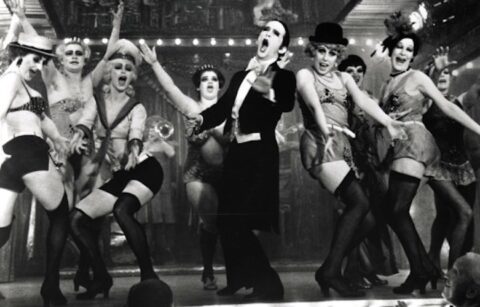 Maybe there are people, even in a society in crisis, who can fit themselves into the circumstances of the time, people for whom life makes sense. This possibility is hinted at in the novel’s original title, Menschen neben dem Leben, People Beside (or Alongside) Life, or, given the novel’s milieu, People Left Behind by Life. These are admittedly not the catchiest phrases in English. It’s understandable that the publishers went with something more resonant. Berlin Shuffle hints at the antic glamor of late Weimar Germany but nails the weariness of a society hammered by the Depression. The Berlin Shuffle: it could be a dance step, straight out of the half-tawdry, half-luminescent nightclubs of the world of Cabaret. In fact, the climactic scene takes place on the dance floor of The Jolly Huntsman. But even here, the dancers sway and lurch drunkenly, stepping on each other’s toes. Nothing elegant or defiant here. The dancing seems exhausted, not so much a respite from the endless struggle to keep your head above water as another version of it. As the night goes on, the dancers only become more dehumanized, reduced to the mechanical movement of body parts. Listening in from the bar in the next room, a character notes, “Feet were shuffling across the floor.”
This sounds like nothing so much as the plodding of the un- or under- or precariously-employed characters as they trudge across Berlin, seeking busy intersections where they hope for a few coins, apartment buildings that other beggars have marked as being home to generous souls, or parks where they can while away the day undisturbed.
People who are beside or alongside life are people who have been left behind. The prepositions distinguish between people (secondary, even worthless) and life (primary, even triumphant, necessarily inhuman). The most sympathetic reading of Berlin Shuffle’s sometimes awkward mix of narration and reportage is that it mimics the lack of fit between its characters experience and their surroundings. For many people, then as now, life calls the tune; the best we can hope to do is shuffle along and hope not get tripped up.
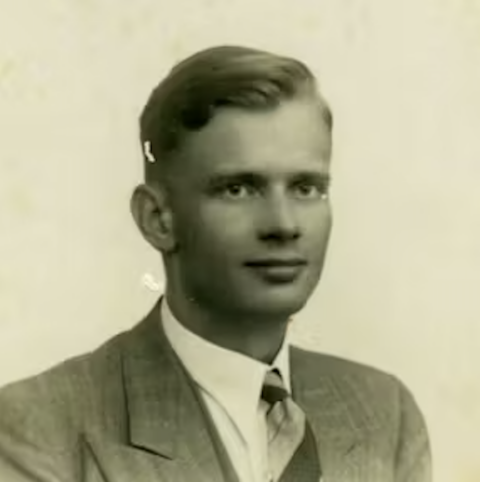
Certainly, life never stopped plaguing Boschwitz himself, whose experiences were even more dramatic than those of his characters. Born in Berlin in April, 1915 to Solomon Boschwitz, an industrialist who died of a brain tumor just weeks after his son’s birth, and Martha Wolgast, an artist forced to take over her husband’s business, Boschwitz and his elder sister, Clarissa, were raised in the Lutheran Church. But even though his father, like many German Jews at the time, had converted to Christianity, Boschwitz became subject to Nazi race persecution as a “half-Jew” with the promulgation of the Nuremberg Laws in 1935. The family soon scattered. Clarissa went to Palestine. Martha’s brother, a prominent lawyer, was murdered on the street. Boschwitz and his mother managed to get to Sweden.
Years of involuntary travel followed. Unable to settle in Sweden, Boschwitz was hounded out of Luxemburg for not having the right papers, studied briefly in Paris, and was living with Martha in London when news arrived of the Kristallnacht pogroms. He folded the latest events from his homeland into his current manuscript, about a man on the run from the Nazis. Although published in England and the US at the beginning of the war, the novel quickly fell out of print until rescued from obscurity in 2018 in Germany and subsequently in English translation as The Passenger. It became a surprise hit 80 years after its first publication.
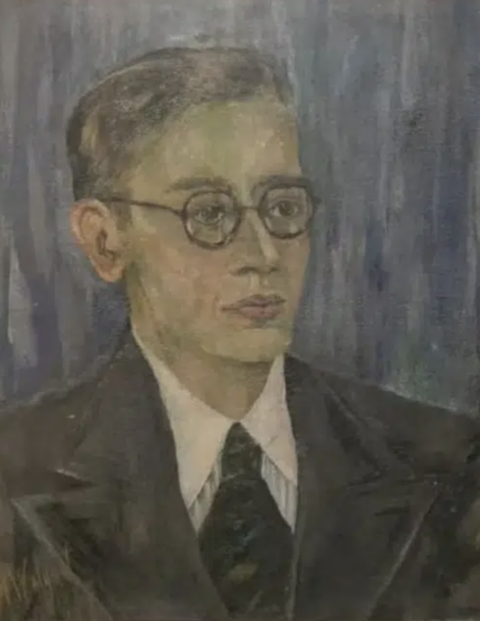 Boschwitz, who, if the portrait painted by Martha after the war is any indication, had a fine sense of irony, might have turned this posthumous success into material for a further novel. In the painting he looks to his left through wire-rimmed glasses and with full, slightly pursed lips, seeing something, perhaps amusing, perhaps bittersweet, that viewers can’t. Only an ironic soul could find anything amusing in the rest of Boschwitz’s short life. In 1940, he was interned by the British government as an enemy alien. From there, he was deported to Australia on a ship whose crew, mostly former criminals, took advantage of the human cargo, stealing anything they deemed valuable and throwing the rest overboard. Boschwitz’s latest manuscript met this fate, which might explain why, after two years behind barbed wire in a POW camp, when he was allowed to return to England, Boschwitz insisted on tying the pages of his new work to his body. Decades later, a fellow passenger reported that Boschwitz hoped his words would live on in case the ship went down and he somehow survived. Prophetic thinking — except that, when the ship was torpedoed by a German submarine, Boschwitz didn’t survive. He was only 27. We can only imagine what might have become of him as a writer. If the leap between Berlin Shuffle and The Passenger is any indication, he would have perfected the melding of social realism and psychological precision.
When a novel resurfaces after many years, it can be easy to confuse the passing of time with the age of the writer. No matter that it was written 90 years ago; Berlin Shuffle, published when its author was only 22, is a young man’s book. It lacks the finesse of other depictions of Weimar-era Berlin, those by Gabriele Tergit or Erich Kästner, for example. But those writers were a generation older. It is fair to say that only specialists of the period would be reading Berlin Shuffle had Boschwitz not gone on to write The Passenger. But American readers have much to learn from this depiction of a society that deems so many of its citizens expendable. The shuffle of a million exhausted feet — a sleep of reason that breeds monsters — isn’t confined to Berlin.
[Published by Metropolitan Books on December 9, 2025, 256 pages, $26.99 hardcover]