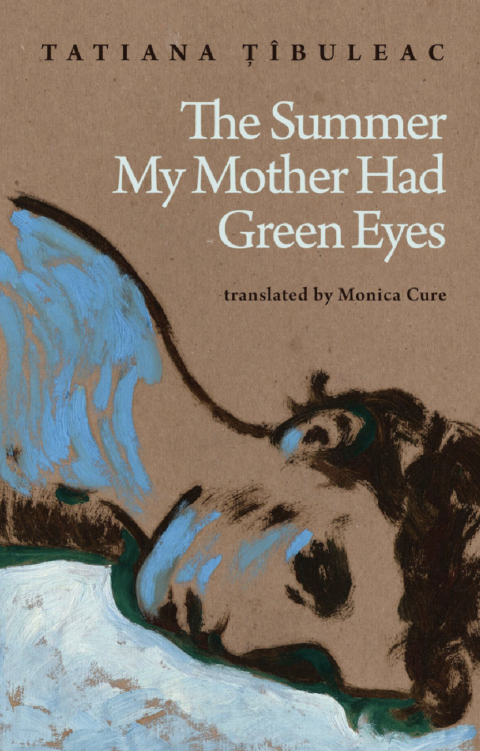
 Tatiana Țîbuleac’s The Summer My Mother Had Green Eyes (Deep Vellum, 2026) is a gut-punch of a novel. Emotionally intense, unvarnished, and at times devastating, the narrator’s arresting voice draws the reader into the messiness of grief, love, and forgiveness, serving as stinging proof of just how much the human spirit can take. Translated from the Romanian by Monica Cure, the novel follows Aleksy, who for most of his young life is consumed by anger and resentment toward his mother, whom he blames for her perceived failures as a parent and for the emotional neglect he suffered after the death of his younger sister, Mika. The story breathes through short, staccato chapters as Aleksy reaches back 14 years to his final summer in Northern France — a season spent in the shadow of his mother’s approaching death. During this summer, Aleksy is forced to confront his mother’s terminal illness and the emotional wounds that have festered between them for years. Țîbuleac’s prose is as savage as it is stunning, finding beauty in the wreckage, taking the dissonance of their lives and transposing it into visual music.
Aleksy is a difficult protagonist to love, but his unfiltered pain makes him impossible to ignore. His resentment is balanced by sudden, piercing moments of love for a mother he spent years hating. Her evolution over that final summer is the soul of the book — a transformation that feels both devastating and hard-earned.
The book vibrates with vivid imagery — from the vast sunflower fields to the piercing green of his mother’s eyes like an “emerald submarine.” I reached out to Tatiana Țîbuleac about her novel when she admitted that she didn’t set out to “construct” symbols, but instead found herself drawn to images that have haunted her since childhood. The sunflower, for instance, is another constant in her work; it’s the flower of her Moldovan youth, tied to memories of her grandparents and the secret reading nooks of her girlhood. While readers may see a calculated metaphor, for her, the sunflower is a “time capsule.” The following conversation took place via email exchange in November 2025 and was edited for brevity.
◆ ◆ ◆ ◆ ◆
BS: What inspired you to write this story?
TT: My father, my late motherhood, a bunch of fears. I don’t think a book starts from only one thing, at least not the first book. I didn’t have a well-defined story in mind. I began writing mostly to vent emotions and basically to express a couple of things. That summer, my dad came to see his grandchildren, but instead it felt like he saw me for the first time. He was clearly a better grandfather than he was a dad, and that made me think about my own childhood. There he stood — caring, interested, mesmerizing. Everything I wished for all my childhood, ramifications came later on.
BS: How did you find Aleksy’s voice? It’s so emotionally charged and volatile — I’m curious about the challenges of balancing his resentment and pain with those quiet moments of reconciliation?
TT: I never write my books from A to Z. The first chapters of Summer were about the ocean, which are now are at the end. I kept adding them randomly and it wasn’t until I wrote the first sentence from the book that I knew I had a story. It was then that I noticed the male voice. I was surprised by this unconscious choice, but seeing that I felt quite comfortable with it, I continued. Maybe it was easier for me to say some things by hiding behind a voice of the opposite sex? I remember the book launch, when I saw my mother in the room. I couldn’t read the passages where Aleksy hates his mother in front of her.
BS: The book moves fluidly between Aleksy’s current life and his ghosts. How did you manage to blur the lines between his past and present so seamlessly?
TT: In fact, this form of writing seems to me to be the closest to the way the human brain works. Most of the time, memories don’t come out of nowhere but are triggered by something in the present. Plus, Aleksy is an artist, which offers a generous margin for madness and atypicality. In other words, I really didn’t think much about a structure. I didn’t even think about what literary genre it was. Some critics have noted that there is a lot of poetry in the book — now I may agree with them, but at the time I didn’t see it. There were times when the text became too heavy, too violent, and then I would take a breather. Maybe that’s what writing poetry means.
BS: The book feels like a slow-motion collision between grief and reconciliation. How did you map out Aleksy’s emotional shift?
TT: I could probably have found something lighter than death. But without it, I couldn’t have talked about reconciliation. Unfortunately, we learn the greatest lessons only in the face of tragedy. Mother had to die, and she died right on first page, so that there would be no room for vain hopes. In fact, the change you are talking about, though it is felt in both characters, actually occurs in only one. Aleksy changes, or rather Aleksy changes the way he looks at his mother. Knowing that she is dying, he tries to listen to her, to look at her, to talk to her. This simple communication makes him see her in a completely different light. I have always regretted in life not the things I said, but especially the things I didn’t. All the words I didn’t say in time grew inside me like coral and hardened me. I didn’t want this for Aleksy.
BS: Aleksy’s journey as a painter is intertwined with his mother’s memories and his healing. Can you tell me about this choice and your intention behind this?
TT: I grew up in a family where artists were considered superhumans. Maybe because we had a series of failed writers and musicians among our relatives, maybe because in the Soviet Union, literature was contaminated by propaganda, but somehow painters seemed to have more freedom. I wanted Alecksy to be free, I wanted him to be easy to understand. I secretly hoped that one day someone would want to reproduce the paintings in the book, and I am happy that now this dream has come true.
BS: Beyond the recurring green eyes, I was struck by Aleksy’s obsession with snails. It feels like a perfect mirror for his own sense of being small, overlooked, and stuck. What drew you to those specific images to ground his search for meaning?
TT: I wrote this book when my children were still small and I relived all the wonders of childhood with them. The episode with the snails, which happened, reminded me once again how differently we relate to the same thing in childhood and then when we grow up. One day after it had rained outside, the garden was attacked by snails and the children let themselves be attacked by them. I found the episode disgusting, while they found it extraordinary! They were like two snail shepherds and that’s where the idea came from. I remembered then how I loved snails when I was their age and how prejudice prevents me from seeing their beauty now.
BS: The translator’s note at the beginning of the novel is illuminating. I was curious about your experience during the translation as you are fluent in English. What was that process like for you? Were there any changes that needed to be made for the English-speaking readership?
TT: I postponed this translation for a long time. It always seemed like the wrong time, though for an Eastern writer to be translated into English is a mandatory goal. Partly this happened because writing is something I don’t necessarily want to share with my family, all English speaking. Partly because it is still my playground, if not a “room” at least a corner of my own. My children know that I write, they know I write about them too, but at home, I prefer to just be their mother. I feel lucky to have a translator who wanted to team up with me. It’s hard to argue with an author who, though he speaks the language worse, thinks he knows better. I was surprised that many passages sounded foreign to me in English, not because of the translation, but because of the text itself. Now that our work is complete, I only hope that the book finds its readers with all that this brings — criticism and joy.
BS: Without spoiling anything, I’ll just say that the novel concludes with a mix of reality and imagined possibilities. What message or feeling did you want to leave with the reader?
TT: There is no ending to the book — the summer never ended. There are people we love more dead than alive. The mother in the book is such a person. If I had to choose just one message from the book, it would be this: it’s never too late to set things right.