To my ear, the greatest performance of Elvis Presley’s late-60s comeback — an era that included “In the Ghetto,” “Suspicious Minds,” and “If I Can Dream” — has always been “Stranger in My Own Home Town.” Written and first recorded by R&B singer-songwriter Percy Mayfield in 1964, its lyrics are dirt simple: I’ve changed, you haven’t, I bet you hate me for it, but I’m stubborn. It’s not hard to see why the song appealed to Presley, who by 1968 had spent a decade in the B-movie wilderness. Returning to Memphis with something to prove, he leans hard into the groove like he did nowhere else during those sessions, repeating the title and giving it every inflection possible: I’m lost, I’m hurt, I’m angry, fuck you.
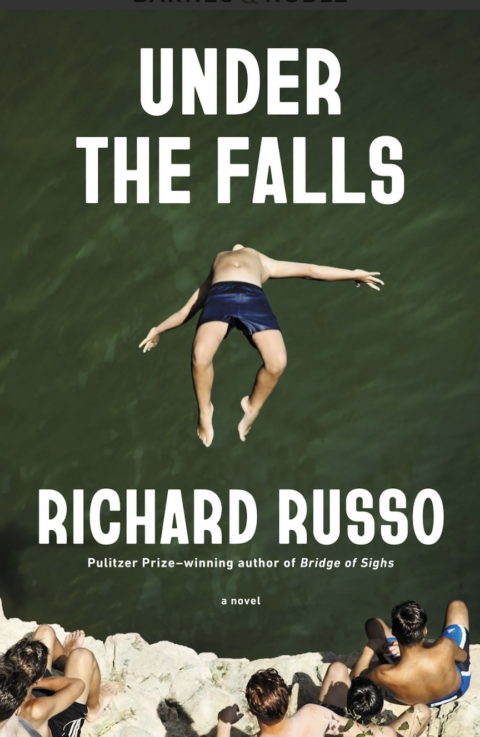 Richard Russo’s new novel, Under the Falls, is also a story about a musical comeback, and likewise it’s at its best when he leans into the complexity of the homecoming theme. Here the musician is Tyler Sinclair, a product — though perhaps refugee is the more appropriate term — from Stone Mountain, a down-at-its-heels upstate New York burg. He’s achieved success as a country-rock singer with his band, also called Stone Mountain. But as he returns there for a benefit for a childhood friend, Tyler’s band name and the childhood identity wrapped up in it both fit him uncomfortably.
There are overt reasons for that: Tyler is rich and famous, while Stone Mountain is poor and dopesick thanks to opioids. And there are less overt reasons: The friend Tyler is supporting, Tim Dockery (aka Doc), is paralyzed thanks to a teenage antic that Tyler had a hand in; one of his most famous songs, “The Long Fall,” is about that moment. As they conduct an interview together for a local TV session, Tyler feels his sense of self begin to slip. Doc’s on-air joshing seems to come with barbs of resentment attached. Russo writes: “It occurs to Tyler that the most effective way to respond might be for him to chuck his tried-and-true interview strategies and simply be himself … But is that person — the real Tyler Sinclair — someone he even has access to? Alone, writing a song, sure. But here? Now?”
The identity crisis only gets worse from there: during the benefit performance, the audience learns that Doc has died. The crowd turns on Tyler, as if he’d murdered Doc himself. As he prepares to play “The Long Fall,” bottles are flung, clocking the mayor on the head. The band makes its escape, but they’re tailgated on a winding road out of Stone Mountain, deliberately run off the road. Tyler’s manager is killed, and Tyler himself is badly injured, then kidnapped
Plotwise, the book is hokum. In the acknowledgements to the novel, Russo explains that Under the Falls originated as a TV pilot script, and it shows. The storyline is stuffed full of well-worn story arcs: dirty cops, drug-running, hostage-taking, who’s-the-real-father questions, secret sex, and so on. Russo, a Pulitzer winner with a deep arsenal of stories about busted homes and class anxiety, is eminently adaptable for the screen —t here are creditable film and TV versions of Nobody’s Fool, Empire Falls, and Straight Man. But Under the Falls is one of his weaker novels for being so designed around camera-friendly beats.
That’s unfortunate, because tucked within all its plotty noise is a host of fine observations about home and place. Most potently, Russo keeps returning to the question of how much of Tyler’s sense of self is inextricably tied to Stone Mountain. Some of that involves primal childhood-imprinting stuff — the incident at the falls, Tyler’s abusive father — but a lot of it involves status. When Doc tells Tyler that many locals feel his music exploited them, he fumes:
“It’s ridiculous, isn’t it? He isn’t stealing from these people. He’s helping them to be seen. If it were not for his songs, who outside of Stone Mountain would even be aware they existed?”
Hospitalized after the accident, though, his defensiveness sloughs off him:
“He remembers living, what that was like. In a nutshell, living is a life-long process of messing things up. You start when you’re young and you just keep at it, doing every damn thing wrong, making a complete hash of everything, until you no longer recognize yourself, or, worse, you know exactly who you are.”
 Russo is thinking a lot about the kind of subtle complexity in a song like “Stranger in My Own Home Town,” where the place you were raised in gave you the ability to escape it, yet your escape is only paid back in resentment. (To that end, Russo is likely thinking a lot about Richard Russo. In a 2010 interview, he was asked if he was anxious about exploiting the region where he grew up: “Yes,” he said. “Always. There is the possibility of disloyalty. I am haunted by the lives of loved ones that I have used — by my father and my grandparents. They have all turned up many times as characters I have elaborated and told lies about. Perhaps the strangest possibility is that you are haunting yourself.”)
Under the Falls is a thriller, but at its best it’s concerned about that matter of haunting — about whether the child can ever be reconciled with the adult, and who gets hurt along the way. If it helps for the plot to work in a nefarious J6er and some gunplay to get there, fine. (A more striking and persuasive treatment of this subject has recently been delivered by Ron Currie Jr. in a pair of novels about a hardscrabble Maine community, 2025’s The Savage, Noble Death of Babs Dionne and this year’s We Will See You Bleed. As it happens, Currie is also one of the authors Russo credits for assisting with Falls.) The surprising, enduring parts of Falls are its quieter reckonings with how and whether you can go home again.
Russo suggests that poor man’s success makes you Schrodinger’s human: your identity is about both old and new places and old and new money, forever, simultaneously and separately. Toward the novel’s end, when Tyler is asked what it’s like to have money (again: TV pilot script), Tyler gives an interesting answer: “It kind of feels like you’re on the clock. Like any day now somebody’s going to notice that there’s been a mistake, after which you’ll go back to being poor.” When you grow up in a place where the other shoe is always dropping, fear of imminent collapse is your richest inheritance.
(Published August 11, 2026, by Alfred A. Knopf; 256 pages, hardcover, $30.)