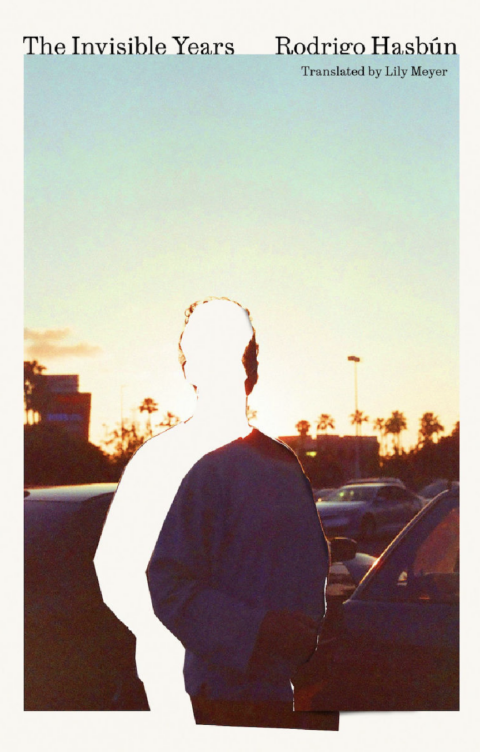
When is the present also the past? In Rodrigo Hasbún’s short novel The Invisible Years, readers are confronted with this question at the outset. The first section, “Back Then,” is narrated in the third person present tense and alternates between two parallel storylines: that of Ladislao, a teenage cinephile and aspiring filmmaker, who falls hard for his English teacher, Joan; and that of Andrea, a young woman who speaks while driving in circles, coming to terms with her need for an abortion.
It’s the 1990s. Ladislao and Andrea are high schoolers in Cochabamba, Bolivia. In Ladislao’s chapters, the present tense narration is marked by Hasbún’s short sentences and terse dialogue to create an effect of immediacy and intimacy, as if the reader is the invisible observer in the film of their lives. Joan and Ladislao meet socially for the first time in a video store. He rents the Wong Kar-Wai film Happy Together, and she invites him to her place to watch it and smoke pot:
“Joan offers him the joint.
He has no idea what to do with it.
He pinches it between his thumb and forefinger and takes a shallow inhale.
She says, ‘You’re not going to feel anything like that, Ladislao.’
He drags harder the second time and coughs, before trying a third.
‘You weren’t here,’ he hears her say.
‘No.”None of this happened.’
‘Don’t worry. I don’t even know where you live.’”
 Both of them shrug off this exchange as if it were a joke, a bit of pot-fueled flirtation at the end of Ladislao’s adolescence. But there is an undercurrent of tension in the dialogue, an admission that what’s happening is inappropriate. For all the grace and tenderness with which Ladislao’s sections unfold, there is no forgetting that Joan is his teacher, a figure of authority, wielding her power — however alluringly — to abuse him (and, as the reader learns later, several other teen boys in his class as well). It’s heartbreaking to watch him fall for her, knowing the harm such sexual abuses can cause. On each page, I felt a sense of anticipatory grief over what’s to come.
Where Ladislao’s chapters appear suffused with nostalgia and deceptive in their longing, Andrea’s are taut with anxiety. When we first meet her, she has only just received the results of her pregnancy test:
“Andrea wants somebody to hug her hard, to squeeze her until every bone in her skeleton cracks. She slides the letterhead back into the envelope and smiles at the nurse, as if the tests were just for her cholesterol… she’s got something inside her, though it’s still too small to feel. Her blood says it’s there. The lab says her blood says.”
The only person she tells about the pregnancy is Dr. Angulo, the family physician, who agrees to provide the abortion. It’s a simple procedure, and she is able to recuperate at home without much pain. But terminating the pregnancy doesn’t solve Andrea’s problems. Her boyfriend Humbertito can sense something is up and calls her constantly, insinuating himself in her life even after she pulls back and attempts to set boundaries. Without going into all the details, Hasbún hints at the moments that led to this situation: the days when Humbertito wheedles Andrea into unprotected sex; the private pressures that made his coming over to her house a given; all the little ways that Humbertito and society at large convince people that these pressures, these attempts to control, are an acceptable form of love.
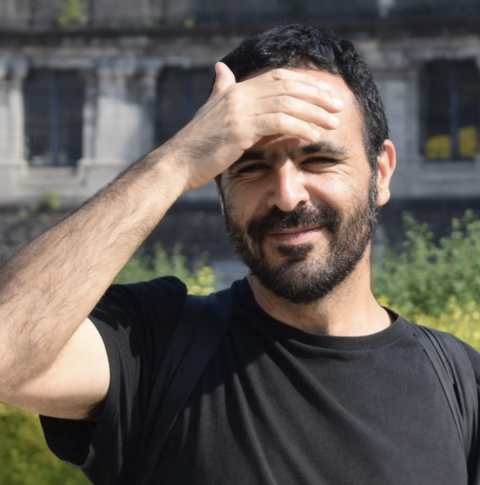
When the novel jumps into the future in the second section, readers can sense that there’s something the characters aren’t talking about — some violent, life-altering events they can’t speak of, at least not directly. The narrative swirls around the unsaid, generating an aura of dread. Twenty-one years have passed, it is now the mid 2010s, and the first-person narrator, silent until this moment, is living in Houston, where he is a writer working on a novel about the woman he calls Andrea and the boy he calls Ladislao. Readers may pause here to consider the metafictional nature of these choices — Hasbún currently lives in Houston and was born in Cochabamba. But ultimately the question “Is the narrator Hasbún and did these events really happen to him or his friends?” is less interesting than the question “What motivates the narrator to revive the past?”
 As I read The Invisible Years, I felt haunted by someone’s ghosts, who were also, at the same time, real characters living in present tense on the page. The woman who the narrator calls Andrea comes to see him in Houston, in this present moment that is also the future and the past, and they talk about the novel, the pieces of it he has shared with her. She likes it. Parts of it, anyway. She doesn’t think he’s captured her character. She’s different now — harder, meaner, the traumatic events of the climax having broken up her family, burned down their house, and sent them scattering across the globe. She has kept up with childhood friends much better than the narrator has, and she’s quick to tell him how they turned out, especially where that doesn’t align with his portrayals. She tells him: “It’s impossible to get a single answer from the past. It’s not a key to anything. It’s just a place we go to trick ourselves.”
Perhaps, in the end, that is the answer to my question. The narrator can’t elude the past. He chooses to write not to make sense of it, since this would be an endeavor he is ill-equipped to handle. If Hasbún believed it were possible for his character to make sense of these tragic events, he would not have employed this metafictional narrative about writing the novel, but would instead have allowed the past to be the past and let Andrea’s and Ladislao’s stories stand on their own, without a future or a present to complicate their conclusion. Hindsight here has about as many virtues as it has vices, and chief among the latter is self-deception. The narrator recounts this disquieting story not because he can sum it up neatly but because, in putting it down on paper, he’s creating a version he can live with. I can’t fault him, and that may be the point — Hasbún wants us to confront a situation that offers no epiphany or closure, but rather the qualities of limitation.
The Invisible Years is a poignant novel with a graceful translation by Lily Meyer, who manages the shifts in tone and syntax between time periods with ease. This novel is a worthy follow-up to Affections (Los afectos, published in Spanish in 2015, then translated into ten languages) and reminds us why Hasbún was named one of Granta’s best Spanish-language writers under 35-years old when his first novel was published.
[Published by Deep Vellum on February 24, 2026, 250 pages, $25.95 hardcover]