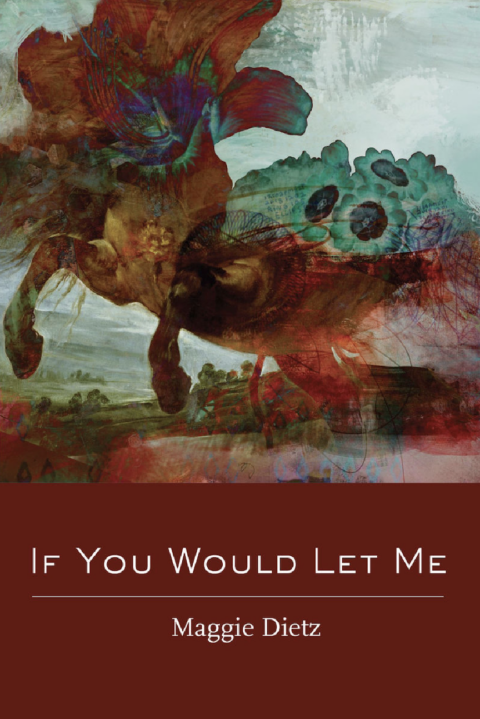
A parent is idealized as the ultimate protector and nurturer, providing safe haven in an enduring and all-encompassing love. In Maggie Dietz’s If You Would Let Me, this idea is visited in poems like “Infancy” but coupled with hard retrospective wisdom: “In a gas of heady love and hormones / I swore I’d keep you safe forever // and we believed me, fools / That that place made us.” The power of If You Would Let Me lies in Dietz’s the retelling of a myth that reaches back to the Homeric Hymns and Ovid’s Metamorphoses: a recounting of Demeter and Persephone — parent and child withstanding disconnection, danger, and surviving unspeakable pain.
We know the story of Persephone. Abducted by Hades and forced into the Underworld, she ate the pomegranate seeds that meant she would have to spend six months each year as queen of the Underworld and in the remaining six return to her mother above. In this retelling, Demeter’s perspective and experience provide the frame to show the depths and limitations of a mother’s love.
 When, whatever the reason, the relationship goes dark or cold and forces intervene that cause a rift neither could have expected, mothers are presumably tasked with holding familial divisions quietly, estrangements hidden — this is exactly what the goddess Demeter did not do as she stormed the Earth in search of her daughter when her world changed. Instead, she railed against the world. Dietz takes hold of this Demeter and gives her a voice. Demeter rages: “It was for love I burned the goddamned world”; and is complicit: “I did what any brokedown woman would and drove / You to a place called Pierced Utopia at / The Saugus mall where a human with a spangled face / Plunged a needle through your perfect nose”; she also openly mourns: “I let you I gave you I held / You I made you but I couldn’t / Save you I couldn’t save you.”
In this book, the mother’s sustaining power is her presence, her continued partnership even if only as silent witness to a perilous adolescence. The conditional “if” (of “If You Would Let Me”) contains a relentless hope that her love might at some point engender stability. This fervent wish pulses through the title poem which sets the book in motion: “If you would let me hold you I could breathe // Away your brinks, lay cushions underneath/Your cliffs. I’d let no shiv of light be taken / From your arctic eyes, you’d see. How much you need!”
The beauty of Dietz’s verse is how she intuitively leans into form, but more than that — it’s all she has absorbed into her sound and sense, making her use of poetry’s parameters seem effortless, and allowing centuries of tradition to shimmer delicately in the shadows of her freest verse. (This is emphasized in the “Instead of epigraphs” section that follows the poems in the back of the book, where there is a catalog of voices that co-inspire these poems, from the Homeric Hymns to William Cowper, to Emily Dickinson and Marianne Moore — everyone who has added to, joined in with, Dietz’s sensibility.) The poems incorporate the preciseness of early poetry whether she weathers the constraints of their forms or not. She gains power from repetitions and through a focus on fleeting minutiae that resonate like depth charges: “no shiv of light” from “your arctic eyes.” The rocking motion created by the enjambment (forced by the form) heightens both the revelations of each line and stanza and the emotional turmoil of both the speaker and the “you.”
In poems like “Don’t Go,” there are lines so clean and self-contained they create stand-alone passages, emphasized by the internal logics of rhythms and wonder: “Why must my grief / Be the gate // You leave through, frozen / Ajar on its ancient hinges?”
Demeter, goddess of the harvest, abandons her duties in her search for her daughter (thus explaining our seasons); doing so, she makes the world cold and barren. Dietz turns this idea on its head in one of the many “Metamorphosis” poems scattered throughout the book, in which a moment between mother and child results in the conversion of a much-loved novelty that once held dreams and hope into a malignant item used to wound. There is rupture, and acceptance of rupture, but while equilibrium is ultimately restored, there’s the gap of no repair:
Because I liked to bring the outside in
I had on my desk a painted bowl with
Three stones in it like eggs in a nest.
I liked to brood over them, to thumb
Their surfaces and think.
They were so gentle, a kind of pure
Potential. One afternoon
I cropped up monstrous, ghost
Of all you couldn’t control.
Looking for anything to lob, you lifted
The largest as I stood across the room.
Later I iced my collarbone and restored
The barren stones to the world.
The poem is exceptional in its simple and razor-sharp images and music: its ability to evoke a mother bird, a nest, and the promise of her eggs — their radiant possibility, and their value to the speaker. It is also impressive for what it doesn’t say, and how its white space acts as a redaction that smothers much of the memory recounted but also focuses the word “potential.” Mid-way through the poem, “potential” frontloads its line with dreams for the future. The poem then tips into harsh reality and the implied grief of acceptance as it resolves.
Another “Metamorphosis” is also about a violent rupture and its effects, while also capturing (as only a mother might see) the brilliant force that permeates:
Sometimes you seemed to want to make
Something dazzling from your rage.
You knew I liked it: the antique mirror
I’d bought at a dusty storefront run by sisters.
You grunted when you swung it from
The wall and flung it to the floor.
For an instant bits of slivered
Glass fell up like inverted rain.
Sure enough, it cut me.
And it took years to pull
The crumbs of glass out of the wool.
The poem evokes a beautiful intimacy in its desperation. The single line stanza “Sure enough, it cut me,” quietly captures the sharp sacrifices and wounds of parenthood, while everything ultimately settles into the subduing rhymes of “pull” and “wool.”
Dietz’s embodiment of Demeter’s desolation rings through “Glacial” in a reflection of solidarity during Persephone’s stay in the Underworld:
For weeks the kettle steamed
Its aching siren, singing deep
Into this house of ice.
Now even the lamp of my longing
Is spent, a jumble of
Moths in the globe.
Nothing outside survives, but
Errant spores have breathed black
Peonies onto the shattered plaster.
From the empty bed
Upstairs the springs uncoil
A warped refrain: You made
This cold, now live in it.
Am I even awake?
Are those embers or icicles
Cracking in the grate?
 Here the musicality from title to last word, with internal rhymes setting their rafters in the three short lines of each stanza; the lovely pun on “spring” followed by a humorous self-incrimination; and the bewildered exhaustion of “Am I even awake? / Are those embers or icicles / Cracking in the grate?” which brings to mind Keats’s “Do I wake or sleep?” but here is less a “drowsy numbness” than an emotional hypothermia.
The book is more than this deep dive into the complexity of a mother-adolescent relationship patterned on a timeless Greek myth — with poems of ancestry, generations of women within a family, the innocence of childhood. But at the heart, it is about what the bonds between parent and child are made of, offering a story not just about separation but violent renting and grief. It culminates in a reprieve of sorts for both the speaker and reader (“Cusp”):
Yesterday I woke to find the branches
Tipped with green and purple flames
Earlier each day now the window frames
The dawn. I see your face in every square
Of the calendar the sun pins to the floor.
I’m baking bread with flour from last year’s wheat.
I washed your favorite sheets and filled
Your room with hothouse tulips.
In “Cusp,” Dietz reminds us of what is, and what is not, in one’s control. It catalogs Demeter’s ultimate superpower, in those days of waiting and hope, impatience and setback, like the cycles of nature itself.
[Published by Four Way Books on March 15, 2026, 78 pages, $17.95 paperback]