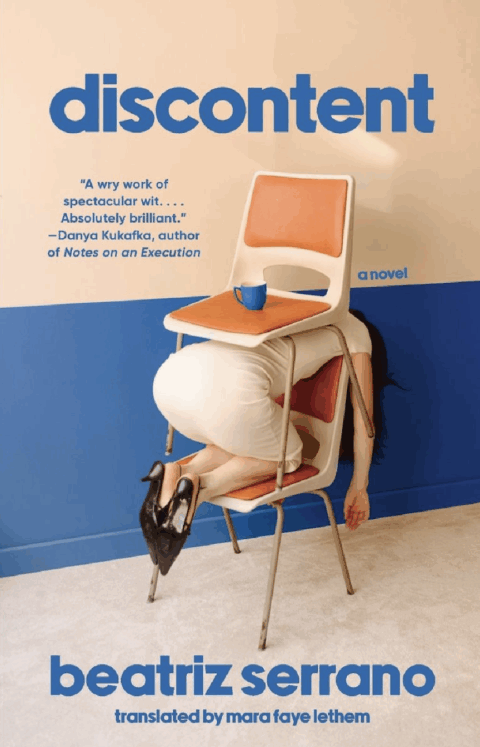
The English translation of Madrid-based journalist Beatriz Serrano’s 2024 debut novel, El descontento, secured a six-figure deal with Vintage, and little wonder. The translator, Maya Faye Lethem, has accumulated many awards for her translations from Spanish and Catalan, and is a novelist in her own right. And the pitch is appealingly simple: a woman who hates her “good” (well-paying, relatively prestigious) job does as little work as possible, self-medicating with YouTube and Ativan to get through the day. In a time of widespread job dissatisfaction and burnout, this novel is bound to resonate. Marisa, our protagonist, wakes up crying every morning when her alarm goes off, deeply anxious about work. Her job responsibilities are, in themselves, not particularly hard; she is able to outsource most of them (to her assistant as well as to a bunch of Marketing MA students she somehow ended up teaching) and is well-practiced at postponing her deliverables.
 She has some outlets for relief from the corporate slog, like her wildly attractive downstairs neighbor, who is both her best friend and her sexual partner; her visits to the Prado to take in Hieronymus Bosch’s The Garden of Earthly Delights; and her luxury grocery shopping outings to Carrefour. And of course, there are the infinite consolations of the above-mentioned YouTube and seemingly endless supply of tranquilizers.
Even so, indefinitely faking it is not going to work for Marisa.
As the novel progresses through the final few weeks of summer, she increasingly loses track of her tasks. She especially struggles as a company retreat approaches for which she will lead a creativity workshop. Her boss wants the workshop to build appreciation among other departments for the soft skills required to do the hard work of persuading people to buy luxury perfumes, lipsticks, and eyelash curlers – or, in Marisa’s words, to “be nice and sell snake oil.” An unhinged weekend ensues, with an appropriately dramatic ending, which I will not spoil here.
While the novel is marketed as corporate satire for those who want more out of life than their soul-sucking jobs, we are locked into a first-person, present-tense perspective that features the type of angsty, self-involved narrator I’ve come to expect more from YA than from this type of middlebrow fiction: “I’ve been doing the same thing for eight years, and I know it doesn’t help anyone. I know the world would be a better place if jobs like mine didn’t exist.” Marisa is arrogant about her own competence and judges everyone else, even as she spirals beyond what she is able to control. She often thinks things to herself like, “the world is filled with repulsive ass-kissers,” and very few of her encounters with other people have the power to puncture such beliefs.
But while she disdains almost everyone around her, the confessional tone of the narration suggests a sympathetic listener on the other end who will accept her as she is. She tells the reader how she hoards little plastic water cups in her office until she can bag them and take them out to the dumpster at night herself, “to make sure no one thinks I hate dolphins.” It’s unclear whether she intends the listener to find this endearing or repulsive, but I suspect she’s going for the former. The desperation of the narrator puts Marisa in a complex relationship with the reader, somewhere between hero and anti-hero.
Thus, as she spews cynicism and struggles to maintain her polished, competent exterior, Marisa isn’t allowed a simple moral high ground. The novel has all of the trappings of a frothy, easy read, but as Serrano gradually excavates Marisa’s views about the world and herself, they are revealed as a jumbled mess of ideas so contradictory that they often lead to self-destructive behaviors (which notably include repeated fantasies of being hit by a bus on the way to work).
 The novel is especially good on these extreme forms of dissonance that Marisa lives with, either because of her miserable job and resulting anxiety, or because she feels she can use her job as an excuse for what she sees as her own bad behavior. Marisa especially clings to the idea, or at least to the appearance, of being a good feminist: “Over the course of my life, I’ve read Simone de Beauvoir, Betty Fridan, Virginia Woolf, Kate Millett, Silvia Federici, Angela Davis, Judith Butler, Virginie Despentes.” But she still shaves her legs – a dissonance she recognizes – and treats her young, female assistant, Natalia, with cruelty – a dissonance she doesn’t. In fact, Marisa survives her job by cannibalizing the work of others. She resents most of the people she knows for being willing corporate peons and has no qualms about manipulating them or plagiarizing their work. She is, of course, deeply insecure and vacillates between deep self-satisfaction with how she manages to con everyone into paying her to pretend to work and loathing people who are happier than she is.
Marisa recalls for me the unnamed first-person narrator of Zadie Smith’s Swing Time, a similarly unlikeable and boring character (by design, I think!). The characters don’t fully engage my sympathy for similar reasons. In Swing Time, the narrator is difficult to connect with because of how intensely she inhabits the shadows of larger, more interesting figures: the mother-turned-politician, the Madonna-like popstar for whom she is a personal assistant. Marisa has no individuals who loom so large for her: it’s the job, or maybe something as amorphous as Late Capitalism, that structures her life so completely that she’s unable to hold any space for meaningful personal expression beyond her YouTube habit (which is, I will admit, impressively wide-ranging).
There were times when the novel’s repetitive descriptions of excruciating corporate boredom and of the minutiae of random YouTube videos dulled the otherwise sharp edge of the satire. And that is perhaps the point: Marisa’s attempts to cope with a horrible job will always wear thin — it’s an impossible task. Nevertheless, the prose sometimes struck me as clumsy, as when the narrator reminds readers of something she had just mentioned the paragraph before. As a reader, I found it a little off-putting to be told (rather than shown) again and again how Marisa is slacking off and losing her control. Then again, a narrator as controlling as Marisa maybe feels a need to tell us how aware she is of her own situation, even when it’s a disaster.
Discontent explores the limits of duplicity, and whether, and at what point, a person inevitably becomes the thing they perform. “I wonder if faking,” Marisa asks, “could end in real feeling.” While this novel has its funny moments, Serrano unsettlingly questions whether her characters – and perhaps any of us – can ever fully keep corporate playacting from becoming our truest lifestyles.
[Published by Vintage on September 2, 2025, 192 pages, $17.00 paperback]